

How to Find the Absolute Cheapest Flights for International Travel: A 2026 Pro Guide

How to Find the Absolute Cheapest Flights for International Travel: A 2026 Pro Guide
The dream of exploring ancient ruins in Rome, bustling markets in Marrakech, or serene beaches in Thailand often feels just out of reach, tethered to the daunting price of an international flight. For many, the airfare is the single biggest expense that can make or break a trip. But what if finding the cheapest flights for international travel wasn't about luck, but about strategy? What if you could consistently pay a fraction of what the person sitting next to you on the plane paid? The truth is, you can. Finding the absolute cheapest flights is a skill, a methodical process of combining the right tools, timing, and tactics. It's about understanding the complex dance of airline pricing and knowing exactly when and where to step in.
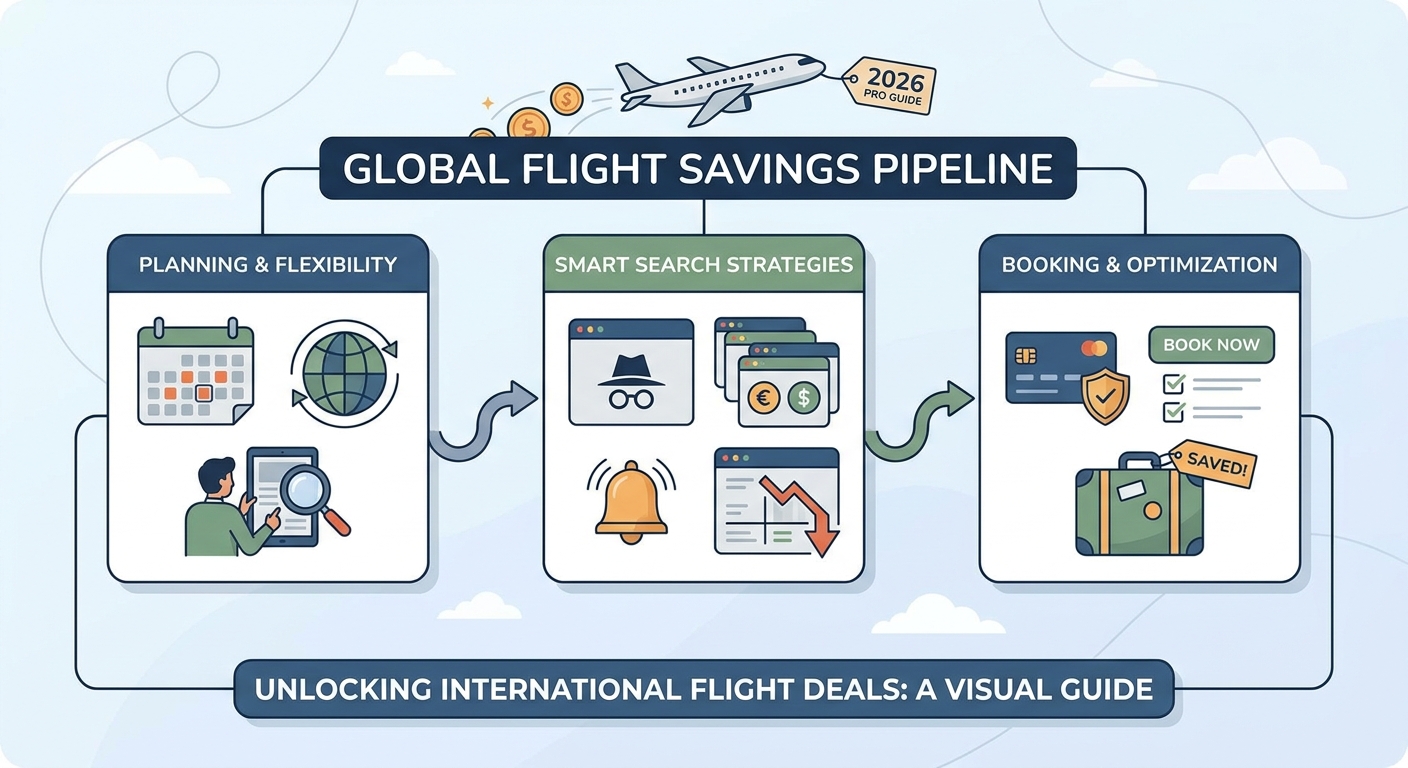
This is not another list of generic tips like "clear your cookies" (a largely debunked myth). This is a comprehensive, depth-driven playbook designed to arm you with the knowledge professional travelers and deal hunters use every day. We will move beyond the basics and dive deep into the core pillars of flight booking mastery. You will learn not just what to do, but why it works, empowering you to adapt these strategies to any trip you can imagine.
From mastering the art of flexibility and leveraging powerful search engines to uncovering secret "error fares" and using advanced tools like VPNs, this guide will walk you through every step. We'll explore the best times to book, the pros and cons of budget airlines, the game-changing power of points and miles, and the subtle logic behind one-way versus round-trip tickets. Prepare to transform the way you think about booking travel. The world is waiting, and it's far more affordable than you think.
When is the Absolute Best Time to Book International Flights?
The best time to book international flights is typically 2-8 months in advance, with the sweet spot often falling around 4-6 months out for the best balance of price and availability. Avoid booking too early (over 10 months) when prices are high and not yet competitive, and too late (within 6 weeks) when last-minute premiums surge.
Understanding the "when" of booking is about navigating two key timelines: the booking window and the travel season. The booking window refers to how far in advance you purchase your ticket. Airlines use sophisticated algorithms that adjust prices based on demand. When flights are first released (usually 11-12 months out), they are often priced high for business travelers and those who must book early. As the departure date nears, prices fluctuate. The 4-6 month window is often ideal because airlines have a good sense of initial demand and begin competing more aggressively for leisure travelers. Booking within the last month is almost always a costly mistake for international travel, as airlines capitalize on last-minute, less price-sensitive customers.
The second, and equally important, factor is the travel season. Every destination has a high season (peak), low season (off-peak), and shoulder season (the months in between). Flying during the low season will almost always yield the cheapest fares. For example, flying to Europe in February is drastically cheaper than in July. The shoulder seasons - like April-May or September-October for Europe - offer a fantastic compromise with good weather, fewer crowds, and significantly lower airfare than the peak summer months. Being aware of your destination's seasonality is paramount.
Real-World Example: Imagine you want to fly from Chicago to Tokyo. Peak season is during the cherry blossoms (late March-April) and summer holidays (June-August). Booking a flight for July six months in advance (in January) might cost you $1500. However, if you shift your travel dates to the shoulder season, say mid-October, and book it in May (five months out), you could easily find the same route for $900. The low season, like late January, could see fares drop even further to $700. This simple shift in travel dates, combined with optimal booking time, saves you over 50%.
Actionable Insight: Don't just focus on how far in advance you book; focus on when you plan to travel. Use Google Flights' price graph or calendar view to visually identify the cheapest months to fly to your desired destination. Set alerts for your route well in advance, and be prepared to book when the price drops into that 4-6 month sweet spot for your chosen travel season.

Which Search Engines and Tools Uncover the Lowest Fares?
The best tools for uncovering the lowest fares are flight aggregators like Google Flights, Skyscanner, and Momondo, each offering unique features for flexible searching. These platforms pull data from hundreds of airlines and online travel agencies (OTAs) simultaneously, giving you a comprehensive view of the market without having to check each site individually.
Relying on a single airline's website is one of the biggest mistakes a budget traveler can make. You need a powerful search engine that acts as your mission control. Google Flights is arguably the most powerful and fastest tool for most travelers. Its standout features are the 'Explore' map, which lets you see prices to dozens of cities from your home airport for a given time frame (e.g., "a one-week trip in October"), and its incredibly intuitive calendar and price graph views that instantly show you the cheapest days to fly. It's best for research and identifying the ideal dates and routes.
Skyscanner and Momondo are also essential tools in your arsenal. Their key advantage is that they often include more budget airlines and smaller OTAs that Google Flights might miss. Skyscanner's "Everywhere" search is a fantastic feature for inspiration if you have flexible dates and just want to find the cheapest possible international destination. Momondo often excels at finding unique flight combinations, sometimes routing you through different airlines to create a cheaper itinerary, known as a "hacker fare". It's always wise to cross-check prices across at least two of these aggregators before booking.
Below is a quick comparison of the top contenders:
| Tool | Best For | Key Feature | Limitation |
|---|---|---|---|
| Google Flights | Speed and flexible date research | Explore Map & Price Graph | Doesn't always show the smallest OTAs |
| Skyscanner | Broad search including budget carriers | 'Search Everywhere' function | Can sometimes show outdated prices that update upon clicking |
| Momondo | Finding unique airline combinations | Price forecasts and hacker fares | Interface can be slightly slower than Google Flights |
| ITA Matrix | Advanced, highly specific searches | Powerful filtering and routing codes | Not for beginners; you cannot book directly on the site |
For advanced users, the ITA Matrix (the software that powers Google Flights) offers unparalleled control. It allows you to specify complex routing, force connections in certain cities, and use advanced codes to build the exact itinerary you want. You can't book on it, but you can take the detailed flight information it provides and replicate it on an airline's site or through an OTA.
Actionable Insight: Start your search broadly on Google Flights to identify the cheapest dates and potential destinations. Once you have a specific route and dates, run the same search on Skyscanner and Momondo to ensure no cheaper options are being missed on smaller booking sites. Never book the first fare you see; a simple cross-check can save you a surprising amount of money.

How Can Flexibility with Dates and Destinations Save You Hundreds?
Flexibility is the single most powerful tool for finding the cheapest flights for international travel. By being open to adjusting your travel dates by even a few days, or choosing a nearby alternative airport or destination, you can unlock savings of 50% or more. This is because airline prices are based entirely on demand, which fluctuates dramatically day by day.
Think of airline pricing like a stock market for seats. Flying on a Friday or Sunday is almost always more expensive because that's when most people with traditional work schedules want to travel. Flying on a Tuesday, Wednesday, or Saturday is often significantly cheaper. If you're rigid about flying out on a specific Friday evening and returning on a specific Sunday, you are competing with the highest demand and will pay a premium. Simply shifting your departure to a Thursday and returning on a Monday could slash the price. The same logic applies to seasons, as discussed earlier. Being flexible enough to travel in the shoulder season instead of peak season is a guaranteed money-saver.
Destination flexibility is another level of savings. Perhaps your heart is set on Paris, but flights are $1200. What if flights to Amsterdam are only $600 for the same dates? A short, inexpensive train ride could get you to Paris while saving you $600 on the transatlantic leg of your journey. Using tools like Google Flights' Explore map or Skyscanner's "Everywhere" search is perfect for this. You input your home airport and desired travel month, and the map populates with prices all over the world. This can introduce you to amazing destinations you hadn't considered that are a fraction of the price to fly to.
Real-World Example: Let's say a group of friends in New York wants a one-week European vacation in May. Their initial search is for NYC to Rome, Friday to Sunday, and the cheapest fare is $1150. By being flexible, they discover a few things. First, by shifting the trip to Tuesday-to-Tuesday, the NYC-Rome fare drops to $900. Next, they use the Explore map and see that flights from NYC to Dublin on the same dates are only $550. From Dublin, a separate round-trip ticket on a budget airline to Rome is only $80. Their new total cost is $630 ($550 + $80), a savings of $520 per person compared to their original rigid plan. They get to spend a day exploring Dublin as a bonus.
Actionable Insight: Approach your trip planning with a question: "Where can I go for a great price during this time frame?" instead of "How much does it cost to go to this specific place on these specific dates?" Always use the calendar or price graph views on flight search engines to see a full month's worth of fares at a glance. Check prices for at least 2-3 alternate airports near both your origin and destination.

What Are Airline Error Fares and How Do You Find Them?
Airline error fares, also known as mistake fares, are deeply discounted flight tickets sold for a fraction of their intended price due to human or technical glitches. These can occur from currency conversion errors, omitted fuel surcharges, or simple data entry mistakes. Finding and booking them requires speed and using specialized deal-finding services, as they are often corrected within hours.
Error fares are the holy grail of cheap flights, but they are unpredictable and rare. The savings can be staggering - think round-trip, business-class flights to Asia for $600, or economy flights to Europe for $200. The key is understanding that these aren't sales; they are genuine mistakes. An airline might accidentally list a $1500 fare as $150, for example. When these go live, a small window of opportunity opens for savvy travelers to book before the airline discovers and fixes the error. You cannot search for these on Google Flights; you need to be alerted to them.
The best way to catch these is by subscribing to specialized airfare deal websites and newsletters. Services like Scott's Cheap Flights (now Going), Secret Flying, and The Flight Deal have teams and algorithms constantly scanning for these pricing anomalies. When they find one, they immediately send an alert to their members via email or app notification. To capitalize on these, you must be ready to act fast. Have your passport information and payment details ready, as the best deals can disappear in minutes.
A Crucial Rule for Error Fares: After you book an error fare, wait. Do not make any non-refundable travel plans like booking hotels or tours for at least one to two weeks. While most jurisdictions require airlines to honor the purchased ticket, there are instances where they may cancel the ticket and issue a refund. Wait until you receive a confirmed e-ticket number and the booking is stable before committing to other expenses. Also, never call the airline to ask about the fare. This will only flag the error and cause it to be corrected faster, ruining the deal for everyone.
Real-World Example: A deal alert goes out: "ERROR FARE: Los Angeles (LAX) to Barcelona (BCN) for $250 round-trip on a major airline." Normally, this route costs over $1000. A traveler sees the alert immediately, clicks the link, finds dates that work for them a few months in the future, and books directly with the airline within 10 minutes. Two hours later, the fare is corrected back to its normal price. The traveler waits two weeks, sees the charge is final and their e-ticket is confirmed, and then proceeds to book their accommodation in Barcelona, having saved over $750 on their flight.
Actionable Insight: Sign up for the free versions of several airfare deal newsletters like Going or Secret Flying. Create a specific email filter to ensure these alerts go directly to your primary inbox so you see them immediately. Even if you don't have a trip planned, seeing the types of deals that are possible will train you to recognize a truly incredible price when it appears for a destination on your bucket list.

Can Using a VPN Actually Help You Find Cheaper Flights?
Yes, using a Virtual Private Network (VPN) can sometimes help you find cheaper flights by making it appear as though you are shopping from a different country. Airlines and booking sites can display different prices for the same flight based on your location (point of sale) and the local currency. By using a VPN to change your virtual location, you can access these potentially lower prices.
This strategy works because of complex airline pricing structures that take local economies and competition into account. A flight ticket is often priced lower when purchased in a country with a lower average income or a more competitive airline market. For example, a ticket for a flight from New York to Bogota might be priced higher on the U.S. version of an airline's website than it is on the Colombian version of the same site, when priced in Colombian Pesos. A VPN allows you to connect to a server in Colombia, access the Colombian site, and see that lower local price.
The process is straightforward. First, search for your desired flight in a private browser window to establish a baseline price. Then, close the window, turn on your VPN, and select a server in a different country. Popular choices include the destination country, the airline's home country, or a country with a lower cost of living. Clear your browser's cookies and cache, then open a new private window and perform the exact same search. You may need to use the airline's country-specific website (e.g., airline.com.co instead of airline.com). Compare the new price, making sure to account for currency conversion rates, to your baseline price.
Important Considerations: This technique doesn't work every time, and the savings can vary. It tends to be most effective on international carriers rather than U.S.-based ones and for routes originating or terminating in the country you are VPN-ing into. Additionally, ensure you use a credit card that doesn't charge foreign transaction fees, as you will likely be paying in a different currency. Some booking sites may also require a local billing address, which can be a hurdle, though booking directly with the airline is often more lenient.
Real-World Example: A traveler in the UK is booking a multi-city trip within Southeast Asia on AirAsia, a Malaysian airline. A flight from Bangkok, Thailand to Kuala Lumpur, Malaysia is showing as £50 on the UK site. The traveler activates their VPN, connects to a server in Malaysia, and navigates to the Malaysian AirAsia website. The exact same flight is now priced at 180 Malaysian Ringgit. After converting the currency, this comes out to approximately £30. By booking through the Malaysian point of sale, they save 40% on the flight.
Actionable Insight: Get a reputable VPN service. When you've found an international flight you want to book, dedicate 15-20 minutes to price-checking it through VPN servers in at least three different locations: your destination country, the airline's home country, and a major nearby country. The potential savings can be well worth the small amount of extra effort.
Are Budget Airlines a Smart Choice for International Travel?
Budget airlines can be an incredibly smart choice for finding the cheapest flights for international travel, provided you understand their business model and pack accordingly. These no-frills carriers offer significantly lower base fares by unbundling services, meaning you pay extra for everything from checked bags and seat selection to meals and drinks. For the savvy, light-packing traveler, this can result in massive savings.
The fundamental difference between a budget (or low-cost) carrier and a full-service carrier is the pricing philosophy. A legacy airline like Delta or British Airways sells you a comprehensive package: your ticket includes a checked bag (often on international routes), seat selection, meals, drinks, and in-flight entertainment. A budget airline like Norse Atlantic, PLAY, or Spirit sells you one thing: a seat. Everything else is an add-on. This a la carte model allows them to advertise incredibly low headline fares that are very attractive.
The key to making budget airlines work for you is to beat them at their own game. First, pack light. The single biggest extra cost is checked luggage, which can sometimes cost more than the flight itself. If you can travel with only a carry-on that fits their (often stricter) size and weight limits, you've already won half the battle. Second, be self-sufficient. Bring your own water bottle (fill it up after security), pack your own snacks or meal, and download entertainment to your tablet or phone beforehand. Third, be flexible with airports. Budget airlines often fly into smaller, secondary airports that are further from the city center to save on landing fees. Factor in the extra cost and time for ground transportation to your destination.
However, it's crucial to do the math. Before booking that tempting $300 flight to Europe, go through the booking process and add the cost of a carry-on bag, a checked bag (if needed), and a seat selection. Compare that final price to the fare on a full-service carrier. Sometimes, once you've added the necessary extras, the legacy airline is only slightly more expensive and offers a much more comfortable experience with more generous luggage allowances and better customer service if things go wrong.
Real-World Example: A traveler sees a $400 round-trip flight from New York to Berlin on a budget airline. A competing flight on a legacy carrier is $650. The budget airline charges $70 each way for a checked bag ($140 total) and $40 each way for a carry-on bag ($80 total). The traveler needs to check one bag. Their new total on the budget airline is $540 ($400 + $140). In this case, the savings of $110 might be worth it. However, if they also needed a carry-on, the total would be $620, making the full-service airline's $650 fare, which includes bags, meals, and better service, a much more compelling option for just $30 more.
Actionable Insight: Always compare the final, all-in price, not just the base fare. Use budget airlines strategically, especially for shorter intra-continental flights (e.g., within Europe or Asia) where you can easily travel with just a backpack for a few days. For long-haul international flights, carefully weigh the discomfort and costs against the savings.
How Do Credit Card Points and Airline Miles Fit into the Cheap Flight Equation?
Credit card points and airline miles are a cornerstone of finding the cheapest flights for international travel. By strategically earning points on everyday spending through travel rewards credit cards and then redeeming them for flights, you can drastically reduce your out-of-pocket costs. This practice, often called "travel hacking," transforms your regular expenses into future travel.
The system works through two primary types of points: transferable points and co-branded airline miles. Transferable points, from programs like Chase Ultimate Rewards, American Express Membership Rewards, or Capital One Miles, are the most valuable and flexible. You earn these points on a bank's credit card and can then transfer them to a wide variety of airline and hotel partners. This flexibility allows you to shop around for the best redemption value. For example, if you need a flight to Japan, you can compare the cost in miles on All Nippon Airways (ANA), United, and Air Canada and transfer your points to whichever program offers the best deal.
Co-branded airline cards, like a Delta SkyMiles American Express or a United Explorer Card, earn miles directly with that specific airline. These are less flexible but can offer valuable perks like free checked bags, priority boarding, and better award availability on that carrier. The most powerful strategy often involves having a mix of both types of cards. The quickest way to accumulate a large balance of points is by earning the sign-up bonus on a new credit card, which can often be enough for a round-trip international flight after meeting a minimum spending requirement.
It's important to understand that the value of a point is not fixed. Redeeming 60,000 points for a $1200 international flight gives you a value of 2 cents per point, which is an excellent redemption. Redeeming those same 60,000 points for a $600 flight yields only 1 cent per point, which is a poor value. Always calculate the value you are getting before you book an award ticket. Sometimes, when cash fares are very low, it's better to pay cash and save your points for a more valuable redemption later.
Real-World Example: A traveler signs up for a Chase Sapphire Preferred credit card and earns the 60,000-point sign-up bonus. They want to fly from the U.S. to Spain. They find a cash fare for $1000. They then check award availability through one of Chase's transfer partners, Iberia. They find an off-peak award ticket for only 34,000 Avios (Iberia's miles) and $120 in taxes and fees. They transfer 34,000 Chase points to their Iberia account and book the flight. Instead of paying $1000, their out-of-pocket cost is just the $120 in taxes, effectively saving them $880.
Actionable Insight: If you are financially responsible and pay your credit card bills in full each month, make a travel rewards credit card your primary spending card. Focus on earning a valuable sign-up bonus first. When it comes time to book, always compare the cash price of a flight to the cost in points to ensure you are getting a good value for your redemption. This strategy requires planning but offers the most substantial savings possible.
Is Booking One-Way or Round-Trip Tickets Cheaper for International Journeys?
For international journeys, booking a round-trip ticket is almost always cheaper than booking two separate one-way tickets on the same airline. Legacy carriers heavily discount round-trip fares (also called "return fares") as they want to secure your entire journey. However, a savvy strategy involves mixing and matching one-way tickets on different airlines, which can sometimes result in a lower total price.
The pricing disparity stems from the traditional airline model. Full-service international carriers build their pricing structure around the assumption that most leisure travelers will return. They price their one-way international flights exorbitantly high, often targeting business travelers with less price sensitivity and more fluid schedules. It's not uncommon to see a one-way ticket from New York to London cost $1200, while a round-trip ticket for the same dates costs only $800. In this classic scenario, booking a round-trip is the obvious choice.
However, the rise of budget airlines and the unbundling of fares have created opportunities. The strategy of booking two separate one-way tickets becomes powerful when you fly out on one airline and return on another. This is particularly effective when budget carriers operate one leg of your journey. Flight search engines like Skyscanner and Momondo are excellent at finding these "hacker fares" or mixed-airline itineraries for you. This allows you to take advantage of a cheap outbound flight on one carrier and a cheap inbound flight on another, combining them for a total price that is lower than a round-trip on a single airline.
This mix-and-match approach offers greater flexibility. It's ideal for open-jaw trips (flying into one city and out of another, e.g., into London and out of Paris) or for long-term travelers who aren't sure of their exact return date. The main caveat is that you are dealing with two separate reservations. If your outbound flight is canceled or significantly delayed, the second airline has no obligation to help you or change your return flight without a hefty fee. You bear the risk of managing two independent bookings.
Real-World Example: A traveler is looking for a flight from Boston to Dublin. A round-trip ticket on Aer Lingus (a legacy carrier) costs $700. Searching for one-way tickets, they find an outbound flight on Aer Lingus for $550 and a return for $500, totaling $1050 - a bad deal. However, they then discover a one-way outbound flight on a new budget carrier for $250. The return flight on Aer Lingus is still $500. By booking the budget carrier out and Aer Lingus back, their total is $750. Still not a saving. But then they find a different return flight on another carrier for $300. By combining the $250 outbound and the $300 inbound on two different airlines, their total cost is $550, saving them $150 compared to the original round-trip fare.
Actionable Insight: Always search for both round-trip and one-way options. For international travel, start with a round-trip search as it's often the baseline to beat. Then, use an aggregator like Skyscanner or Kiwi.com to search for one-way combinations to see if you can construct a cheaper itinerary by mixing airlines. Be mindful of the added risks and luggage fee differences between the two carriers.
What Lesser-Known Strategies Do Pro Travelers Use to Slash Flight Costs?
Beyond the common advice, pro travelers use several lesser-known strategies to find deeply discounted flights, including hidden-city ticketing, utilizing the 24-hour rule, and positioning for cheaper departures. These tactics require more effort and understanding of airline rules but can lead to significant savings that average travelers miss.
Hidden-City Ticketing: This is an advanced strategy where you book a flight that has a layover in your desired destination and you get off the plane there, forfeiting the final leg of the journey. For example, a flight from New York to Chicago might be $300, but a flight from New York to Denver with a layover in Chicago might be only $180. You would book the cheaper flight to Denver and simply exit the airport in Chicago. This works because airline pricing is based on market demand, not distance. There are huge risks: you can only bring a carry-on bag (any checked luggage will go to the final destination), it only works for one-way trips, and airlines explicitly forbid this practice. If caught, they could cancel your frequent flyer account. Websites like Skiplagged are built to find these fares.
The 24-Hour Rule: In the United States, the Department of Transportation mandates that airlines must allow you to cancel a flight within 24 hours of booking for a full refund, as long as the flight was booked at least seven days before departure. Pro travelers use this as a free "hold" button. If you find a great fare but aren't 100% sure, book it. This locks in the price. You can then use the next 24 hours to confirm plans with travel partners, check for even better deals, or finalize accommodation. If your plans fall through or you find something cheaper, you can cancel with no penalty. This protects you from price jumps while you finalize your decision.
Positioning Flights: Sometimes, the best international flight deals aren't from your home airport. A flight from New York to Rome might be $1000, but a deal from Boston to Rome is on sale for $500. A positioning flight is a separate, cheap domestic ticket you book to get from your home city (New York) to the city with the cheap international departure (Boston). A flight from NYC to Boston might be $80 round-trip. By booking this separate ticket, your total cost becomes $580, saving you $420. This requires careful planning to ensure you have enough time for the connection (especially on the return), as the airlines are not responsible if your first flight is delayed and you miss the second.
Real-World Scenario: A traveler in Miami (MIA) wants to fly to Lisbon (LIS). The best price they can find is $950. A deal-finding service alerts them to a $450 round-trip fare from Fort Lauderdale (FLL) to Lisbon. Fort Lauderdale is only a 45-minute drive from Miami. Instead of flying from their home airport, they drive to FLL and take the cheaper flight, saving $500. This is a simple form of positioning that doesn't even require a second flight.
Actionable Insight: While hidden-city ticketing is risky, leveraging the 24-hour rule should be a standard part of your booking process. For every international trip, expand your search to include major airports within a few hours' drive or a short flight from your home. The savings on the long-haul portion of your trip can often far outweigh the cost of positioning.
How Does Your Choice of Airport Impact the Final Ticket Price?
Your choice of departure and arrival airports has a massive impact on the final ticket price, as competition, airline hubs, and airport fees vary dramatically from one airport to another. Flying into a major international hub or an airport served by many budget carriers is often significantly cheaper than flying to a smaller, regional airport.
Large, competitive airports are your best friend. An airport that serves as a hub for a major airline (like Atlanta for Delta or Dallas for American Airlines) or is a major destination for international and budget carriers (like New York's JFK or London's Heathrow) will almost always have lower prices. This is due to simple economics: more airlines and more flights mean more competition, which drives down prices for consumers. A smaller regional airport with only one or two carriers flying international routes has a captive audience and can charge premium prices.
This applies to both your origin and destination. As discussed with positioning flights, being willing to drive or take a short flight to a larger airport can unlock huge savings. The same is true on the other end. Many major European cities have multiple airports. For example, London is served by Heathrow (LHR), Gatwick (LGW), Stansted (STN), Luton (LTN), and more. Flights to Gatwick or Stansted, which are major bases for budget airlines, are often hundreds of dollars cheaper than flights to Heathrow. The trade-off is usually a longer and slightly more expensive train or bus ride into the city center. You must always factor in this additional ground transportation cost and time to determine the true savings.
Always check the 'nearby airports' option on flight search engines like Google Flights. This simple checkbox will automatically include prices from alternative airports in your search results, making it easy to spot potential savings. Don't assume your closest airport is the cheapest. A two-hour drive could easily save you an amount of money that makes the trip worthwhile.
Real-World Example: A traveler wants to fly from Cincinnati (CVG) to Paris. The cheapest flight from CVG is $1,300. They expand their search to include nearby airports. They find that flying from Chicago (ORD), a 5-hour drive away, costs only $750 for the same dates. The cost of gas and parking for the drive might be $100. By choosing to depart from Chicago, their net savings are $450. On the arrival side, they find that a flight into Paris Orly (ORY) is $100 cheaper than flying into the main Charles de Gaulle (CDG) airport. By combining these two airport choices, their savings become even more substantial.
Actionable Insight: Before every international flight search, identify all major airports within a 3-4 hour driving radius of your home. Search for flights from all of them. For your destination, if it's a major city, research its secondary airports and include them in your search as well. Always calculate the cost and hassle of ground transport from these alternative airports before booking to make sure the savings are real.
Conclusion: Your Blueprint for Affordable World Travel
Finding the absolute cheapest flights for international travel is not a myth or a matter of pure luck; it is a deliberate and repeatable process. As we've journeyed through the core strategies, a clear blueprint emerges, built on the foundational pillars of flexibility, technology, timing, and savvy tactics. The era of passively accepting the first price you see is over. You are now equipped with the knowledge to actively hunt for deals, question conventional pricing, and take control of your travel budget. The difference between an unaffordable dream and a booked reality often lies in applying just a few of the techniques detailed in this guide.
Let the core principles guide your every search. Embrace flexibility as your most valuable asset - being open to shifting your dates, destination, or airports is the single fastest way to unlock immediate savings. Harness the power of technology by making tools like Google Flights and Skyscanner your first stop, but don't forget to cross-check their findings. Remember the importance of timing, both in terms of booking well in advance and choosing to travel during the more affordable shoulder or off-peak seasons. Finally, layer on the advanced strategies: set up alerts for error fares, explore the potential of points and miles, and don't be afraid to construct your own itinerary by mixing and matching airlines or positioning to a cheaper airport.
Your journey to becoming a master of cheap flights begins now. Start small. For your next trip idea, challenge yourself to find a flight that's 20% cheaper than your initial search. Use the calendar view. Check a nearby airport. Sign up for one deal-alert newsletter. By integrating these habits into your planning process, you will systematically lower your single biggest travel expense, trip after trip. This process will not only save you thousands of dollars over your lifetime but will also open up a world of destinations you may have previously thought were out of reach. The ultimate secret is that the journey to an affordable trip begins long before you step foot in an airport; it starts with a smarter search.
Frequently Asked Questions
The 'golden window' for booking international flights is generally considered to be 2 to 8 months before your departure date. The absolute sweet spot for the best prices often falls between 4 and 6 months out. Booking further in advance than 8-10 months can result in higher prices as airlines haven't yet released their full range of fares or started competing on price. Booking closer than 6-8 weeks to your travel date is also very risky, as last-minute fares for international travel are typically extremely high to capture business travelers and desperate planners. Aiming for this window gives you the best chance to find a deal.
The idea that booking on a specific day of the week, like Tuesday, is always cheaper is largely a myth from the past. Modern airline pricing is dynamic and changes 24/7 based on complex algorithms. However, it is often cheaper to *fly* on a Tuesday, Wednesday, or Saturday because these are days with lower travel demand compared to Fridays and Sundays. While some sales may be launched on a Tuesday, the best strategy is to search for flights over a whole month using a tool like Google Flights' calendar view to identify the cheapest days to depart and return, regardless of the day you book.
Yes, using incognito mode to find cheaper flights is largely a myth. The theory is that airlines use your browser cookies to track your searches and raise prices on routes you repeatedly check. While this is technically possible, there is no large-scale evidence to support that it happens in a significant way. Prices change because of dynamic pricing based on real-time demand, not because of your individual search history. While using a private browser won't hurt, you will get far better results by focusing on proven strategies like being flexible with your dates, checking alternate airports, and using the right search tools.
Flights with long layovers can be significantly cheaper than non-stop flights, sometimes saving you anywhere from 20% to 40% on an international ticket. Airlines price non-stop routes at a premium because of their convenience. By accepting a layover of 5-10 hours or even overnight, you are choosing a less convenient option that airlines offer at a lower price to fill their planes. This can be a great strategy if you're on a tight budget and not on a tight schedule. Some airlines and airports even offer free city tours or hotel rooms for extremely long layovers, allowing you to see another city for free.
The best way to pay for international flights is with a credit card that does not charge foreign transaction fees. These fees are typically around 3% of the purchase amount and can add up quickly if you are booking with a foreign airline in a different currency. Many travel-focused credit cards, from entry-level to premium, waive this fee entirely. Using such a card ensures the price you see is the price you pay. Additionally, top-tier travel cards often provide valuable trip insurance and purchase protections, adding another layer of security to your booking without extra cost.