

Agoda vs Booking.com: Which Is Better for Hotels?
Agoda
Agoda is best for budget-focused travelers and those planning extensive trips within Asia-Pacific, who are comfortable with diligent price comparisons. It excels in offering aggressive discounts and a vast inventory, especially in its core markets, with the added benefit of AgodaCash rewards.
View DealOverall Score
Top Picks
Agoda
Agoda is best for budget-focused travelers and those planning extensive trips within Asia-Pacific, who are comfortable with diligent price comparisons. It excels in offering aggressive discounts and a vast inventory, especially in its core markets, with the added benefit of AgodaCash rewards.
Booking.com
Booking.com is best for global travelers, those prioritizing flexibility, ease of use, and a reliable booking experience across diverse destinations. It offers unparalleled global coverage, transparent pricing, and robust customer support, making it a strong all-around choice.
Comparison
Price Competitiveness & Value
Property Coverage & Variety
Search & Booking Experience
Transparency & Fees
Flexibility, Changes & Cancellation
Customer Support & Refunds
Choosing the right online travel agency (OTA) for your hotel bookings can significantly impact your trip planning, budget, and overall experience. In 2026, two dominant players continue to vie for travelers' attention: Agoda and Booking.com. Both platforms, part of the same parent company (Booking Holdings), offer vast inventories of accommodation types, from luxury resorts to budget-friendly hostels and vacation rentals. However, their core strengths, pricing strategies, user interfaces, and customer support approaches often cater to different traveler preferences and destinations.
This comprehensive comparison article delves into the nuances of Agoda and Booking.com, helping you navigate their offerings to determine which platform is truly better for your hotel needs in the current travel landscape. We'll examine their price competitiveness, property coverage, search experience, transparency around fees, flexibility with cancellations, and the crucial aspect of customer support. Whether you're a budget-conscious backpacker, a family planning an elaborate vacation, or a business traveler seeking efficiency, understanding these differences is key to making a confident booking decision that maximizes value and minimizes stress.
Our goal is to provide a data-driven, editorial-quality analysis that cuts through the marketing claims, offering practical insights into the real-world traveler experience. By the end of this guide, you'll have a clear understanding of each platform's strengths and weaknesses, empowering you to choose the optimal booking site for your next hotel stay in 2026.
Comparison Table
| Feature | Agoda | Booking.com |
|---|---|---|
| Best For | Travelers seeking deep discounts in Asia-Pacific, longer stays, and non-hotel accommodations. | Global travelers, short-term stays, free cancellation, and diverse property types worldwide. |
| Price Range | Often more competitive for specific regions, especially Asia. | Generally competitive, with strong global coverage and frequent deals. |
| Key Strength | Exceptional deals and inventory in Asian markets; AgodaCash rewards. | Extensive global reach, robust filter options, and strong focus on free cancellation. |
| Key Weakness | Price transparency can be inconsistent until final checkout; less global brand recognition. | Can sometimes be pricier for certain niche markets compared to Agoda's deep discounts. |
| Price Competitiveness & Value | 8.7/10 | 8.2/10 |
| Property Coverage & Variety | 8.5/10 | 9.2/10 |
| Search & Booking Experience | 8.0/10 | 8.8/10 |
| Transparency & Fees | 7.5/10 | 8.5/10 |
| Flexibility, Changes & Cancellation | 7.8/10 | 9.0/10 |
| Customer Support & Refunds | 7.0/10 | 7.8/10 |
| Overall Rating | 8.1/10 | 8.6/10 |
| Action | View Agoda Deals | Explore Booking.com Stays |
Quick Verdict
Choose Agoda if: You are primarily traveling within Asia-Pacific, seeking deep discounts, booking longer stays, or exploring non-traditional accommodations like apartments and homes where Agoda often shines. Its AgodaCash rewards program can also provide significant savings for frequent users in its core markets. However, be prepared to scrutinize final prices for hidden fees at checkout.
Choose Booking.com if: You prioritize global coverage, consistent free cancellation options, a highly intuitive user experience, and robust filtering for diverse property types worldwide. Booking.com is generally more transparent with its pricing upfront and offers reliable customer support, making it a safer choice for most travelers, especially those planning international trips outside of Asia or who value peace of mind.
Choose neither if: Your primary concern is direct communication with the property or maximizing loyalty points with a specific hotel chain, in which case booking directly with the hotel brand might be more beneficial. For complex itineraries with multiple components, a full-service travel agent might be a better fit.
Overall, Booking.com is generally better for most travelers due to its unparalleled global reach, user-friendly interface, and strong emphasis on flexible booking options. For beginners, Booking.com's straightforward process and clearer upfront pricing make it a less daunting choice. While Agoda can offer better value in specific regions, Booking.com typically provides a more consistent and safer booking experience for a broader range of users. The strongest long-term case belongs to Booking.com, given its continuous investment in global inventory and customer-centric features, making it a reliable default for diverse travel needs.
Compare live prices on Booking.com today!
Short Answer
For hotels in 2026, Booking.com is generally the better choice for most travelers due to its extensive global property coverage, user-friendly interface, and strong emphasis on free cancellation policies. Agoda, however, often provides more competitive pricing and a deeper inventory for hotels and alternative accommodations, particularly within the Asia-Pacific region, making it ideal for budget-conscious travelers focused on that area. The ultimate decision depends on your destination, desired flexibility, and willingness to compare prices diligently across platforms.
Rating Summary
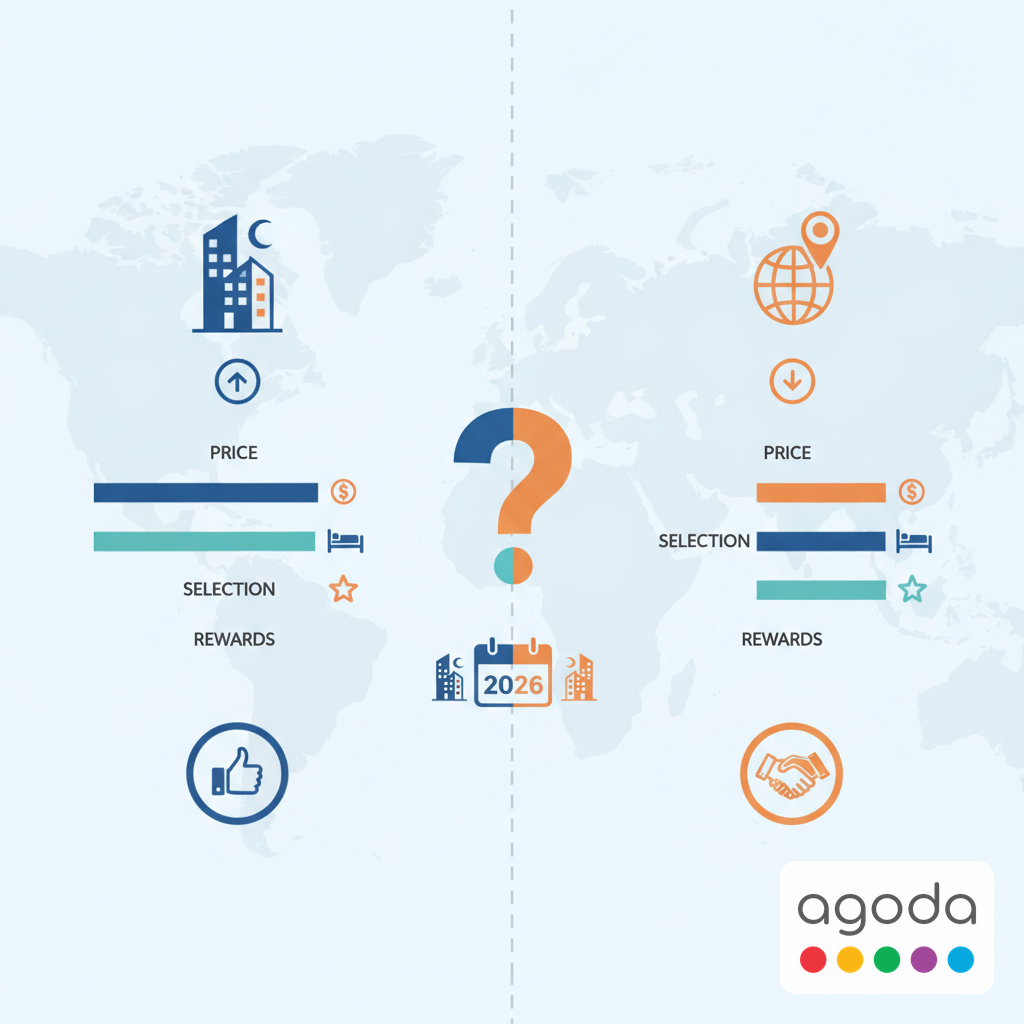
When comparing Agoda and Booking.com for hotel bookings in 2026, a detailed look at key dimensions reveals distinct strengths for each platform:
Agoda: 8.1/10 Overall
- Price Competitiveness & Value: 8.7/10 - Agoda frequently offers aggressive discounts, especially for properties in Asia, and its AgodaCash rewards add tangible value for repeat users.
- Property Coverage & Variety: 8.5/10 - While strong globally, Agoda truly excels in Asia with an impressive range of hotels, apartments, and unique local stays.
- Search & Booking Experience: 8.0/10 - The search filters are powerful, but the booking flow can sometimes introduce additional fees later in the process, requiring careful attention.
- Transparency & Fees: 7.5/10 - Prices often appear low initially, but taxes and service fees are sometimes added late in the checkout, impacting final transparency.
- Flexibility, Changes & Cancellation: 7.8/10 - Offers flexible options, but these might be less prominent or come with higher price tags compared to Booking.com's default.
- Customer Support & Refunds: 7.0/10 - Support can be slower or more challenging to access for urgent issues, and refund processes can be less straightforward.
Best for: Budget-focused travelers and those planning extensive trips within Asia-Pacific, who are comfortable with diligent price comparisons.
Booking.com: 8.6/10 Overall
- Price Competitiveness & Value: 8.2/10 - Consistently competitive global pricing, though sometimes outmatched by Agoda's flash sales in specific regions.
- Property Coverage & Variety: 9.2/10 - Boasts an unparalleled global inventory, covering virtually every type of accommodation in nearly every country.
- Search & Booking Experience: 8.8/10 - Highly intuitive interface with robust filters, map search, and a streamlined checkout process.
- Transparency & Fees: 8.5/10 - Generally provides clearer upfront pricing, with most taxes and fees displayed earlier in the booking process.
- Flexibility, Changes & Cancellation: 9.0/10 - A strong emphasis on free cancellation options, making it ideal for travelers with uncertain plans.
- Customer Support & Refunds: 7.8/10 - Offers more accessible and responsive customer service channels, with a generally smoother process for changes and refunds.
Best for: Global travelers, those prioritizing flexibility, ease of use, and a reliable booking experience across diverse destinations.
Where Agoda wins: Agoda's strength lies in its ability to secure incredibly competitive prices, particularly for hotels and alternative accommodations in Asian markets. Its loyalty program, AgodaCash, also provides a compelling reason for frequent users to return, offering future discounts that can significantly reduce overall travel costs.
Where Booking.com wins: Booking.com's dominance comes from its truly global reach and consistent user experience. Its platform is exceptionally user-friendly, with powerful search tools and a transparent approach to showcasing free cancellation options, which is a major draw for many travelers in 2026. Its customer support network is also generally perceived as more robust and responsive.
Where the decision depends on user preference: The choice between Agoda and Booking.com largely depends on your travel destination and booking priorities. If you're heading to Southeast Asia, Agoda often presents a stronger value proposition. For trips to Europe, North America, or South America, Booking.com's extensive network and flexibility often make it the preferred choice. The importance of price versus flexibility is also a key differentiator; budget-first travelers might lean towards Agoda's deals, while those valuing peace of mind and easy changes might favor Booking.com.
Which scoring category matters most for this niche: For hotel booking platforms, Property Coverage & Variety and Flexibility, Changes & Cancellation are arguably the most critical categories. A platform's ability to offer a wide range of options ensures travelers can find exactly what they need, while strong flexibility policies provide crucial peace of mind in an unpredictable travel landscape. While price is always a factor, the ability to find the right property and modify or cancel without penalty often outweighs a marginal price difference for many travelers.
Which Is Better: Agoda or Booking.com?
In 2026, for the vast majority of hotel bookings, Booking.com stands out as the overall better platform, primarily due to its unparalleled global inventory, consistently user-friendly experience, and robust emphasis on free cancellation policies. While Agoda remains a strong contender, particularly for specific regions and deal-seekers, Booking.com's comprehensive approach makes it the more reliable and versatile choice for most people across diverse travel scenarios.
For beginners, Booking.com offers a more intuitive and less confusing experience. Its interface is clean, and the presentation of key information like cancellation policies and total prices is generally clearer from the outset. This reduces the learning curve and potential for unexpected fees, making it a safer entry point into online hotel booking. Advanced users, who are comfortable with detailed price comparisons and navigating different platforms, might find Agoda's deeper discounts in specific markets more appealing, but they must be prepared to invest more time in checking final costs and terms.
When it comes to value, the answer is nuanced. Agoda can deliver better value for budget buyers, especially if their travel plans are concentrated in Asia or involve longer stays where Agoda's pricing models and AgodaCash rewards can yield significant savings. However, Booking.com often provides superior value in terms of booking flexibility and access to a wider range of properties, which can prevent costly last-minute changes or cancellations. For long-term ownership of the booking experience - from search to post-stay support - Booking.com generally offers a more consistent and less stressful journey.
The most important niche dimensions for hotel booking platforms are property coverage, flexibility, and transparency. Booking.com excels in all three, offering an extensive selection of accommodations globally, a strong focus on free cancellation, and generally clearer pricing. While Agoda's coverage in Asia is exceptional, its global reach is not as comprehensive, and its pricing transparency can sometimes be a point of concern until the final checkout stage. Therefore, based on these critical dimensions, Booking.com emerges as the stronger, more consistent choice for most hotel bookings in 2026.
Key Differences Between Agoda and Booking.com
While both Agoda and Booking.com operate under the same parent company, Booking Holdings, they have evolved with distinct philosophies, target users, and operational nuances that create meaningful differences for travelers. Understanding these distinctions is crucial for selecting the platform best suited to your specific hotel booking needs in 2026.
Product Philosophy and Target Users
Agoda historically started with a strong focus on the Asia-Pacific market, developing deep relationships with local properties and tailoring its offerings to Asian travelers. This has resulted in a platform that often provides unparalleled inventory and aggressive pricing in countries like Thailand, Vietnam, and Japan. Its target users are often budget-conscious travelers, those looking for longer stays, or individuals seeking unique local accommodations beyond standard hotels. Booking.com, conversely, has always aimed for global dominance, building an expansive network across all continents. Its philosophy centers on providing a vast, diverse inventory with a strong emphasis on flexibility and user-friendliness, appealing to a broader international audience, from solo adventurers to business travelers and families.
Feature Differences and Inventory Focus
Agoda's inventory shines with a significant number of apartments, guesthouses, and homestays, particularly in Asian destinations, often offering better rates for extended stays. It also features a loyalty program, AgodaCash, which rewards users with credits for future bookings. Booking.com, while also offering alternative accommodations, is renowned for its sheer volume of traditional hotels globally. Its strength lies in its comprehensive filtering system, allowing users to pinpoint specific amenities, neighborhoods, and even property types with ease. Booking.com also heavily promotes 'free cancellation' options, making it a go-to for travelers with uncertain plans.
Pricing Models and Transparency
Agoda is famous for its 'secret deals' and 'Agoda price drops', often displaying a lower initial price that can change significantly once taxes and service fees are added at later stages of checkout. This can lead to frustration for some users who prefer upfront transparency. Booking.com, while not immune to dynamic pricing, generally presents a more transparent final price earlier in the booking process. Taxes and most fees are typically integrated or clearly itemized before the final payment stage, which contributes to a more predictable booking experience.
Performance Differences and Geographic Strength
As mentioned, Agoda consistently outperforms Booking.com in terms of price and inventory depth within Asia. Travelers heading to this region in 2026 will likely find better deals and more unique accommodation options on Agoda. Outside of Asia, particularly in Europe and the Americas, Booking.com generally offers a more robust selection and often more competitive pricing. The performance difference is geographical; Agoda is a specialist in the East, while Booking.com is a generalist everywhere.
Long-Term Fit and Loyalty Programs
Agoda's AgodaCash program, where users earn credits on eligible bookings, is a direct loyalty incentive. For travelers who frequently book with Agoda, especially in its strong markets, this can lead to substantial long-term savings. Booking.com has its 'Genius' loyalty program, which offers tiered discounts, free breakfasts, and room upgrades based on booking frequency. While valuable, it's less about earning direct cash credits and more about unlocking perks. The long-term fit depends on your travel patterns and whether you prioritize direct monetary rewards or tiered service benefits.
| Feature | Agoda | Booking.com |
|---|---|---|
| Primary Focus | Asia-Pacific, budget, alternative stays | Global, diverse properties, flexibility |
| Inventory Depth | Exceptional in Asia; strong globally for non-hotels | Unparalleled global hotel and diverse accommodation options |
| Loyalty Program | AgodaCash (direct credits) | Genius (tiered discounts, perks) |
| Price Transparency | Can add fees late in checkout; requires diligence | Generally clearer upfront pricing |
| Cancellation Options | Available, but less emphasized than Booking.com | Prominently featured, strong focus on free cancellation |
| User Interface | Functional, can feel busy; strong for detailed filtering | Clean, intuitive, excellent map search |
| Customer Support | Can be slower; often email/chat focused | More accessible channels (phone, chat); generally responsive |
| Best for Regions | Asia, Middle East | Europe, Americas, Global |
| Where to Buy | View Deal | View Deal |

Search & Booking Experience: Finding Your Ideal Stay
The search and booking experience is a critical factor when choosing a hotel platform, as it directly impacts how easily and efficiently you can find and secure your ideal accommodation. In 2026, both Agoda and Booking.com offer robust tools, but their approaches to design, interface, and the overall user journey present notable differences.
Booking.com's user experience is often praised for its simplicity and intuitiveness. The interface is clean, uncluttered, and highly responsive, making it easy for even first-time users to navigate. Its search filters are extensive and exceptionally well-organized, allowing travelers to refine results by price, star rating, property type (hotel, apartment, hostel), amenities (pool, Wi-Fi, parking), neighborhood, and even specific guest review scores. The map search feature is particularly strong, enabling users to visually explore properties in relation to landmarks or specific areas, which is invaluable for destination-based decisions. The booking flow is streamlined, typically requiring fewer steps to confirm a reservation, and important information like cancellation policies and payment options are clearly displayed upfront. This focus on clarity and efficiency makes Booking.com a highly user-friendly platform.
Agoda's search and booking experience, while powerful, can sometimes feel a bit more complex. The interface, especially on desktop, can appear busier with more information and promotional elements. However, Agoda excels in its granular filtering options, often providing highly specific criteria that can be beneficial for niche searches, such as particular room features or very specific locations within a city. Its strengths are particularly evident when searching for alternative accommodations in Asia, where it might offer more specialized filters relevant to local property types. The booking process, while functional, requires a keen eye for detail. As noted earlier, prices can fluctuate more significantly during checkout, and various add-ons or taxes may appear later, demanding careful review before final confirmation. This means that while Agoda can unearth fantastic deals, the path to securing them might involve more vigilance from the user.
Ultimately, Booking.com's user experience is designed for broad appeal, prioritizing ease of use, global consistency, and transparent information delivery. Its map search and refined filtering make it quick to find relevant options. Agoda, on the other hand, caters more to a user willing to delve deeper for potentially better deals, especially in its strong geographical markets, but this often comes with a slightly less polished and more complex checkout process. For travelers prioritizing a seamless, low-friction booking experience from start to finish, Booking.com generally holds an edge in 2026.
Pricing and Value for Money: Unpacking the Costs
When it comes to hotel bookings, price is often the ultimate decision-maker, and both Agoda and Booking.com employ different strategies that can impact the final cost and perceived value. In 2026, comparing their pricing models requires more than just looking at the initial advertised rate.
Agoda's pricing strategy is often characterized by aggressive discounts, particularly for properties in Asia and for longer stays. It frequently offers flash sales, 'secret deals,' and 'Agoda price drops' that can present significantly lower initial rates than competitors. However, a crucial aspect of Agoda's pricing is its transparency - or sometimes, lack thereof - until the final stages of checkout. While the base price might be enticingly low, travelers must be vigilant as taxes, service fees, and other charges are often added later in the booking flow. This can sometimes lead to a final price that is higher than initially expected, requiring careful comparison with other platforms. The value proposition on Agoda is strong if you are disciplined in checking the final price before confirming and if you can leverage its AgodaCash rewards program for future savings.
Booking.com's pricing strategy tends to be more globally consistent and generally more transparent from the outset. While it also offers discounts and deals, including its 'Genius' member pricing, the displayed prices typically include most taxes and mandatory fees much earlier in the search or on the property page itself. This provides a clearer picture of the actual cost per night. Booking.com's value often comes from its extensive inventory, allowing travelers to compare many options, and its strong emphasis on free cancellation, which adds significant value in terms of flexibility and peace of mind. While it might not always offer the absolute lowest base price compared to Agoda's deepest discounts, its overall value is often perceived as higher due to its reliability and clearer cost breakdown.
| Pricing Aspect | Agoda | Booking.com |
|---|---|---|
| Base Price Competitiveness | Often lowest in Asia, strong for long stays | Consistently competitive globally |
| Taxes & Fees Visibility | Often added at later checkout stages | Generally included or clearly itemized upfront |
| Loyalty Program Value | AgodaCash (direct credits for future bookings) | Genius (tiered discounts, perks, upgrades) |
| "Hidden" Cost Risk | Medium (due to late fee additions) | Low (generally transparent upfront) |
| Best for Budget Travelers | Yes, especially in Asia with careful checks | Yes, for global options and transparent pricing |
| Overall Value Perception | High for specific markets/deal-seekers, if vigilant | High for reliability, transparency, and flexibility |
| Where to Buy | View Deal | View Deal |
Prices, availability, fees, and cancellation rules can change by route, date, supplier, and country. Always confirm the final terms at checkout before booking. While Agoda can provide exceptional value in specific scenarios, Booking.com often provides a more straightforward and transparent pricing journey, which many travelers find more valuable in 2026.
Check the latest pricing on Agoda for your next trip!
Flexibility, Cancellations, and Refunds: Navigating Changes
In the unpredictable world of travel, the ability to change or cancel bookings without penalty is a highly valued feature. Both Agoda and Booking.com offer various flexibility options, but their emphasis and clarity around these policies differ significantly, impacting a traveler's peace of mind in 2026.
Booking.com excels in offering and highlighting flexible booking options. Its platform is designed to prominently display "free cancellation" as a key filter and feature for many properties. This makes it incredibly easy for travelers to find and choose refundable rates, often with clear deadlines for cancellation without charge. This emphasis on flexibility is a major draw for travelers who need to keep their plans adaptable due to work, personal circumstances, or unforeseen events. When a cancellation is initiated, Booking.com's process is generally straightforward within their platform, and refunds for eligible bookings are typically processed efficiently, adhering to the stated policy terms. They act as a strong intermediary between the traveler and the property, often facilitating communication and ensuring policies are followed.
Agoda also offers cancellation options, but they may not be as universally prominent or as straightforward to navigate. While many properties on Agoda come with free cancellation, you might need to actively filter for these options, and the terms can sometimes be more varied depending on the specific property and rate. Agoda's strength often lies in its deeper discounts, which can sometimes be tied to stricter non-refundable policies. Travelers seeking maximum flexibility on Agoda may find themselves paying a slightly higher premium for refundable rates compared to its cheapest, often non-refundable, options. When it comes to refunds, the process can sometimes be more protracted, with travelers reporting longer wait times or more back-and-forth communication required to secure their eligible refunds. This is often because Agoda's refund process can be more dependent on the individual property's response and adherence to the policy.
For uncertain travel plans in 2026, Booking.com is generally the superior choice due to its clear communication of cancellation terms and its broad availability of free cancellation rates. This proactive approach minimizes risk and provides a greater sense of security. While Agoda does offer flexible options, travelers need to be more diligent in selecting them and understanding the precise terms, as the platform's primary focus leans towards securing the lowest possible price, which often comes with less flexibility. Therefore, if peace of mind and the ability to easily modify or cancel your hotel booking are paramount, Booking.com is the stronger platform.
Customer Support and Disruption Handling: When Things Go Wrong
The true test of any booking platform comes when something goes wrong - a cancellation, a change of plans, or an issue at the property. Effective customer support and disruption handling are crucial for a stress-free travel experience in 2026. Here, Agoda and Booking.com have different reputations and service models.
Booking.com generally offers more robust and accessible customer support. They provide multiple channels for assistance, including a comprehensive help center, live chat, phone support, and email. Their phone support is often available in multiple languages and is typically more responsive, which is critical for urgent travel issues. In cases of disruption, such as a hotel overbooking or an unexpected closure, Booking.com's customer service agents are generally empowered to assist with rebooking, mediating with the property, or processing refunds quickly. Their platform also allows for easy management of bookings, including self-service options for changes and cancellations, further reducing the need for direct support intervention for simple requests. Traveler reviews often highlight Booking.com's reliability in stepping in to resolve issues, although response times can still vary during peak travel periods.
Agoda's customer support has a more mixed reputation. While they do offer help through email, live chat, and a help center, direct phone support can sometimes be harder to access or might have longer wait times, particularly for non-English speakers or outside of Asian business hours. For complex issues or urgent disruptions, this can be a significant drawback. Refund processes, as mentioned earlier, can also be slower or require more proactive follow-up from the traveler. Agoda's support often acts more as an intermediary, relying on communication with the property, which can extend resolution times. While many travelers have positive experiences, patterns in third-party reviews suggest that when problems arise, Agoda's resolution process can be less seamless and more challenging to navigate than Booking.com's.
For travelers who prioritize accessible and responsive human support, especially during urgent travel disruptions, Booking.com is the more reliable choice in 2026. Its multi-channel support and generally quicker resolution times provide a greater sense of security. Agoda's support is functional for routine inquiries, but for high-stakes or time-sensitive problems, its less direct approach can be a source of frustration. When comparing these platforms, consider the potential for things to go wrong and which service provider you trust more to help you navigate those challenges effectively.
Trust, Safety, and Traveler Risk: Booking with Confidence
Booking accommodation involves entrusting a platform with your money, personal data, and travel plans. Therefore, brand trust, safety measures, and understanding potential traveler risks are paramount for making a confident decision in 2026. Both Agoda and Booking.com are established players, but their approaches to these aspects can influence a traveler's perceived risk.
Booking.com has built a strong global reputation for trust and reliability. As a publicly traded company with extensive market presence, it benefits from high brand recognition and generally positive customer perception. Its payment systems are secure, utilizing standard encryption protocols (HTTPS) and partnering with reputable payment processors. For traveler protections, Booking.com often acts as a robust mediator between the guest and the property, offering assistance if there are issues upon arrival, such as overbooking or misrepresented accommodations. Their platform clearly outlines terms and conditions, and user reviews are typically verified, adding a layer of authenticity to property listings. While no platform is entirely immune to issues, Booking.com's established processes and global reach generally translate into a lower perceived risk for travelers, especially for international bookings where familiarity and a reliable intermediary are valued.
Agoda, while also a legitimate and widely used platform, sometimes faces more scrutiny regarding trust and transparency. Its payment security is comparable, employing industry-standard encryption. However, the previously discussed issues with price transparency - where taxes and fees are added late in the checkout process - can erode trust for some users, making them feel as though there are 'hidden costs.' This can lead to a perception of higher price risk. Additionally, for complex itineraries or issues that require intervention, Agoda's customer support, as noted, can be less direct, which might increase the perceived support risk. While Agoda has a vast network of verified properties, travelers should always double-check property reviews and policies carefully. Data privacy policies are in line with industry standards, but the overall booking journey can sometimes feel less 'safe' for those who prefer absolute clarity at every step.
For the average traveler in 2026, Booking.com generally presents a lower overall risk profile due to its consistent transparency, reliable customer support, and strong global brand reputation. Agoda is a trustworthy platform, but travelers using it should be more diligent in reviewing the final price breakdown and understanding cancellation terms to mitigate potential price and policy risks. When booking with either platform, always ensure your payment is secure, read recent reviews, and understand the property's specific policies to ensure a confident and safe travel experience.
App & In-Trip Experience: Your Mobile Travel Companion
In 2026, a seamless mobile experience is no longer a luxury but a necessity for travelers. Both Agoda and Booking.com offer dedicated mobile apps designed to enhance the in-trip experience, from managing itineraries to accessing customer support. However, their execution and specific strengths cater to slightly different user needs.
Booking.com's mobile app is widely regarded as one of the best in the travel industry. It boasts a clean, intuitive interface that mirrors the desktop experience while optimizing for smaller screens. Key features include easy access to booking confirmations, mobile check-in instructions, and the ability to communicate directly with properties through an integrated chat function. The app provides real-time notifications for booking updates, check-in reminders, and special offers. Its offline access capabilities allow users to view itineraries and property details even without an internet connection, which is invaluable when traveling internationally. Customer support is easily accessible directly through the app, with options for live chat or phone calls. The overall design prioritizes quick access to essential information and tools, making it a highly reliable and convenient companion throughout the travel journey.
Agoda's mobile app is also highly functional and well-regarded, particularly by its loyal user base. It offers a comprehensive set of features, including booking management, access to AgodaCash rewards, and detailed property information. The app is particularly strong for discovering deals and often provides exclusive mobile-only discounts, making it a compelling tool for budget-conscious travelers. While the interface can sometimes feel a bit more crowded than Booking.com's, it offers powerful filtering and search capabilities. Like Booking.com, it provides booking confirmations and allows for communication with properties. However, some users report that while functional, the overall polish and seamlessness of the in-app customer support experience might not always match Booking.com's. Despite this, for finding deals and managing bookings, especially for properties in Asia, Agoda's app is a very capable tool.
For travelers who prioritize a polished, universally intuitive, and feature-rich app experience for managing global itineraries, Booking.com's app is generally superior. Its seamless design, robust offline capabilities, and integrated support make it an ideal in-trip companion. Agoda's app, while excellent for deal discovery and particularly strong for its Asian market focus, might have a slightly steeper learning curve for new users and can sometimes feel less streamlined in its support functions. Both apps are valuable, but Booking.com's offers a more consistently smooth and comprehensive mobile travel management experience in 2026.
Pros and Cons: A Balanced View for Each Platform
Agoda Pros and Cons
- Pro: Deep Discounts in Asia-Pacific. Agoda frequently offers the lowest prices for hotels and alternative accommodations across Southeast Asia, East Asia, and the Middle East, making it a go-to for budget travelers in these regions.
- Pro: Extensive Inventory in Asian Markets. Beyond just hotels, Agoda boasts a massive selection of apartments, guesthouses, and unique local stays, offering more diverse options.
- Pro: AgodaCash Rewards Program. Earn credits on eligible bookings that can be applied to future stays, providing tangible savings for frequent users.
- Pro: Strong for Longer Stays. Often provides better rates for multi-night or extended bookings, appealing to digital nomads or slow travelers.
- Pro: Mobile-Only Deals. The Agoda app frequently features exclusive discounts not available on the desktop site, encouraging app usage.
- Con: Inconsistent Price Transparency. Final prices with taxes and fees are sometimes only revealed at later checkout stages, requiring careful review. This is a deal-breaker for those who value upfront honesty.
- Con: Customer Support Challenges. Support can be slower to respond, particularly for urgent issues, and phone access might be less straightforward than competitors. This can be a deal-breaker for high-value or complex bookings.
- Con: Less Global Consistency. While improving, its inventory and price competitiveness are not as strong outside of its core Asian markets.
- Con: User Interface Can Feel Busy. The desktop site, in particular, can appear cluttered with various promotions and options, potentially overwhelming some users. This is a minor trade-off for most.
- Con: Refund Process Can Be Slower. Getting a refund for eligible cancellations can sometimes take longer or require more follow-up compared to Booking.com. This can be a minor trade-off, but sometimes a deal-breaker if funds are needed quickly.
Booking.com Pros and Cons
- Pro: Unparalleled Global Coverage. Offers one of the largest and most diverse inventories of hotels, apartments, villas, and hostels in virtually every country worldwide.
- Pro: User-Friendly Interface. A clean, intuitive design on both desktop and mobile, with excellent search filters and map functionality, making booking easy for everyone.
- Pro: Strong Emphasis on Free Cancellation. Many properties offer flexible booking options, clearly highlighted, providing peace of mind for uncertain travel plans.
- Pro: Transparent Upfront Pricing. Generally displays total prices, including most taxes and fees, much earlier in the booking process.
- Pro: Reliable Customer Support. Multiple accessible channels (phone, chat, email) with generally responsive agents, crucial for urgent travel issues.
- Pro: Genius Loyalty Program. Offers tiered discounts, free breakfasts, and room upgrades for frequent bookers, adding value over time.
- Con: Can Be Pricier in Specific Markets. For certain destinations, particularly in Asia, Agoda might offer deeper discounts. This can be a minor trade-off for budget-conscious travelers.
- Con: Less Focus on Long-Term Stays. While possible, it may not always offer the best rates for extended periods compared to platforms specializing in long-term rentals. This is a minor trade-off for most.
- Con: Less Direct Cash Rewards. The Genius program offers perks, but not direct cash credits like AgodaCash, which some travelers prefer. This is a minor trade-off depending on loyalty preference.
- Con: Occasional Overbooking Issues. With such a vast inventory, rare instances of properties overbooking can occur, though Booking.com generally steps in to resolve them. This is a minor risk that is well-managed.
Use-Case Segmentation: Who Should Choose Which?
The choice between Agoda and Booking.com often boils down to specific travel needs, destination, and priorities. Here's a breakdown of who should choose which platform in 2026:
| Traveler Type / Priority | Choose Agoda If... | Choose Booking.com If... |
|---|---|---|
| Budget Traveler (Asia-focused) | You want the absolute lowest price for hotels and alternative accommodations in Asia, and are willing to scrutinize final costs. | You need consistently competitive global pricing with transparent fees, prioritizing ease of comparison and reliability. |
| Global Traveler / Diverse Destinations | You are primarily traveling within Asia-Pacific or the Middle East and seeking local deals. | You need unparalleled property coverage across all continents, from Europe to the Americas and beyond. |
| Flexible Traveler / Uncertain Plans | You are comfortable paying a slight premium for flexible rates, or your plans are firm. | You prioritize prominent free cancellation options and easily adjustable bookings for peace of mind. |
| Family Traveler | You're looking for larger apartments or guesthouses in Asia that offer good value for families. | You need reliable access to family rooms, child policies, and family-friendly amenities globally, with clear booking terms. |
| Business Traveler | You're traveling to Asia frequently and can leverage AgodaCash for cost savings on company trips. | You require a consistent, efficient booking experience with clear receipts and reliable support for expense claims. |
| Long-Stay Traveler / Digital Nomad | You are planning an extended stay, especially in Asia, and want to find properties with better monthly rates. | You need diverse accommodation options for longer periods globally, with robust filters for amenities like workspaces and strong Wi-Fi. |
| First-Time International Traveler | You are traveling exclusively to a well-researched destination in Agoda's strong markets. | You need a straightforward, globally recognized platform with clear policies and accessible customer support for reassurance. |
| Loyalty Program Enthusiast | You prioritize earning AgodaCash for direct monetary discounts on future bookings. | You value tiered perks like discounts, free upgrades, and breakfasts through the Genius program. |
Real-World Scenarios
To illustrate how these differences play out, let's consider a few real-world scenarios for travelers planning their hotel stays in 2026:
Scenario 1: The Southeast Asian Backpacking Adventure
Maya is planning a three-month backpacking trip through Thailand, Vietnam, and Indonesia. Her primary goal is to find the cheapest hostels, guesthouses, and budget hotels, and she's comfortable with booking last-minute or for extended periods in each location. She prioritizes price over strict flexibility, though some wiggle room is appreciated. In this case, Agoda would be Maya's go-to platform. Agoda's deep discounts in Southeast Asia, extensive inventory of local and budget accommodations, and potential for AgodaCash rewards on longer stays align perfectly with her needs. She would, however, need to be diligent about checking the final price inclusive of all fees before confirming each booking, as well as carefully reviewing the cancellation policies for each property.
Scenario 2: The European Family Vacation
The Chen family is planning a two-week multi-city trip across Italy and France, needing family-friendly hotels with clear amenities, good locations near attractions, and the flexibility to adjust dates due to potential changes in their kids' school schedules. They value transparency, ease of use, and reliable customer support for peace of mind. For them, Booking.com would be the superior choice. Its unparalleled global coverage in Europe ensures a wide selection of suitable hotels, apartments, and villas. More importantly, Booking.com's strong emphasis on free cancellation, clear upfront pricing, and intuitive filtering for family-specific needs (like connecting rooms or pools) provides the security and convenience the Chens require. Should any issues arise during their trip, Booking.com's more accessible customer support would be a significant advantage.
Scenario 3: The Last-Minute Business Trip to New York City
David needs to book a hotel for a two-night business trip to New York City next week. He needs a mid-range hotel in Midtown, with reliable Wi-Fi, a comfortable workspace, and a straightforward booking process to submit for company expenses. Flexibility is secondary as his trip is confirmed, but efficiency and clear pricing are key. Here, both platforms could work, but Booking.com likely offers a slightly smoother experience. Its vast inventory in major global cities like New York ensures plenty of options, and its clear, upfront pricing helps David quickly compare final costs for expense reports. The intuitive search and booking flow allows him to secure a room quickly. While Agoda might offer a flash deal, the potential for late-added fees could complicate his expense reporting process, making Booking.com the more efficient and transparent option for this particular scenario.
Final Verdict: Making Your Ultimate Hotel Booking Decision
After a thorough examination of Agoda and Booking.com for hotel bookings in 2026, the verdict is clear: Booking.com emerges as the overall winner for the vast majority of travelers globally. Its extensive property coverage, user-friendly interface, transparent pricing (for the most part), and strong emphasis on free cancellation make it an incredibly reliable and versatile platform for almost any hotel booking need.
For those seeking the best value pick, the answer is nuanced. If your travel is heavily concentrated in Asia-Pacific, Agoda often provides deeper discounts and more aggressive deals, making it the value champion in that specific region. However, for overall value that combines competitive pricing with high flexibility and reliability, Booking.com offers a more consistent and less risky value proposition across the board.
There isn't a distinct "premium pick" between these two, as both cater to a wide range of budgets. However, for a best beginner pick, Booking.com's intuitive design and straightforward booking process make it the ideal starting point. Its clear display of policies and accessible customer support minimize potential confusion and stress for new or infrequent travelers.
For the best long-term pick, Booking.com's continuous investment in global inventory, user experience refinements, and its Genius loyalty program provide a consistent and rewarding platform for frequent travelers. While AgodaCash offers direct monetary rewards, Booking.com's broader utility and reliability often make it the default choice for repeat business across various destinations.
Choose Agoda if: You are an experienced traveler primarily heading to destinations in Asia-Pacific or the Middle East, seeking the absolute lowest price for hotels or unique alternative accommodations, and are prepared to meticulously check all fees and cancellation terms at checkout. Its AgodaCash loyalty program can also be a significant draw for recurrent bookings in its strong markets.
Choose Booking.com if: You prioritize unparalleled global hotel inventory, a consistently user-friendly and intuitive booking experience, strong emphasis on free cancellation options, and transparent upfront pricing. It's the safer, more reliable, and more versatile choice for most international travelers, families, and those who value peace of mind and accessible customer support for their hotel bookings in 2026.
Ultimately, while both platforms are legitimate and offer value, Booking.com provides a more well-rounded and less risky hotel booking experience for the modern traveler. However, for specific regional deep dives, Agoda remains a powerful tool worth checking.
Still comparing? Check the latest pricing on Booking.com before deciding.
Frequently Asked Questions
Yes, Agoda is a legitimate and widely recognized online travel agency, part of Booking Holdings. It is safe to book with, using industry-standard security for payments and data. However, travelers should be diligent in checking final prices for all fees and understanding cancellation policies, as these can sometimes be less transparent upfront compared to Booking.com, leading to a perception of higher price risk.
Booking.com is not always cheaper than Agoda, and vice versa. Agoda often offers more aggressive discounts, especially for hotels and alternative accommodations in the Asia-Pacific region and for longer stays. Booking.com typically provides consistently competitive global pricing with better upfront transparency. Always compare the final checkout price on both platforms, including all taxes and fees, before making a booking decision, as prices fluctuate significantly.
If your hotel booking is cancelled, the outcome depends on the cancellation policy you selected (refundable vs. non-refundable) and who initiated the cancellation (you or the property). Both platforms generally follow the stated policy. Booking.com is known for its clear free cancellation options and generally smoother refund processes. Agoda also offers cancellation, but refunds might take longer or require more follow-up. Always review the specific terms at the time of booking.
Booking.com generally offers better and more accessible customer support for hotel issues. They provide multiple channels, including responsive phone support and live chat, often available in multiple languages, which is crucial for urgent travel problems. Agoda's support, while functional, can sometimes be slower to respond or harder to reach for complex issues, particularly via phone, making Booking.com the more reliable choice when things go wrong.
For international travel in 2026, Booking.com is generally better due to its unparalleled global property coverage and consistent user experience across continents. Agoda excels for international travel specifically within Asia-Pacific, where it offers deeper inventory and potentially better deals. If your international travel is primarily to Europe, the Americas, or Africa, Booking.com typically provides a more comprehensive and reliable booking experience.
Agoda is often better for budget hotels, especially if you are traveling in Asia-Pacific. It frequently has aggressive discounts, flash sales, and a vast selection of hostels, guesthouses, and budget-friendly hotels in this region. However, budget travelers should carefully check the final price during checkout on Agoda, as taxes and fees can be added late. Booking.com also offers many budget options globally with clearer upfront pricing.
Booking directly with the hotel often provides maximum control, direct communication, and eligibility for hotel loyalty programs and specific perks. Use Agoda or Booking.com when they offer significant savings, better search tools, or valuable flexibility options (like free cancellation from Booking.com) that booking direct might not. Always compare prices and policies across all options before finalizing your hotel booking in 2026.
Agoda's 'AgodaCash' program offers direct monetary credits on eligible bookings, which can be applied to future stays, providing clear and tangible savings. Booking.com's 'Genius' program offers tiered benefits like discounts, free breakfasts, and room upgrades based on booking frequency. The 'better' program depends on whether you prefer direct cash credits (Agoda) or service-based perks and status (Booking.com).