Cruise vs. All-Inclusive Resort: Which Vacation Style is Right for You in 2026?
Cruise Vacation
Ideal for travelers who want to see multiple destinations in one trip and enjoy a wide array of high-energy entertainment and activities.
Overall Score
Top Picks
Cruise Vacation
Cruises excel in providing a high-energy, multi-destination experience packed with entertainment. They offer incredible value for seeing the world but can feel restrictive and nickel-and-dime you if you're not careful with your budget.
All-Inclusive Resort
All-inclusive resorts are the champions of relaxation and convenience. They offer a truly hassle-free vacation with superior beverage inclusions and more spacious accommodations, though they lack the travel component of a cruise.
Comparison
Design
Performance
Value for Money
Ease of Use
Durability
Features
The great vacation debate: Should you sail the high seas on a floating city or plant your feet in the sand at a sprawling, all-inclusive resort? Both promise sun, relaxation, and a wallet-friendly, single-price experience, but they deliver vastly different holidays. Choosing the wrong one can lead to disappointment, while the right choice can create memories that last a lifetime. This is not just about choosing a destination; it's about choosing a vacation philosophy.
We've analyzed dozens of cruise itineraries and resort packages, crunched the numbers on hidden costs, and evaluated real-world traveler feedback to bring you the definitive, data-driven comparison. We'll move beyond the surface-level differences and dive deep into the nuances of dining, activities, value, and overall experience to help you make an informed decision.
Cruise vs. All-Inclusive Resort: At a Glance
| Feature | Cruise Vacation | All-Inclusive Resort |
|---|---|---|
| Overall Concept | A floating resort that travels to multiple destinations. | A land-based resort in a single location with all amenities included. |
| Variety of Scenery | High. Wake up in a new port or city every 1-2 days. | Low. Immersive experience in one specific location. |
| Pricing Structure | Base fare covers accommodation, some food, and basic drinks. Extras like alcohol, Wi-Fi, and excursions are often extra. | Upfront price typically covers accommodation, all food, all drinks (including alcohol), and on-site activities. |
| Best For | Travelers who want to sample multiple destinations, enjoy structured activities and world-class entertainment. | Travelers who want to deeply relax, immerse themselves in one location, and enjoy unlimited food and drink without hassle. |
| Typical Hidden Costs | Port fees, daily gratuities, drink packages, specialty dining, shore excursions, Wi-Fi. | Airport transfers, premium activities (e.g., spa, golf), off-site excursions, top-shelf liquor. |
| Pros |
|
|
| Cons |
|
|
| Our Rating | 8.8/10 | 8.5/10 |
| Call to Action | Find Cruise Deals | Find Resort Deals |
Quick Verdict: Which Should You Choose?
Here's the bottom line, fast: Choose a cruise if you value variety, exploration, and entertainment. A cruise is essentially a multi-destination sampler platter. If the idea of waking up in a new country every morning, seeing world-class Broadway-style shows in the evening, and having a structured list of activities excites you, a cruise is your ideal match. It's perfect for the traveler who gets restless easily and wants to see as much as possible in a short time without the logistical nightmare of booking multiple hotels and flights. The trade-off is often less time to truly immerse yourself in any single location and the potential for a bill full of add-ons at the end.
Choose an all-inclusive resort if your primary goal is deep relaxation, convenience, and immersion. A resort is a destination in itself. If your dream vacation involves claiming a specific spot by the pool or on the beach, enjoying unlimited craft cocktails, and never having to think about where to go for dinner, an all-inclusive is your sanctuary. It's built for unwinding and de-stressing. You'll get to know one location intimately, from its beaches to its local culture (if you venture out). This is the best choice for travelers who want to completely switch off, unpack once, and have every need catered to in a single, beautiful location.
Rating Widget: Cruise vs. All-Inclusive Resort
Which is Better: A Cruise or an All-Inclusive Resort?
Deciding whether a cruise or an all-inclusive resort is 'better' depends entirely on your vacation priorities, as they excel in different areas. A cruise is better for travelers who prioritize seeing multiple destinations and enjoy a constant stream of high-quality entertainment. An all-inclusive resort is better for those who seek deep relaxation, convenience, and a more immersive experience in a single location.
Think of it as a trade-off between breadth and depth. A 7-night Caribbean cruise might take you to Jamaica, Grand Cayman, and Mexico. You get a taste of three different cultures, but you only have about 8-10 hours in each port. It's a fantastic overview, ideal for someone who isn't sure which island they'd like to visit for a longer stay in the future. The ship itself is a destination, with rock climbing walls, surf simulators, ice skating rinks, and elaborate stage productions. The energy is high, and there's always something to do. This is a vacation in motion.
Conversely, a 7-night stay at an all-inclusive resort in Jamaica allows you to explore that one island in depth. You can spend days relaxing on the famous Seven Mile Beach, venture inland to see Dunn's River Falls, and spend evenings enjoying local music, all without the pressure of a ship's departure horn. The pace is set by you. The focus is on relaxation and enjoying the resort's amenities - multiple pools, water sports, and various themed restaurants - to their fullest. This is a vacation of stillness and immersion.
Ultimately, the 'better' choice is a reflection of your personality. If you're an explorer who thrives on a schedule and new scenery, the cruise wins. If you're a connoisseur of relaxation who wants to unpack once and let the world melt away, the all-inclusive resort is superior.
What Are the Key Differences?
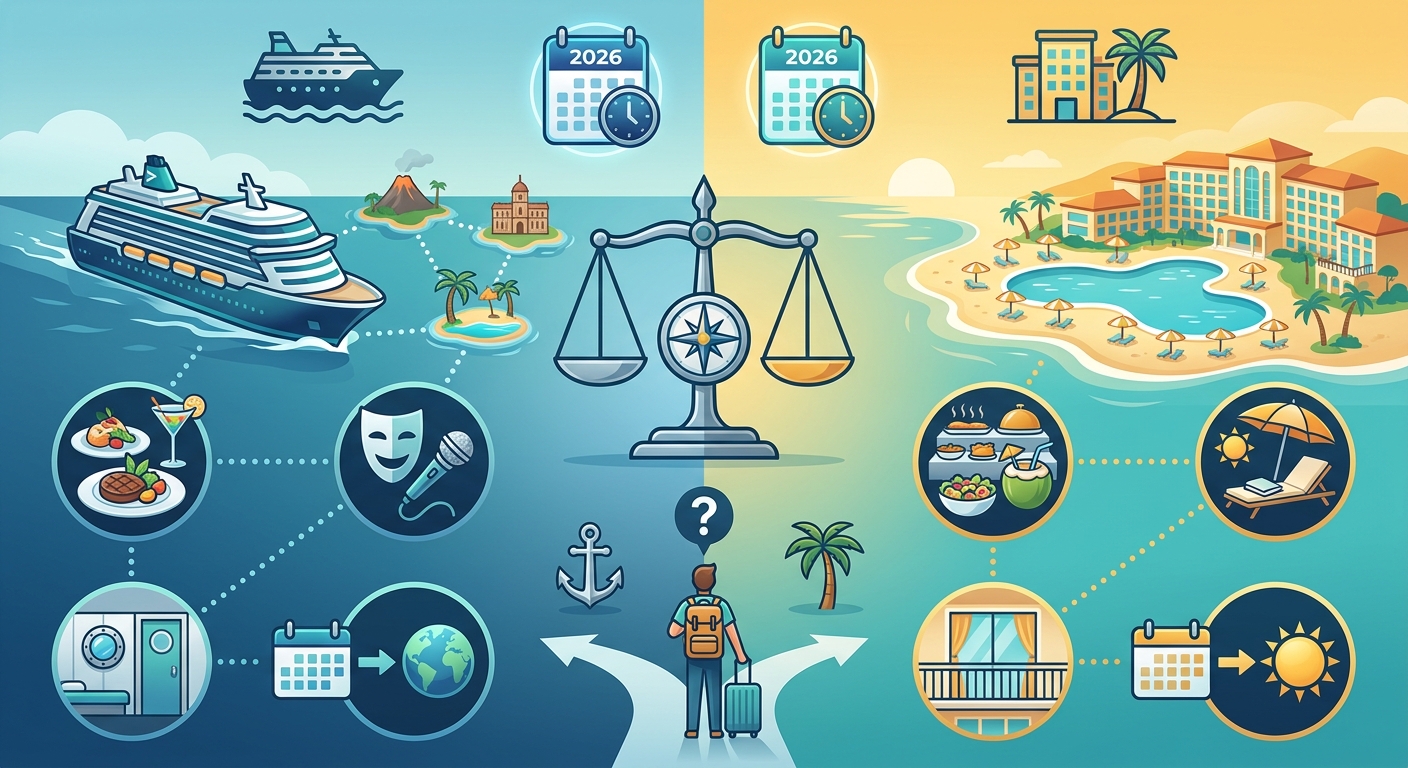
While both vacation types bundle costs, their core philosophies are fundamentally different. The key differences between a cruise and an all-inclusive resort lie in mobility, inclusions, and atmosphere. A cruise is a moving destination offering a sampler of places, while a resort is a stationary destination offering a deep dive into one place. This core distinction ripples through every aspect of the experience.
First, mobility and destination experience are the most significant differentiators. A cruise is inherently about travel and discovery. You unpack once, and your hotel travels with you to new cities or countries. For example, a Mediterranean cruise might visit Rome, Florence, and Barcelona in one week - a logistically complex trip made simple. However, your time in each port is limited, often just a single day, which can feel rushed. An all-inclusive resort, like one in Playa del Carmen, offers the opposite. You are rooted in one spot, allowing for a deep, unhurried exploration of the local area, from ancient ruins to cenotes, on your own schedule. You sacrifice the variety of multiple countries for a richer experience in one.
Second, the concept of 'all-inclusive' varies dramatically. At most land-based resorts, 'all-inclusive' truly means all food, all drinks (including most alcoholic beverages), and non-motorized water sports are included in the upfront price. It's a genuinely cashless experience for the essentials. On a cruise, the base fare covers your cabin, meals in the main dining room and buffet, and basic beverages like tap water, iced tea, and standard coffee. Soda, specialty coffees, and alcoholic drinks almost always require an expensive add-on beverage package. Similarly, the most exciting activities - the shore excursions - are a significant extra cost, whereas a resort's on-site activities are typically free.
Finally, the atmosphere and environment are distinct. Cruise ships, especially the mega-ships from lines like Royal Caribbean or Carnival, are bustling, high-energy environments. They are designed to entertain thousands of people with a non-stop schedule of events, parties, and shows. It's a social and often loud atmosphere. All-inclusive resorts, while also social, tend to offer a more tranquil and spacious environment. With sprawling grounds, multiple pools (including quiet ones), and long stretches of beach, it's easier to find a peaceful corner to relax and unwind. The overall vibe is less about a packed schedule and more about leisure at your own pace.
Ambiance & Environment: Floating City vs. Sprawling Oasis
The physical environment and overall ambiance of your vacation set the stage for your entire experience. A cruise ship offers a compact, dynamic, and ever-changing environment, akin to a vibrant floating city. An all-inclusive resort provides a spacious, stable, and immersive environment, like a private, self-contained oasis.
On a modern cruise ship, the design is a marvel of efficiency and engineering. Everything is vertically integrated. Your cabin, though typically smaller than a standard hotel room, is your home base. Just steps away are a dozen restaurants, multiple theaters, pools, bars, a casino, and a spa, all connected by a network of elevators and promenades. The 'Royal Promenade' on Royal Caribbean ships, for example, feels like an urban shopping mall at sea, complete with parades and street parties. The downside is potential crowding. With 3,000 to 6,000+ passengers, pool decks can be packed on sea days, and lines can form for popular attractions. The view is constantly changing, from the endless ocean one day to the dramatic coastline of a new port the next, which is a major part of the appeal.
In contrast, an all-inclusive resort is defined by its connection to its location and its sense of space. Take a resort like Sandals South Coast in Jamaica, which is set on a 2-mile stretch of private beach within a 500-acre nature preserve. The rooms are significantly larger than cruise cabins, often featuring balconies or patios with direct beach or pool access. The layout is horizontal and spread out, encouraging leisurely strolls through manicured gardens from your room to the beach, to a seaside restaurant, to a swim-up bar. The ambiance is one of permanence and tranquility. You are not just visiting a place; you are living in it for a week. The environment is designed to maximize relaxation, with an emphasis on natural beauty - the sound of the waves, the feel of the sand, and the lush tropical landscape.
The choice here comes down to stimulation versus serenity. A cruise ship is a hub of constant stimulation, with manufactured environments designed to wow and entertain. A resort leverages its natural environment to create a sense of escape and calm. If you thrive on energy and variety, the floating city is for you. If you need space and natural beauty to unwind, the sprawling oasis is the clear winner.
Activities & Entertainment: Structured Spectacle vs. Leisurely Pursuits
When it comes to filling your days, both options offer a wealth of activities, but they deliver them in starkly different ways. Cruises offer a highly structured, diverse, and often spectacular array of entertainment and activities scheduled from morning to night. All-inclusive resorts provide a more flexible, leisure-focused menu of activities centered around the resort's location and amenities.
A cruise ship is an entertainment powerhouse. Each evening, a daily planner, like Carnival's 'Fun Times', is delivered to your cabin, detailing a dizzying schedule for the following day. You might start with a morning trivia session, followed by a cooking demonstration, an afternoon on the FlowRider surf simulator, a pre-dinner comedy show, a full-scale Broadway production like 'Hairspray' in the main theater, and a late-night dance party on the pool deck. The quality of this entertainment is often exceptional and is a primary selling point for lines like Royal Caribbean and Norwegian. The activities are designed to cater to all ages and energy levels, ensuring no one is ever bored. The downside is that this can create a sense of 'fear of missing out' (FOMO), where you feel pressured to constantly be doing something.
All-inclusive resorts, on the other hand, build their activities around a more relaxed, 'do as you please' philosophy. The focus is often on the water. A resort like Beaches Turks & Caicos includes a full PADI-certified scuba diving program, snorkeling trips, Hobie Cat sailing, paddleboarding, and kayaking, all available whenever you feel like it. On land, you might find yoga classes, tennis clinics, or a cocktail-making class. The entertainment is typically more low-key and localized. Instead of a Broadway show, you'll find a live reggae band, a fire-dancing performance on the beach, or a themed party. The schedule is a suggestion, not a mandate. The primary activity for many is simply relaxing by the pool or ocean with a book and a drink, an experience that can be hard to find on a bustling cruise ship.
The real-world use case is clear: A family with teenagers who have different interests might thrive on a cruise, where one can be at the sports court, another at the teen club, and the parents at a wine tasting, all simultaneously. Conversely, a couple looking to reconnect and de-stress would likely prefer the resort's unstructured environment, where the most pressing decision of the day is whether to order a margarita or a mojito at the swim-up bar. It's a choice between a vacation as an event and a vacation as an escape.
Dining & Inclusions: Navigating the 'All-Inclusive' Maze
The term 'all-inclusive' is where these two vacation styles diverge most significantly, particularly concerning food and drink. All-inclusive resorts generally offer a more genuinely inclusive dining and beverage experience, while cruises operate on a tiered system with a good baseline of included options and numerous opportunities to pay for upgrades.
At a typical mid-to-high-end all-inclusive resort (think brands like Secrets, Hyatt Ziva, or Sandals), your upfront price covers virtually everything you can eat or drink. This includes breakfast, lunch, and dinner at a variety of restaurants, from casual beach grills to fine-dining a la carte venues serving Italian, French, or Japanese cuisine, all without reservations. More importantly, all alcoholic beverages are included - from local beer to premium-brand spirits like Grey Goose vodka or Johnnie Walker scotch - available at numerous bars from morning until late at night. Room service is also frequently included. The freedom to order what you want, when you want, without seeing a bill, is a cornerstone of the resort value proposition.
On a cruise, the dining structure is more complex. Your fare includes meals in the main dining room (with set seating times or a flexible option), the massive buffet, and a few casual spots like a pizza or sandwich counter. The food quality here is generally very good. However, the most exciting culinary experiences are found in the 'specialty restaurants' - like a steakhouse, a sushi bar, or a restaurant by a celebrity chef - which carry an extra charge, typically from $30 to $60 per person. When it comes to drinks, only basic beverages are free. To get soda, beer, wine, or cocktails, you must pay per drink or, more commonly, purchase a beverage package. These packages can cost anywhere from $60 to $100+ per person, per day, and often you must buy it for the entire cruise duration. This can add over $1000 to a couple's week-long vacation cost.
Let's compare a real-world scenario. A couple at the Hyatt Ziva Cancun can visit a tequila bar for a tasting, enjoy a multi-course French dinner with a bottle of included wine, and grab a late-night snack from the 24-hour lounge, all for $0 extra. A couple on a Norwegian cruise might have a free dinner in the main dining room, but a similar experience - a pre-dinner cocktail, wine with dinner at the specialty French bistro, and an after-dinner drink - could easily cost them an additional $150 for that evening alone, unless they've pre-purchased an expensive package. This makes the resort a better value for those who enjoy premium beverages and varied dining without wanting to constantly calculate costs.
Pricing & Value for Money: Deconstructing the Final Bill
Determining which option offers better value is complex, as it requires looking far beyond the advertised sticker price. While cruises often have a lower entry price, all-inclusive resorts frequently provide better overall value once all 'hidden' costs are accounted for, especially for travelers who enjoy premium food and drinks.
Let's break down a hypothetical 7-night Caribbean vacation for two adults. The cruise might be advertised at $899 per person. That's a compelling $1798 base fare. However, you must add mandatory port fees and taxes (approx. $200 pp), and daily gratuities (approx. $16 pp per day, so $224 total). Now the price is $2422. If you want a drink package, add roughly $700 per person, bringing the total to $3822. And we haven't even included any shore excursions, which can average $100 per person per port. Three excursions could add another $600. Suddenly, the 'cheap' cruise costs $4422.
Now consider an all-inclusive resort advertised at $2000 per person, for a total of $4000. This price typically includes taxes. It also includes all your food, all your premium alcoholic drinks, on-site activities, and often even the gratuities. Your only major additional costs might be airport transfers (approx. $100) and any off-site excursions you choose to do. Even with one major excursion (like Chichen Itza for $150 pp), your total comes to around $4400. The final cost is surprisingly similar, but the resort experience involved far less nickel-and-diming and a higher quality of inclusions (especially beverages).
The value proposition shifts based on your travel style. If you don't drink alcohol, plan to eat only at the included venues, and are happy to explore ports on your own without booking official excursions, the cruise maintains its cost advantage. You could stick closer to that initial $2422 figure. However, for the average vacationer who wants to enjoy a few cocktails, try a special restaurant, and see the sights, the all-inclusive resort's transparent, upfront pricing model often proves to be the more relaxing and financially predictable option. The key is to be brutally honest about your spending habits before you book. The 'value' is not in the base price, but in what that price actually buys you.
See Top Cruise Packages Explore All-Inclusive ResortsPros and Cons: A Detailed Breakdown
No vacation style is perfect. Understanding the specific advantages and disadvantages of each is crucial for aligning your expectations with reality. Here's a deeper dive beyond the summary points.
Cruise Vacation
Pros:
- Unmatched Destination Variety: This is the cruise's superpower. The ability to visit three, four, or even five different destinations or countries in a single week without packing and unpacking is an incredible logistical feat. It's ideal for sampling a region to see where you might want to return for a longer trip.
- World-Class Entertainment: Mega-ships offer entertainment that rivals Las Vegas. From full Broadway shows and mesmerizing aqua-theater performances to ice skating spectaculars and headline comedians, the quality and variety are something a single resort can rarely match.
- Activities for All Ages: The sheer volume of onboard activities - from kids' clubs and teen discos to adult-only sundecks and casinos - means that multi-generational families can travel together while still allowing everyone to pursue their own interests.
Cons:
- The Feeling of Being 'Nickeled and Dimed': The business model relies on onboard spending. From the moment you step on board, there are constant upsells for drink packages, specialty dining, photos, spa treatments, and art auctions. It can be exhausting and lead to a surprise bill at the end.
- Crowds and Queues: Modern ships carry thousands of passengers. This can lead to lines for embarkation, disembarkation, guest services, and even the buffet. On sea days, finding a free lounge chair by the main pool can be a competitive sport.
- Limited Time in Port: While you see many places, you don't see them for long. A typical port day is 8-10 hours, and once you factor in the time to get off and back on the ship, you may only have 6-7 hours to explore. This often leads to rushed, superficial experiences.
All-Inclusive Resort
Pros:
- Ultimate Relaxation and Convenience: The resort philosophy is built around eliminating decision fatigue. You unpack once. Your biggest choice is pool or beach. The absence of a strict schedule and the freedom from carrying a wallet create a profoundly relaxing atmosphere.
- Superior Value on Inclusions: What's included is generally of a higher quality. This is most evident with beverages, where premium spirits and cocktails are standard, unlike on a cruise. Rooms are also significantly more spacious, providing a more comfortable personal retreat.
- Deep Immersion in a Single Location: Staying in one place for a week allows you to truly soak in the local vibe. You have the time for longer excursions, to explore local towns at your own pace, and to discover hidden gems you'd miss on a short cruise stop.
Cons:
- Potential for Monotony: If you're someone who gets bored easily, being in the same place for seven days can feel confining. While resorts offer activities, the scenery doesn't change, and the entertainment can become repetitive by the end of the week.
- The 'Resort Bubble': It can be easy to never leave the confines of the resort, which means you might travel to a country like Mexico or Jamaica and only experience a sanitized, tourist-focused version of it, missing out on authentic local culture.
- Inconsistent Food Quality: To cater to thousands of guests, buffet food can sometimes be hit-or-miss. While a la carte restaurants are usually better, the overall culinary experience can sometimes lack the 'wow' factor of a cruise ship's best specialty dining venues.
Which is Best for Beginners?
For someone new to the all-inclusive vacation concept, making the first choice can be daunting. For most beginners, an all-inclusive resort is the better and safer starting point. The primary reason is simplicity. The all-inclusive resort model is more straightforward and has fewer hidden variables, making it a more predictable and less overwhelming first experience.
A first-timer at an all-inclusive resort has a very gentle learning curve. You arrive, check in, and from that moment on, nearly every decision is optional and low-stakes. Food and drinks are included, so you don't need to learn the complexities of drink packages or specialty dining surcharges. Activities are available, but there's no pressure to participate. The entire experience is designed to be intuitive and relaxing from the get-go. This allows a beginner to simply ease into the vacation mindset without needing to study ship layouts, understand port-day logistics, or track onboard spending accounts.
In contrast, a first-time cruiser faces a barrage of choices and systems from day one. You need to decide on a drink package before you even sail, pre-book shore excursions, understand the difference between fixed and flexible dining times, and navigate a massive, complex ship. Onboard, the constant upselling and need to manage an onboard account can be stressful for someone not used to it. Missing the ship's departure time in a port is a real and costly risk. While seasoned cruisers navigate these systems with ease, it can be a lot for a novice to handle and can detract from the relaxation a vacation is supposed to provide.
A real-world example: A couple trying their first inclusive vacation at a resort in Punta Cana simply needs to find the pool bar and order a drink. A couple on their first cruise needs to find their muster station, figure out which dining room they're assigned to, decide if the $95 per day drink package is worth it, and plan their limited time in Nassau. The resort offers a 'plug-and-play' vacation, which is perfect for easing into this style of travel. After a successful resort stay, a traveler might then feel more confident and prepared to tackle the more complex world of cruising for their next trip.
Use-Case Segmentation: Who Should Choose What?
The best vacation choice is deeply personal. Let's break it down by traveler type to provide a clear recommendation for your specific needs.
For Families with Young Children (Ages 4-12)
Winner: All-Inclusive Resort. While cruise lines like Disney are fantastic, a land-based resort generally offers more flexibility and space for families with younger kids. Resorts often have zero-entry pools, splash pads, and kids' clubs that are less structured, allowing children to come and go. Nap times are easier in a spacious, quiet room. There's no stress about re-boarding a ship at a specific time, and the unlimited snacks and drinks are a parent's dream. A resort like Dreams or Beaches provides a contained, safe environment where kids have freedom and parents have peace of mind.
For Families with Teenagers
Winner: Cruise. This is where mega-ships shine. A teenager who might get bored at a resort will be endlessly entertained on a ship like Royal Caribbean's 'Icon of the Seas'. With rock climbing walls, surf simulators, massive water parks, dedicated teen clubs, and the excitement of a new port, there's a level of stimulation a resort can't match. It gives teens a safe and supervised way to have independence, meeting others their age while parents relax elsewhere on the ship. The variety keeps even the most easily-bored teen engaged for the entire week.
For Couples and Honeymooners
Winner: All-Inclusive Resort. For romance and relaxation, it's hard to beat a high-end, adults-only all-inclusive resort like Sandals or Secrets. The larger rooms, private plunge pools, couples massages on the beach, and candlelit dinners create a more intimate and romantic atmosphere. The focus is on connection and leisure, without the crowds and rigid schedules of a cruise. The ability to spend an entire day together on a secluded beach bed is a luxury that a cruise ship's bustling pool deck can't replicate.
For Solo Travelers
Winner: Cruise. Cruising is exceptionally well-suited for solo travelers. Cruise lines like Norwegian have award-winning studio cabins priced for one, with an exclusive lounge for solo guests to meet and mingle. The structured social environment, with group dining tables, organized activities, and group shore excursions, makes it very easy to meet new people in a low-pressure setting. It provides a perfect balance of social opportunities and private time, with the added safety of being in a contained environment.
For Budget-Conscious Travelers
Winner: It's a tie, but with a big caveat. A cruise has a lower entry price, making it seem cheaper. If you are extremely disciplined - no drinks, no specialty dining, no paid excursions - a cruise will be the cheaper option. However, for the average traveler, an all-inclusive resort often represents better value because the upfront cost is a more honest reflection of the final bill. For predictable budgeting, the resort wins. For the absolute lowest possible cost, a disciplined cruiser can spend less.
Final Verdict: The Right Vacation is About Your Priorities
After a deep dive into every facet of these two incredible vacation styles, the conclusion is clear: there is no single 'best' option, only the best option for you. The choice between a cruise and an all-inclusive resort is not a matter of quality but of personality and priorities. It's a decision between a vacation of motion and a vacation of place.
You should book a cruise if your soul craves variety, discovery, and world-class entertainment. A cruise is a masterfully orchestrated journey that simplifies the incredible feat of seeing multiple parts of the world in one trip. It's for the traveler with a high-energy spirit who wants a packed schedule of dazzling shows, diverse activities, and the thrill of waking up to a new horizon. If you see vacation as a time for action, exploration, and making the most of every moment, the structured spectacle of a modern cruise ship will be your paradise. Be prepared for a more complex pricing structure and be mindful of onboard spending to keep your budget in check.
You should book an all-inclusive resort if your mind and body are calling for true relaxation, deep immersion, and effortless convenience. A resort is a sanctuary designed to melt away stress. It's for the traveler who wants to unpack their bags and their worries, sinking into a single, beautiful location. If your ideal vacation involves leisurely days by the water, unlimited premium cocktails, spacious and comfortable accommodations, and the freedom of an unstructured schedule, the tranquil oasis of an all-inclusive is your perfect match. It offers a more predictable budget and a genuinely hassle-free experience from start to finish.
To make your final choice, ask yourself one simple question: What is the primary goal of this vacation? If the answer is 'to see and do as much as possible,' then start browsing cruise itineraries. If the answer is 'to relax and recharge as much as possible,' your perfect all-inclusive resort is waiting.
Frequently Asked Questions
A cruise often has a cheaper starting price, but an all-inclusive resort can be cheaper overall once you add the cost of drinks, gratuities, and excursions to the cruise fare. For travelers who enjoy cocktails and plan on activities, the resort's upfront price is often a better value and more predictable. If you don't drink alcohol and plan to explore ports independently, a cruise can be the more budget-friendly option.
For the most part, yes. High-quality all-inclusive resorts typically include all meals, snacks, alcoholic and non-alcoholic drinks, on-site activities like non-motorized water sports, and entertainment. Things that usually cost extra are spa treatments, motorized water sports, premium wine selections, and off-site excursions. It's a much more inclusive model than what is offered by cruise lines.
A standard cruise fare does not include alcoholic beverages, sodas, specialty coffees, Wi-Fi, gratuities for the crew, specialty dining restaurants, or shore excursions in the ports of call. These are all significant extra costs that can substantially increase the final price of your vacation. Most cruise lines offer packages to bundle some of these costs, but they come at a premium.
Food quality is subjective and varies greatly by cruise line and resort brand. Generally, cruises offer more variety and their specialty (extra cost) restaurants can be exceptional, often rivaling high-end land restaurants. All-inclusive resorts can sometimes have less consistent buffet quality but often excel in their a la carte restaurants, which are included in the price. The main advantage for resorts is that all dining venues are typically included.
For most honeymooners, an adults-only all-inclusive resort is the better choice. Resorts offer a more romantic, intimate, and relaxing atmosphere with larger rooms, more privacy, and amenities geared towards couples, like private dinners on the beach. A cruise is high-energy and crowded, which may not fit the relaxed, intimate vibe most couples seek for a honeymoon. However, an adventure-seeking couple might prefer a cruise to a unique destination like Alaska or the Greek Isles.