

Kiwi.com vs Trip.com: Which is Better for Cheap International Flights (2026)?
Trip.com
Trip.com is the best choice for most travelers, offering a fantastic balance of competitive pricing, a user-friendly interface, and reliable customer support. It's the go-to platform for stress-free booking of standard flight itineraries.
Overall Score
Top Picks
Trip.com
Trip.com stands out for its reliability, excellent user experience, and strong customer support, making it the top choice for travelers who prioritize peace of mind alongside competitive prices.
Kiwi.com
Kiwi.com is the champion for budget-conscious, flexible travelers due to its powerful travel-hacking tools that uncover unbeatable prices, though this comes with the risk of self-transfers.
Comparison
Design
Performance
Value for Money
Ease of Use
Durability
Features
Finding the absolute best deal on an international flight can feel like a full-time job. With countless online travel agencies (OTAs) all promising the lowest prices, it's tough to know where to turn. Two of the biggest names in the game, Kiwi.com and Trip.com, offer vastly different approaches to getting you from A to B. Kiwi.com is the innovative travel hacker, using complex algorithms to stitch together unlikely flight combinations for massive savings. Trip.com is the established, all-in-one travel super-app, offering reliability and a seamless booking experience.
So, which one is truly better for finding cheap international flights? The answer isn't simple - it depends entirely on what kind of traveler you are. This guide will break down every single aspect of Kiwi.com vs Trip.com, from their core technology to their customer service reputations, to give you a definitive answer.
| Feature | Kiwi.com | Trip.com |
|---|---|---|
| Primary Focus | Finding the cheapest possible routes using "virtual interlining" and travel hacks. | Providing a comprehensive, reliable booking service for flights, hotels, and more. |
| Pricing Model | Extremely low base fares with tiered add-ons for baggage and support (the Kiwi Guarantee). | Competitive, all-in pricing, often with fewer surprise fees at checkout. |
| Unique Features | Nomad (multi-city tool), Self-Transfer Itineraries, Hidden Cities, Radius Search. | Price Freeze, PointsPLUS Rewards Program, 24/7 Customer Support, Flight + Hotel Bundles. |
| Customer Service | Reputation varies; basic support is limited, premium support costs extra. | Generally considered more accessible and reliable, integrated within the app. |
| Best For | Flexible, budget-conscious backpackers and adventurous travelers willing to accept some risk. | Families, business travelers, and anyone who values simplicity, reliability, and support. |
| Overall Rating | 8.2 / 10 | 8.8 / 10 |
| Call to Action | Check Flights on Kiwi.com | Check Flights on Trip.com |
Quick Verdict: Which Platform Should You Choose?
For travelers who are pressed for time, here's the direct answer: Trip.com is the better choice for the majority of travelers seeking a balance of good prices and reliability. It offers a straightforward, secure booking process, transparent pricing, and dependable customer support, making it ideal for families, business travelers, and anyone whose trip has fixed dates.
However, Kiwi.com is the undisputed champion for flexible, budget-driven travelers who prioritize the absolute lowest price above all else. If you're a backpacker with an open schedule, a digital nomad piecing together a complex multi-country trip, or an adventurer who enjoys the thrill of a "travel hack," Kiwi.com's powerful algorithms and unique features like Nomad can uncover savings that are simply impossible to find elsewhere. You must be willing to accept the potential risks of self-transfers and be prepared for a more hands-off customer service experience unless you pay for their premium guarantee.
Choose Kiwi.com if: You are flexible with your dates and airports, you're planning a complex multi-city journey, and your primary goal is to save the most money, even if it means a bit more risk.
Choose Trip.com if: You need a simple round-trip or one-way ticket, you value peace of mind, you want accessible customer support, and you prefer a seamless, all-in-one booking experience for flights and hotels.
Rating Breakdown: Kiwi.com vs. Trip.com
Kiwi.com Rating
- Overall Rating: 8.2/10
- Search & Pricing: 9.5/10
- Unique Features: 9.8/10
- Value for Money: 9.0/10
- Ease of Use: 8.0/10
- Reliability & Support: 6.5/10
- Booking Process: 7.5/10
Kiwi.com excels where it matters most for its target audience: finding incredibly cheap flights through innovative technology. Its features like Nomad are game-changing for complex trips. However, its score is pulled down significantly by a less reliable customer support model and the inherent risks associated with self-transfer itineraries, which can be daunting for inexperienced travelers.
Trip.com Rating
- Overall Rating: 8.8/10
- Search & Pricing: 8.5/10
- Unique Features: 8.0/10
- Value for Money: 8.5/10
- Ease of Use: 9.5/10
- Reliability & Support: 9.0/10
- Booking Process: 9.5/10
Trip.com is a high-performer across the board, offering a polished, user-friendly experience from start to finish. It may not always find the absolute rock-bottom, hacked-together fare that Kiwi.com can, but it consistently delivers competitive prices on standard routes. Its major strengths are its reliability and excellent customer support, providing peace of mind that many travelers are willing to pay a small premium for.
Which is Better Overall: Kiwi.com or Trip.com?
The direct answer is that Trip.com is the better overall platform for the average traveler. It combines competitive pricing with a reliable, user-friendly interface and strong customer support, making it a safer and more predictable choice for booking international flights. The entire process, from search to checkout and post-booking management, is designed to be smooth and stress-free. For those planning vacations, family visits, or business trips where schedules are relatively fixed, Trip.com provides the ideal balance of cost-effectiveness and peace of mind.
This conclusion, however, comes with a major caveat. While Trip.com is better for most, Kiwi.com is undeniably superior for a specific, yet significant, niche of travelers. Kiwi.com isn't just a search engine; it's a travel hacking tool. Its core strength - "virtual interlining" - allows it to create itineraries by combining airlines that do not have partnership agreements. This means it can find a route from New York to Bangkok by combining a flight on JetBlue to Los Angeles with a separate flight on ZIPAIR to Tokyo, and a final leg on Thai AirAsia to Bangkok. No other platform does this as effectively.
Consider a real-world scenario: a recent college graduate planning a three-month backpacking trip through Southeast Asia. They have a starting point (e.g., London) and an ending point (e.g., Singapore) but are completely flexible on the order of cities in between (Bangkok, Hanoi, Kuala Lumpur). Using Trip.com, they would have to search for each leg individually, a time-consuming and likely expensive process. Using Kiwi.com's Nomad feature, they can input all their desired cities and the duration of stay in each, and the algorithm will calculate the absolute cheapest possible order and combination of flights to visit them all. The savings can amount to hundreds of dollars, making it the clear winner for this use case.
Ultimately, the choice comes down to a trade-off between price and risk. Trip.com sells you a ticket that is protected by airline and OTA agreements. Kiwi.com sells you a series of separate tickets and offers its own guarantee (at a cost) to protect you if a connection is missed. For the average person, the simplicity and security of Trip.com's model are preferable. For the adventurous globetrotter, the raw cost-saving power of Kiwi.com is a tool too good to ignore.

What Are the Key Differences? Virtual Interlining vs. Traditional Booking
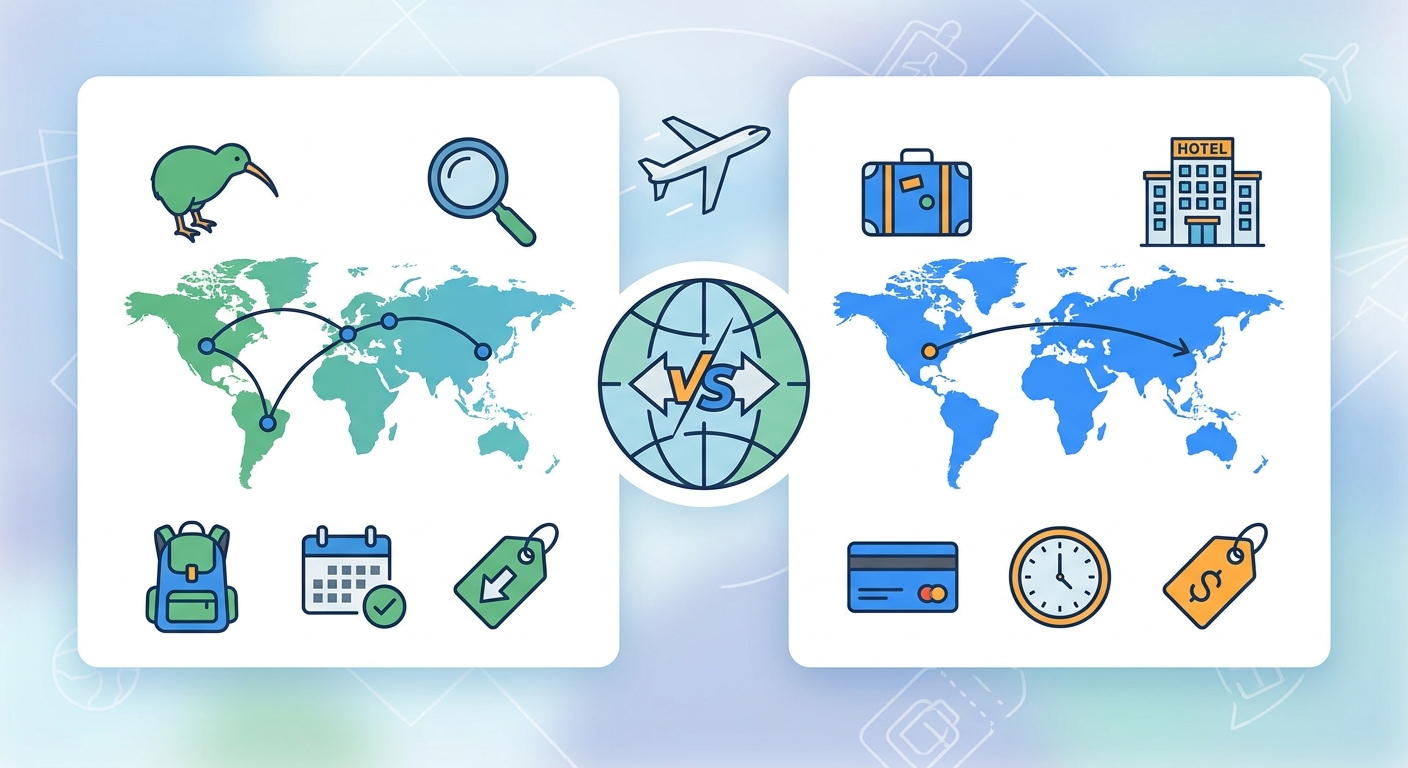
The single biggest difference between Kiwi.com and Trip.com lies in their fundamental approach to building flight itineraries. Kiwi.com's entire business is built on the concept of "virtual interlining" or self-transfers, while Trip.com operates as a more traditional Online Travel Agency (OTA), selling tickets on airlines that have official partnerships (interline or codeshare agreements).
Let's break this down. When you book a connecting flight on Trip.com, for example from Chicago to Rome via Munich on Lufthansa and its partner United, you are buying a single ticket. Your bags are checked through to your final destination, and if your first flight is delayed causing you to miss your connection, the airline is responsible for rebooking you on the next available flight at no extra cost. This is the standard, protected way of traveling. It's simple, secure, and what most travelers are accustomed to.
Kiwi.com turns this model on its head. It might find that the cheapest way to get from Chicago to Rome is by booking one ticket on a budget airline like Spirit to New York, and a completely separate ticket on a different budget carrier like Norse Atlantic from New York to Rome. This is "virtual interlining." To the airlines, you are not a connecting passenger. You are flying two separate, unrelated journeys. This means during your layover in New York, you must collect your checked luggage, exit the secure area, go to the check-in counter for the next airline, re-check your bags, and go through security again. This is a "self-transfer." The massive risk here is that if your Spirit flight is delayed, Norse Atlantic has no obligation to you. You've simply missed your flight and will likely have to buy a new, expensive last-minute ticket.
To mitigate this risk, Kiwi.com offers the "Kiwi.com Guarantee." For an additional fee, they promise to rebook you or offer a refund if you miss a connection due to a delay, cancellation, or schedule change. While this offers a layer of protection, it puts the responsibility on you to contact Kiwi.com's support during a stressful travel disruption, rather than dealing directly with the airline at the airport. In contrast, with a Trip.com booking, you would simply go to the airline's service desk. This fundamental difference in philosophy shapes the entire user experience and is the most critical factor to consider when choosing between them.
Design & User Experience Comparison
When it comes to a clean, intuitive, and polished user experience, Trip.com has a clear edge over Kiwi.com. Trip.com's website and mobile app are designed to feel comprehensive yet uncluttered, guiding the user smoothly through the booking process with minimal friction. It feels like a mature, well-funded tech product designed for a mass audience.
Trip.com's interface is bright, uses a standard layout that is immediately familiar, and presents flight options in a clear, easy-to-compare format. Filters are prominent and logical, allowing users to quickly narrow down choices by stops, airlines, duration, and more. The platform also seamlessly integrates its other offerings - hotels, trains, cars - making it a true one-stop-shop. This integration is a key part of its design philosophy; it wants to be the only travel app you need. For example, after booking a flight, you are immediately prompted with relevant hotel deals in your destination city, often with a bundled discount. This creates a cohesive and convenient user journey for someone planning a standard vacation.
Kiwi.com, on the other hand, has a design that reflects its function as a powerful search tool. The interface is more utilitarian and data-heavy, especially on the desktop version. The default search is a map-based interface that encourages exploration, asking you to click on destinations rather than just typing them in. This is fantastic for discovery - for instance, you can set your departure city as 'London' and your destination as 'Anywhere' to see a map populated with cheap fares across the globe. This design choice is brilliant for its target user: the flexible traveler looking for inspiration. However, for a user with a specific destination in mind, it can feel a bit clunky compared to Trip.com's straightforward search fields.
Furthermore, the presentation of results on Kiwi.com can be more complex. It clearly labels itineraries as 'Self-transfer' and highlights layover times, but the sheer number of options and the different service tiers (Basic, Standard, Flex) can be overwhelming for a novice user. While Trip.com prioritizes clarity and simplicity, Kiwi.com prioritizes displaying every possible option, leaving it up to the user to sift through the details. The mobile app for Kiwi.com is more streamlined than its website, but the core philosophy remains. Ultimately, Trip.com wins on pure aesthetic appeal and ease of use for standard bookings, while Kiwi.com's design is purpose-built for the power user who wants to explore every possible travel hack.

Performance Comparison: Finding the Cheapest Flights
In a head-to-head performance test for finding the absolute, rock-bottom cheapest international flight, Kiwi.com is the more powerful and consistently successful platform. Its ability to search across virtually all airlines, including low-cost carriers that other OTAs miss, and its unique virtual interlining algorithm give it a decisive advantage in uncovering outlier deals. This is the core reason for its existence and where it performs best.
Let's run a real-world simulation. Imagine searching for a one-way flight from a secondary European city like Prague (PRG) to a Southeast Asian hub like Ho Chi Minh City (SGN) in three months. A search on Trip.com would likely yield results from major carriers like Qatar Airways, Emirates, or Turkish Airlines, with a single, protected layover in their respective hubs (Doha, Dubai, Istanbul). The price might be a competitive $600. Trip.com's performance is fast and reliable, delivering these standard, vetted options within seconds.
Running the exact same search on Kiwi.com would paint a different picture. The initial results might include the same Qatar and Emirates flights, but buried further down, or revealed by sorting by 'Cheapest,' you might find a far more creative option. For example, a $450 fare that involves a Wizz Air flight from Prague to Abu Dhabi, a four-hour self-transfer layover, and then a separate ticket on IndiGo from Abu Dhabi to Ho Chi Minh City. This itinerary is $150 cheaper - a significant saving. Kiwi.com's performance isn't just about search speed (which is also very fast), but about the depth and creativity of its search. It's performing billions of calculations to find these non-obvious pairings.
However, performance isn't just about price; it's also about relevance and usability of the results. This is where Trip.com shines. Its results are cleaner and more predictable. It won't show you options with dangerously short self-transfer layovers or itineraries that land at one airport in a city and depart from another unless you specifically ask for it. Kiwi.com's algorithm can sometimes be too clever, presenting options that are technically the cheapest but practically unworkable for most travelers, like an overnight layover in a city that requires a transit visa. While Kiwi.com wins on raw price-finding power, Trip.com delivers a better-curated and more practical set of results for the average user, making its overall performance feel more refined and trustworthy.
Features Comparison: Travel Hacks vs. Comprehensive Service
Kiwi.com's feature set is built around creative travel hacking, while Trip.com focuses on providing a comprehensive, secure, and rewarding booking service. This is perhaps the area where the two platforms diverge the most, catering to completely different traveler mentalities. Kiwi.com is the specialist tool for the job, whereas Trip.com is the versatile and reliable multi-tool.
Kiwi.com's standout features are revolutionary for flexible travelers:
- Nomad: This is Kiwi.com's killer app. A user can input a list of cities they want to visit and a timeframe, and Nomad will calculate the cheapest possible order and combination of flights to link them all together. This is a monumentally complex calculation that is impossible to do manually and can save thousands of dollars on a multi-destination trip.
- Radius Search: Instead of searching from a specific airport, you can search from a city and tell Kiwi.com to include all airports within a certain radius. This can uncover huge savings if you're willing to travel an hour or two to a less popular airport.
- Self-Transfer and Hidden City Itineraries: As discussed, this is the core of their model. They also occasionally offer "hidden city" tickets (where you get off at a layover city instead of the final destination), which is an advanced and risky travel hack.
Trip.com's features, in contrast, are designed to build trust and provide value within a more traditional framework:
- Price Freeze: For a small fee, users can lock in a flight price for a set period. If the price goes up, Trip.com covers the difference; if it goes down, you pay the lower price. This is an excellent feature for those who need a day or two to confirm plans without risking a fare hike.
- PointsPLUS and Trip Coins: Trip.com has a robust loyalty program. Users earn Trip Coins on bookings which can be used to get instant discounts on future flights and hotels. This encourages platform loyalty and provides tangible long-term value.
- Flight + Hotel Bundles: The platform excels at offering discounts when you book your flight and accommodation together. This seamless integration provides both convenience and cost savings.
- 24/7 Customer Support: Easily accessible, multi-lingual customer support is a core feature, offering a safety net that Kiwi.com only provides at a premium tier.
| Feature | Kiwi.com | Trip.com | Winner |
|---|---|---|---|
| Multi-City Search | Nomad tool finds cheapest order of destinations (Unbeatable) | Standard A-B-C multi-city search | Kiwi.com |
| Price Protection | No price freeze feature | Price Freeze allows locking in fares for a small fee | Trip.com |
| Loyalty Program | No integrated loyalty program | Trip Coins offer tangible discounts on future bookings | Trip.com |
| Customer Support | Tiered support model; basic is limited, premium costs extra | Comprehensive 24/7 support included with all bookings | Trip.com |
| Flexibility Tools | Radius search, flexible date ranges, 'Anywhere' search | Standard +/- 3 day flexible date search | Kiwi.com |

Pricing & Value for Money
While Kiwi.com often displays the lowest initial price, Trip.com frequently offers better overall value for money once all factors and potential costs are considered. This distinction is crucial; the advertised price is not always the final price, especially on Kiwi.com, and the cheapest ticket is not always the best value.
Kiwi.com's pricing strategy is a classic example of unbundling. They lure you in with an incredibly low base fare that often doesn't include a checked bag, seat selection, or even priority customer support. These are then offered as add-ons during the checkout process. For example, you'll be presented with service tiers: a 'Basic' ticket with no frills and the riskiest self-transfer connection, a 'Standard' ticket that adds the Kiwi.com Guarantee, and a 'Flex' ticket that allows for changes. By the time you add the Guarantee - which is highly recommended for any self-transfer itinerary - and a checked bag, the price can creep up to be very close to, or even exceed, the price of a standard, protected ticket on Trip.com.
Trip.com's pricing is more transparent and all-inclusive. The price you see in the search results is generally much closer to the final price you'll pay. While they also have ancillary charges for things like extra baggage, the core product you're buying is a standard airline ticket with all the protections that entails. The value proposition of Trip.com also includes their loyalty program. Earning Trip Coins on every booking provides a real, calculable discount on future travel, enhancing the long-term value for frequent users. A $700 flight on Trip.com that earns you $10 in Trip Coins and includes robust support is arguably better value than a $680 flight on Kiwi.com with a risky connection and no support.
Let's consider the value of your time and potential stress. If a self-transfer connection on a Kiwi.com booking goes wrong, the value of the Kiwi.com Guarantee is tested. You may have to spend hours on the phone, potentially in a foreign airport, to get rebooked. The potential savings of $50 might not seem worth it in that moment. With a Trip.com booking, a similar issue would be handled directly by the airline staff at the airport, a much more efficient process. Therefore, Trip.com's value comes from its predictability and peace of mind, while Kiwi.com's value is purely in the potential for a significantly lower upfront cost, provided everything goes exactly as planned.
Find Your Next Cheap Flight on Kiwi.com Book Your Reliable Trip on Trip.comPros and Cons: A Detailed Breakdown
Choosing between these two platforms requires a clear understanding of their respective strengths and weaknesses. Here's a detailed look at the pros and cons of each, moving beyond the summary table to provide deeper context.
Kiwi.com: The Innovator
Pros:
- Unbeatable Low Prices: Its primary strength. The virtual interlining algorithm is second to none at finding the absolute cheapest combination of flights, often saving hundreds of dollars on long-haul international routes.
- Powerful Flexible Search Tools: Features like Nomad, radius search, and the 'Anywhere' destination option are game-changers for travelers with flexible plans, making it an incredible tool for discovery and budget-optimization.
- Inclusion of Low-Cost Carriers: Kiwi.com's search net is incredibly wide, including budget airlines that are often excluded from major OTAs. This is key to how it builds its ultra-cheap itineraries.
Cons:
- Risk of Self-Transfers: This is the single biggest drawback. Missed connections on separate tickets can lead to catastrophic travel disruptions and significant unexpected costs if you haven't purchased their top-tier guarantee. The process of re-checking bags and clearing security multiple times is also a major hassle.
- Complicated Customer Service: The support model is tiered. Basic support can be slow and unhelpful. You are dealing with Kiwi.com as a middleman, not the airline, which adds a layer of complexity during stressful situations.
- Ancillary Fees Add Up: The attractive base price can be misleading. The cost of adding the Kiwi.com Guarantee, checked baggage, and other essentials can significantly inflate the final price.
Trip.com: The Reliable All-Rounder
Pros:
- Reliability and Peace of Mind: Bookings are for standard, protected itineraries on partner airlines. This eliminates the risk of self-transfer nightmares and ensures the airline is responsible for rebooking in case of disruptions.
- Excellent User Experience: The website and app are exceptionally well-designed, intuitive, and fast. The entire booking process is seamless and straightforward, making it ideal for all levels of tech-savviness.
- Strong Customer Support: Trip.com is known for its accessible and generally helpful 24/7 customer service. Having a reliable support line is a huge advantage when travel plans go awry.
- Value-Added Features: The loyalty program (Trip Coins) and Price Freeze feature provide tangible value that goes beyond just the ticket price.
Cons:
- Prices Are Not Always the Absolute Lowest: While very competitive, Trip.com can't always match the rock-bottom fares found by Kiwi.com's hacking methods, as it's limited to selling official airline tickets.
- Fewer 'Creative' Itinerary Options: For travelers looking to build complex, unconventional trips, Trip.com's standard search functions can feel restrictive compared to Kiwi.com's powerful tools.
- Focus on Asian Market: While a global powerhouse, its roots are in China, and sometimes the best deals and hotel integrations are found within the Asian market, though its global inventory is still massive.

Which is Best for Beginners?
For beginners or any traveler who feels overwhelmed by the complexities of flight booking, Trip.com is unequivocally the better and safer choice. The entire platform is designed around simplicity, clarity, and security, which are the most important factors for someone new to booking their own travel. A first-time international traveler has enough to worry about - from passports and visas to packing lists - without adding the stress of a potential self-transfer mishap.
The booking process on Trip.com mirrors what one would expect from a top-tier e-commerce site. The steps are logical, the information is presented clearly, and there are fewer 'gotcha' moments during checkout. When a beginner sees a flight from New York to Paris on Trip.com, they can be confident it's a single, protected ticket. The concept of having your bags checked through to the final destination and being taken care of by the airline during a delay is the standard they should expect, and Trip.com delivers this reliably.
Furthermore, the accessibility of customer support is a critical safety net for beginners. If they need to clarify a baggage allowance, ask about a schedule change, or need assistance with a cancellation, having an easily reachable 24/7 support team via phone or chat is invaluable. This builds confidence and makes the entire experience less intimidating.
In contrast, using Kiwi.com as a beginner could be a recipe for disaster. A novice traveler might not fully grasp the implications of a 'self-transfer' itinerary. They might see the cheap price and book it, only to realize at the airport that their 75-minute layover is impossible when they have to collect and re-check luggage. They might not understand the necessity of purchasing the Kiwi.com Guarantee, leaving them completely unprotected. While a seasoned travel hacker knows how to navigate these risks, a beginner is likely to be caught off guard. Therefore, the predictability and security offered by Trip.com make it the responsible recommendation for anyone who isn't a highly experienced and risk-tolerant flyer.
Use-Case Segmentation: Who Should Choose Kiwi.com vs. Trip.com?
The best way to make a final decision is to identify which traveler profile you fit into. The right platform for a solo backpacker is the wrong one for a family of four. Here's a breakdown of specific use cases and the clear winner for each.
The Budget Backpacker / Digital Nomad
Winner: Kiwi.com This is Kiwi.com's core audience. A backpacker planning a multi-month trip through South America or a digital nomad looking for the cheapest one-way ticket to a new base is primarily driven by price and flexibility. They often travel with just a carry-on, negating the baggage re-check issue. Their schedules are fluid, so a long layover can be a bonus opportunity to explore another city. For this user, Kiwi.com's Nomad and 'Anywhere' search features are not just helpful; they are essential planning tools that can fundamentally shape their journey and save them a fortune. The risk of self-transfer is a calculated one they are willing to take for the immense savings.
The Family on Vacation
Winner: Trip.com For a family traveling with children, reliability and simplicity are paramount. The last thing parents need is to be running through an airport with kids in tow to re-check four suitcases during a short self-transfer layover. The potential for a missed connection is a non-starter. Trip.com provides the peace of mind of a single, protected ticket. The user-friendly interface makes it easy to book for multiple passengers, and the ability to bundle flights with a family-friendly hotel for a discount adds significant value. Dependable customer support is the final, crucial piece that makes Trip.com the only logical choice for family travel.
The Business Traveler
Winner: Trip.com Business travel operates on strict schedules. A missed connection isn't an inconvenience; it's a missed meeting and a potential financial loss. Business travelers need efficiency, reliability, and excellent support. Trip.com delivers this with its easy-to-use platform and standard protected tickets. Furthermore, features for managing invoices and a loyalty program that rewards frequent travel are tailored to the needs of corporate travelers or their travel managers. Kiwi.com's model is simply too risky and unpredictable for a trip where time is money.
The Last-Minute Getaway Planner
Winner: It's a Tie (with a slight edge to Kiwi.com) This is an interesting case. For a spontaneous weekend trip, both platforms have merits. Trip.com can quickly provide reliable, standard options. However, if the traveler is truly flexible ('I just want to go somewhere warm and cheap this weekend'), Kiwi.com's map-based 'Anywhere' search is unparalleled for finding surprising last-minute deals to unexpected destinations. If the last-minute trip is for a specific event like a wedding, Trip.com's reliability wins. If it's pure wanderlust, Kiwi.com's discovery tools give it the edge.
| Traveler Profile | Primary Need | Recommended Platform | Reasoning |
|---|---|---|---|
| Backpacker | Lowest Cost & Flexibility | Kiwi.com | Nomad tool and virtual interlining provide unmatched savings. |
| Family | Reliability & Simplicity | Trip.com | Protected connections and strong support eliminate travel stress. |
| Business Traveler | Punctuality & Support | Trip.com | Self-transfer risks are unacceptable for time-sensitive travel. |
| Inexperienced Traveler | Ease of Use & Safety | Trip.com | Intuitive interface and clear process prevent costly mistakes. |
Alternatives to Kiwi.com and Trip.com
While Kiwi.com and Trip.com are formidable competitors, they aren't the only options available. No single search engine is perfect, and savvy travelers should always compare prices across multiple platforms before booking. Here are a few key alternatives and where they fit in.
Google Flights: The Benchmark Tool. Google Flights is not an OTA; it's a powerful meta-search engine that lets you compare prices across hundreds of airlines and OTAs (including sometimes Trip.com, but rarely Kiwi.com). Its main strength is its incredible speed and data visualization. The calendar view, which shows prices for an entire month, and the map explorer are fantastic for flexible searches. Most experienced travelers start their search on Google Flights to find out which airlines fly a route and what a 'good' price looks like. You don't book on Google; it sends you to the airline or OTA to complete the purchase. It's an essential research tool, but it won't uncover the virtual interlining hacks of Kiwi.com.
Skyscanner: The Hybrid Competitor. Skyscanner operates similarly to Google Flights as a meta-search engine, but it has a broader reach, often including more budget carriers and smaller OTAs in its results. It's one of the most popular flight search tools in the world for good reason. Like Kiwi.com, it has an 'Everywhere' search feature for inspiration. Like Trip.com, it presents results in a clear and easy-to-understand way. Skyscanner is an excellent middle ground and a great place to get a second opinion on the prices you've found on other sites. It sometimes finds Kiwi.com's self-transfer fares and displays them alongside standard tickets, making it a good aggregator of different travel styles.
Momondo: The Price Comparison Specialist. Owned by the same parent company as Kayak, Momondo excels at digging deep to find the lowest prices from a vast array of online travel agencies. Its interface is clean, and its price trend data can be very helpful for deciding when to book. It often uncovers prices from smaller, lesser-known OTAs that might offer a slightly better deal than the major players. When you are confident in your dates and destination and are solely focused on shaving off the last few dollars from a standard itinerary, it's always worth running a final check on Momondo. The key is to use these tools in combination: start broad with Google Flights or Skyscanner, then check the specialists like Kiwi.com for hacks or Trip.com for reliable booking before making a final decision.
Final Verdict: Your Ultimate Guide to Choosing
After a deep dive into every facet of Kiwi.com and Trip.com, the verdict is clear: there is no single 'best' platform, only the 'best' platform for your specific needs. The choice hinges on a fundamental trade-off: are you willing to exchange security and convenience for potentially significant cost savings?
Trip.com emerges as the superior choice for the vast majority of travelers. If you are planning a family vacation, a business trip, or any journey with a fixed schedule, the value of a protected, single-ticket itinerary cannot be overstated. Trip.com's polished user interface, transparent pricing, valuable loyalty program, and, most importantly, reliable 24/7 customer support create a stress-free booking experience from start to finish. The small premium you might occasionally pay over a Kiwi.com fare is an insurance policy against the chaos of a missed self-transfer connection. For peace of mind and predictability, Trip.com is the clear winner.
Kiwi.com, however, remains an indispensable tool for a specific and passionate segment of the travel community. For the flexible backpacker, the long-term nomad, or the adventurous soul who gets a thrill from gaming the system, Kiwi.com's technology is nothing short of magical. Its ability to find and assemble itineraries that no other search engine can conceive of is its unique selling proposition. Features like Nomad can save travelers literally thousands of dollars on complex multi-city trips. If you understand and are comfortable with the inherent risks of virtual interlining, and you see travel disruptions as part of the adventure, then the cost-saving power of Kiwi.com is unmatched.
To make your final decision, ask yourself this: What is the worst-case scenario I am willing to tolerate? If the answer is 'a bit of a delay, handled by the airline,' then choose Trip.com. If your answer is 'I'm okay with the small chance of having to rebook a flight myself in a foreign airport if it saves me $200 upfront,' then Kiwi.com is the platform for you. Use the tool that aligns with your travel style, risk tolerance, and budget, and you'll be well on your way to your next adventure.
Frequently Asked Questions
The Kiwi.com Guarantee is a form of trip protection for its self-transfer itineraries, but its reliability can be mixed. It's not airline-provided protection. If a flight is delayed and you miss your connection, you must contact Kiwi.com's support, not the airline. Many users report success in getting rebooked or refunded, but others have experienced long wait times and difficulties, especially with basic support. For the guarantee to be most effective, it's crucial to purchase their higher-tier service and to contact them immediately when a disruption occurs. It's a workable safety net, but not as seamless as traditional airline protection.
No, Trip.com is generally known for its transparent pricing and does not have 'hidden fees' in the traditional sense. The price displayed in the search results is usually very close to the final price you will pay. Like all travel agencies, they will offer optional add-ons during checkout, such as upgraded seats, extra baggage, or travel insurance. However, these are clearly marked as optional purchases and are not required to complete the booking. Their model is much more straightforward compared to platforms that unbundle every service, making the final cost more predictable.
Kiwi.com is vastly superior for complex multi-city flights, specifically for flexible travelers. Its unique 'Nomad' feature automatically calculates the cheapest order to visit a list of cities, a task that is nearly impossible to do manually and can save hundreds of dollars. Trip.com has a standard multi-city function where you input your destinations in a fixed order (A to B, B to C, etc.), which is fine for simple open-jaw or pre-planned trips but lacks the optimization power of Kiwi.com's algorithm. For pure cost-saving on a multi-destination adventure, Kiwi.com is the clear winner.
Yes, you can trust Kiwi.com to book the tickets you purchase; it is a legitimate and large company. The issue of trust is more about understanding their business model. You are trusting them to issue separate tickets and trusting their 'Kiwi.com Guarantee' (if purchased) to assist you during disruptions. The process is less direct than booking with an airline or a traditional OTA like Trip.com. For savvy travelers who understand the risks of self-transfers and have a flexible schedule, Kiwi.com is a trustworthy tool to save money. For those who want traditional protections, it may feel less secure.
Trip.com's customer service is generally considered to be one of its strong points and is typically helpful for flight changes and issues. They offer 24/7 support through multiple channels, including phone and chat. However, it's important to remember that all OTAs, including Trip.com, are bound by the rules and policies of the airline that issued the ticket. If you purchased a non-refundable, non-changeable basic economy ticket, even the best customer service agent may have limited options. For flexible tickets, their agents are known to be effective at facilitating changes and communicating with the airline on your behalf.
Kiwi.com finds exceptionally cheap flights primarily through a technology called 'virtual interlining.' Instead of only showing flights from airlines that have partnership agreements, their algorithm scans billions of combinations of flights on completely separate, non-partner airlines (especially low-cost carriers). It then 'stitches' these separate tickets together into a single itinerary. This creates routes that other search engines cannot see, often resulting in dramatically lower prices. The trade-off is that these are 'self-transfer' connections, which carry more risk for the traveler.