
Kiwi vs Expedia: Which Is Better for Booking Flights?
Kiwi
Kiwi is best for adventurous, budget-savvy travelers comfortable with managing complex itineraries. Its virtual interlining finds unique, low-cost routes, but requires careful attention to self-transfer risks and potentially challenging support for disruptions.
View DealOverall Score
Top Picks
Kiwi
Kiwi is best for adventurous, budget-savvy travelers comfortable with managing complex itineraries. Its virtual interlining finds unique, low-cost routes, but requires careful attention to self-transfer risks and potentially challenging support for disruptions.
Expedia
Expedia is best for mainstream travelers seeking reliability, convenience, and package deals. It offers a more traditional, lower-risk booking experience with clearer policies and more accessible support for standard flights and bundled trips.
Comparison
Price & Value
Transparency & Fees
Search & Booking Experience
Flight Inventory & Coverage
Flexibility, Changes & Cancellation
Refunds & Disruption Support
Introduction: Navigating Flight Bookings with Kiwi and Expedia in 2026
In the dynamic world of online travel, choosing the right platform for booking flights can significantly impact your trip's cost, convenience, and peace of mind. For travelers in 2026, two prominent names often emerge in the flight booking arena: Kiwi and Expedia. Both platforms promise access to a vast array of flight options, competitive pricing, and user-friendly interfaces, yet they operate with distinct philosophies and cater to different traveler needs. This comprehensive comparison aims to cut through the marketing claims and provide a data-driven, editorial-quality analysis of Kiwi versus Expedia, specifically focusing on which platform is better for booking flights.
This article is designed for buyers researching a purchase in the Travel & Booking niche - whether you are a budget-conscious backpacker, a family planning a vacation, or a business traveler seeking efficiency. We will delve into their core functionalities, pricing structures, flexibility options, customer support mechanisms, and overall traveler risk profiles. By the end of this expert review, you will have a clear understanding of each platform's strengths and weaknesses, enabling you to make a confident buying decision tailored to your specific travel requirements in 2026. Our goal is to empower you to select the platform that best aligns with your priorities, ensuring a smoother and more enjoyable journey from booking to destination.
Comparison Table: Kiwi vs Expedia for Flight Bookings
| Feature | Kiwi | Expedia |
|---|---|---|
| Best For | Complex, multi-carrier, and budget-optimized itineraries; self-transfer routes. | Standard direct flights, flight + hotel packages, loyalty program benefits. |
| Price Range | Often finds the absolute lowest prices, especially for complex routes. | Competitive, especially when bundled with hotels; good for standard routes. |
| Key Strength | Virtual Interlining technology for unique, cheaper flight combinations. | Comprehensive travel ecosystem, strong package deals, established brand trust. |
| Key Weakness | Higher risk with self-transfer bookings; customer support can be challenging. | Less flexibility for highly customized, complex, or budget-extreme itineraries. |
| Price & Value Rating | 9.0/10 | 8.2/10 |
| Transparency & Fees Rating | 7.5/10 | 8.0/10 |
| Search & Booking Experience Rating | 8.8/10 | 8.5/10 |
| Flight Inventory & Coverage Rating | 9.2/10 | 8.7/10 |
| Flexibility, Changes & Cancellation Rating | 7.0/10 | 7.8/10 |
| Refunds & Disruption Support Rating | 6.8/10 | 7.5/10 |
| Overall Rating | 8.1/10 | 8.0/10 |
| CTA | Compare Flight Deals on Kiwi | Find Flights on Expedia |
Quick Verdict: Kiwi vs Expedia for Flight Bookings
For most travelers prioritizing the absolute lowest price and willing to manage potential complexities, Kiwi edges out Expedia, especially for intricate, multi-carrier itineraries in 2026. Its unique virtual interlining technology can unearth flight combinations that other platforms simply don't offer, leading to significant savings. However, this often comes with increased risk and a greater reliance on the traveler to understand self-transfer policies.
Choose Kiwi if your primary goal is to find the cheapest possible flight, particularly for complex or international routes that might involve combining different airlines. Be prepared, however, for potentially more challenging customer support interactions if disruptions occur, and ensure you understand the implications of self-transfer bookings.
Choose Expedia if you prefer a more traditional, lower-risk booking experience, especially for standard direct flights or when bundling flights with hotels or other travel components. Expedia offers a robust, well-established platform with generally more straightforward policies and a stronger emphasis on comprehensive customer support, though its prices might not always be the absolute lowest for highly optimized routes.
Choose neither if you require maximum flexibility with guaranteed refunds for any reason, or if you prefer to book directly with an airline for simple, single-carrier itineraries to leverage loyalty programs and direct support. In such cases, a specialized travel agent or direct airline booking might be a safer choice for peace of mind.
Short Answer: Which Is Better for Booking Flights in 2026?
For booking flights in 2026, Kiwi is generally better for budget-conscious travelers seeking the absolute lowest prices on complex, multi-carrier itineraries, thanks to its innovative virtual interlining. Conversely, Expedia is the stronger choice for those prioritizing a more traditional, lower-risk booking experience, especially for standard direct flights or when bundling travel components, offering greater reliability and more accessible support for common travel scenarios. The best platform depends heavily on your tolerance for risk versus your desire for maximum savings and itinerary customization.
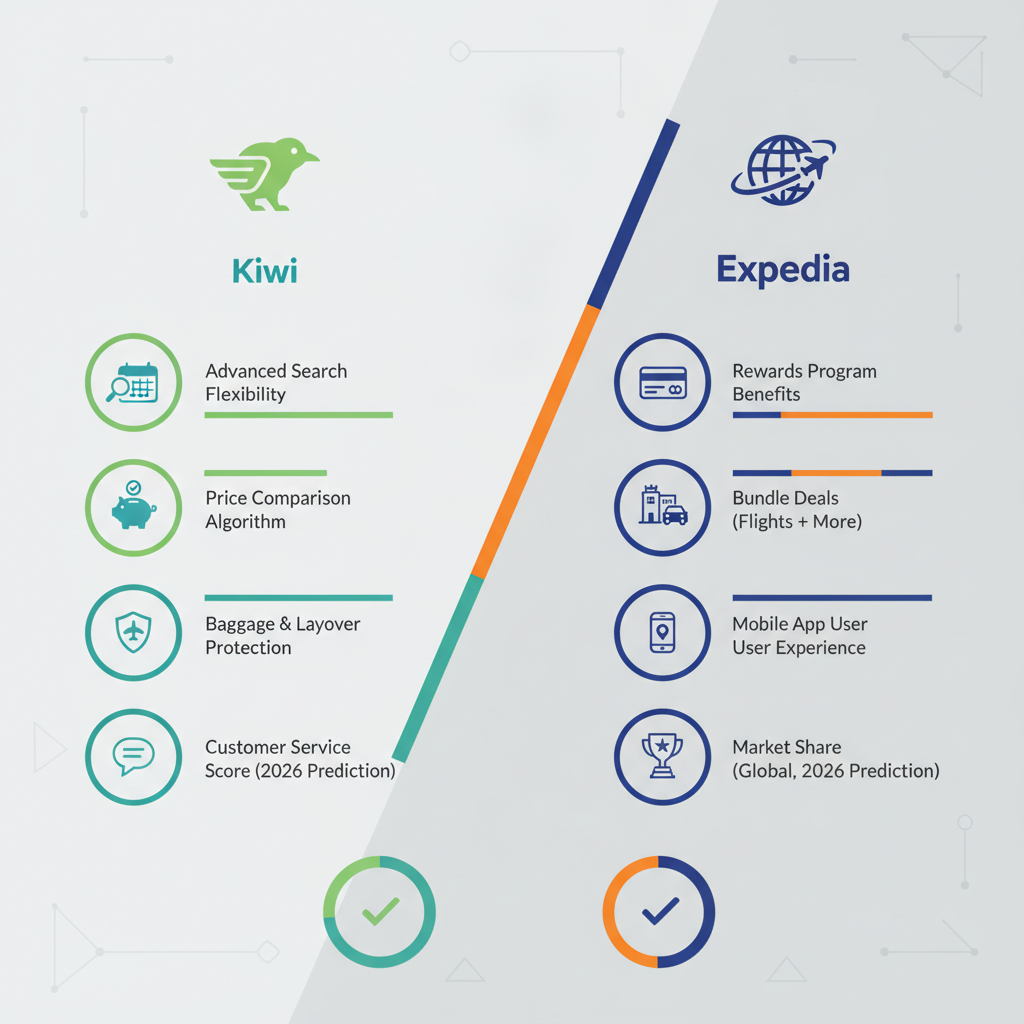
Rating Summary: Kiwi
| Dimension | Score | Notes |
|---|---|---|
| Price & Value | 9.0/10 | Often finds the lowest prices due to virtual interlining, but total value depends on hidden costs. |
| Transparency & Fees | 7.5/10 | Fees are disclosed, but self-transfer risks and baggage costs require careful attention. |
| Search & Booking Experience | 8.8/10 | Excellent search flexibility for multi-city and self-transfer routes; intuitive interface. |
| Flight Inventory & Coverage | 9.2/10 | Unparalleled breadth, combining major airlines with low-cost carriers for unique routes. |
| Flexibility, Changes & Cancellation | 7.0/10 | Generally less flexible for changes and cancellations, especially with virtual interlining. |
| Refunds & Disruption Support | 6.8/10 | Can be challenging due to complex itineraries and reliance on multiple suppliers. |
| Overall Rating | 8.1/10 | Best for: adventurous, budget-savvy travelers comfortable with managing complex itineraries. |
Rating Summary: Expedia
| Dimension | Score | Notes |
|---|---|---|
| Price & Value | 8.2/10 | Competitive, especially for packages, but less aggressive on unique low-cost combinations. |
| Transparency & Fees | 8.0/10 | Clearer breakdown of standard fees and add-ons, less hidden complexity than self-transfers. |
| Search & Booking Experience | 8.5/10 | User-friendly and straightforward for standard bookings; good for packages. |
| Flight Inventory & Coverage | 8.7/10 | Excellent coverage of major airlines and direct routes, but lacks virtual interlining. |
| Flexibility, Changes & Cancellation | 7.8/10 | Policies generally align with airline rules, with some flexible options available. |
| Refunds & Disruption Support | 7.5/10 | More established support channels for standard disruptions, though still reliant on airlines. |
| Overall Rating | 8.0/10 | Best for: mainstream travelers seeking reliability, convenience, and package deals. |
Where Kiwi wins: Kiwi consistently outperforms Expedia in unearthing the absolute lowest prices, particularly for complex, multi-stop, or multi-carrier itineraries. Its unique virtual interlining technology is a game-changer for budget travelers, allowing for creative flight combinations that traditional OTAs often miss. This directly impacts the Price & Value and Flight Inventory & Coverage scores, where Kiwi excels by offering options that simply aren't available elsewhere.
Where Expedia wins: Expedia shines in its straightforwardness, reliability, and comprehensive travel ecosystem. For standard direct flights, flight + hotel packages, and a generally more predictable booking experience, Expedia offers superior Transparency & Fees and more robust Customer Support & Reliability, leading to a less stressful journey for most mainstream travelers. Its established brand reputation also contributes to a higher sense of trust.
Where the decision depends on user preference: The choice between Kiwi and Expedia largely hinges on a traveler's comfort level with risk and complexity versus their desire for extreme cost savings. If you prioritize maximum savings and are comfortable navigating potential self-transfer challenges, Kiwi is your pick. If you value simplicity, comprehensive support, and the convenience of bundling, Expedia is likely a better fit. The Search & Booking Experience is strong for both but optimized for different priorities - Kiwi for discovery, Expedia for ease of transaction.
For flight bookings, the most crucial scoring category often comes down to Price & Value, especially for budget-conscious travelers. However, Refunds & Disruption Support runs a close second, as the true cost of a cheap flight can skyrocket if something goes wrong and support is inadequate. This is where the trade-offs between these two platforms become most apparent.
Which Is Better: Kiwi or Expedia?
When evaluating Kiwi versus Expedia for flight bookings in 2026, there isn't a single 'better' option; instead, the superior choice is dictated by the traveler's priorities and risk tolerance. For the vast majority of travelers seeking a balanced approach to price and convenience, Expedia often emerges as the safer, more traditional overall winner. It provides a reliable booking experience, generally clearer policies, and a more established customer support infrastructure, which is crucial when dealing with the inherent uncertainties of air travel. Expedia's strength in bundling flights with other travel components also offers significant value and simplicity for those planning comprehensive trips.
However, for advanced users or budget buyers who are willing to navigate more complex itineraries and potential risks, Kiwi is undeniably better for finding the absolute lowest prices. Its innovative virtual interlining technology, which combines flights from otherwise unassociated airlines, can unlock incredibly cheap routes that no other platform offers. This makes Kiwi the best choice for those whose primary goal is to minimize travel costs, even if it means accepting a higher degree of self-reliance and potential challenges during disruptions. For long-term travel planning that prioritizes cost-efficiency above all else, Kiwi's unique algorithms are a powerful tool. The decision ultimately boils down to whether you prioritize rock-bottom prices and itinerary flexibility (Kiwi) or a more predictable, supported, and integrated booking experience (Expedia).
Key Differences Between Kiwi and Expedia
The fundamental differences between Kiwi and Expedia stem from their core business models and technological approaches, particularly in how they source and combine flight inventory. These distinctions directly impact pricing, flexibility, and the overall traveler experience.
Key Differences Breakdown: Kiwi vs Expedia
| Feature Category | Kiwi | Expedia |
|---|---|---|
| Core Business Model | Online Travel Agency (OTA) with a focus on 'virtual interlining' (combining separate tickets). | Traditional Online Travel Agency (OTA) with direct airline partnerships and package deals. |
| Flight Sourcing | Aggregates flights from 750+ airlines (including low-cost carriers) and other OTAs; creates unique connections. | Direct partnerships with major airlines, GDS systems; strong focus on published routes. |
| Pricing Strategy | Optimizes for the absolute lowest price by creating virtual interlining routes; often cheaper but with more complex terms. | Competitive pricing for standard routes and packages; less emphasis on creating 'new' routes. |
| Risk Profile for Flights | Higher risk due to self-transfer bookings (separate tickets); traveler is responsible for missed connections. | Lower risk for direct flights; rebooking responsibility generally with the airline or Expedia for packages. |
| Flexibility & Changes | Often more rigid; changes/cancellations can be complex due to multiple, unlinked tickets. | Generally aligns with airline policies; some flexibility for refundable fares and package changes. |
| Customer Support Focus | Support for complex itineraries can be challenging; optional 'Kiwi.com Guarantee' offers some protection. | More robust and multi-channel support for standard issues; better for package resolution. |
| Package Deals | Limited package options; focuses almost exclusively on flights. | Strong emphasis on flight + hotel, flight + car, and all-inclusive packages. |
| Loyalty Program | No direct loyalty program; focuses on price savings. | One Key Rewards program allows earning and redeeming points across flights, hotels, cars, and activities. |
| Where to Buy | View Deal |
Kiwi's core innovation lies in its virtual interlining. This technology allows it to combine flights from airlines that do not have interline agreements, issuing separate tickets for each leg of a journey. While this can result in significantly lower prices, it transfers the risk of missed connections (e.g., due to delays on the first flight) directly to the traveler, unless they purchase Kiwi's additional guarantee. This is a fundamental philosophical difference from Expedia, which primarily sells tickets as an authorized agent for airlines, meaning your booking is typically a single contract with the airline or a package contract through Expedia.
Expedia, as part of the Expedia Group, leverages its extensive network of direct partnerships with airlines, hotels, and car rental companies. Its strength lies in providing a comprehensive travel planning solution, often with attractive discounts when bundling services. This makes Expedia a more straightforward choice for travelers seeking conventional itineraries and the convenience of managing multiple bookings through a single, well-established platform. The contrast in their approaches to flight sourcing and risk management is the most critical differentiator for travelers in 2026.

User Experience: Search, Interface, and Booking Flow
The user experience (UX) on a flight booking platform is crucial, influencing how quickly and confidently a traveler can find and secure their desired itinerary. Both Kiwi and Expedia offer distinct interfaces and booking flows tailored to their respective strengths. Kiwi excels in its advanced search capabilities for complex itineraries, while Expedia provides a more streamlined, intuitive experience for traditional bookings.
Kiwi's interface is designed for discovery and flexibility. Its search engine is incredibly powerful, allowing users to search for flights to 'Anywhere' or within a 'Radius,' and to specify flexible dates, multi-city routes, and even 'Nomad' trips that optimize for the cheapest way to visit multiple destinations. The visual representation of routes, especially with its virtual interlining, can be highly informative for experienced travelers. However, this complexity can sometimes feel overwhelming for first-time users or those simply looking for a direct round-trip flight. The checkout process on Kiwi is generally clear, but travelers must pay close attention to the details of each flight segment, baggage allowances, and the implications of self-transfer bookings, as these are often presented with necessary disclaimers.
Expedia, conversely, offers a more conventional and universally accessible search experience. Its interface is clean, well-organized, and prioritizes ease of use for standard flight searches, including round-trip, one-way, and multi-city options. The filters are robust, allowing users to refine results by airline, stops, departure/arrival times, and price. Expedia's strength lies in its ability to integrate flight search seamlessly with hotel and car rental options, making it a one-stop shop for comprehensive travel planning. The booking flow is straightforward, with clear steps for passenger details, seat selection, and payment. While Expedia does present upsells for travel insurance, car rentals, or hotels, these are generally less intrusive than the detailed policy warnings required on Kiwi for self-transfer risks.
For mobile usability, both platforms offer dedicated apps and responsive websites. Kiwi's app is particularly strong for managing complex itineraries on the go, with real-time updates for its virtual interlining routes. Expedia's app provides a solid experience for managing standard bookings, accessing loyalty benefits, and viewing itinerary details. Ultimately, the 'better' user experience depends on whether you value Kiwi's powerful, flexible search for unique deals or Expedia's more traditional, integrated, and lower-risk booking journey.
Pricing, Fees, and Total Cost
Understanding the true cost of a flight involves more than just the advertised base price; it requires a deep dive into taxes, service fees, baggage charges, and potential hidden costs. In 2026, both Kiwi and Expedia employ different pricing strategies that can significantly impact the final total.
Pricing and Value Comparison: Kiwi vs Expedia
| Cost Factor | Kiwi | Expedia |
|---|---|---|
| Base Price Competitiveness | Often lowest, especially for complex, multi-carrier routes due to virtual interlining. | Competitive for standard direct flights and package deals; may not find extreme low-cost combinations. |
| Service Fees | May include a booking service fee, especially for complex itineraries or add-ons like the Kiwi.com Guarantee. | Generally transparent service fees, often included in the displayed price or clearly itemized. |
| Taxes & Government Fees | Clearly displayed at checkout, consistent with industry standards. | Clearly displayed at checkout, consistent with industry standards. |
| Baggage Fees | Crucial to check per flight segment, as virtual interlining often means separate baggage rules for each carrier. Not always included. | Generally follows airline rules; options to add baggage often available at checkout or post-booking. |
| Payment Processing Fees | May apply depending on payment method and currency; transparently shown. | Typically minimal or none for standard credit card payments; transparently shown if applicable. |
| Hidden Cost Risk | Higher risk, primarily from unexpected baggage recheck fees, missed connection costs (if no guarantee), or visa issues for layovers. | Lower risk for direct flights; hidden costs are rare beyond standard airline extras or resort fees (if bundled). |
| Value for Money | Excellent for those prioritizing absolute lowest base fare and comfortable with managing risks. | Good for those valuing convenience, reliability, and package savings over extreme price optimization. |
| Where to Buy | View Deal |
Kiwi's strength lies in its ability to find incredibly low base fares, often by piecing together routes from different low-cost carriers. This can result in significant savings, particularly for international and multi-city trips. However, the 'hidden cost risk' with Kiwi is notably higher. Travelers must be diligent in checking individual baggage allowances for each flight segment, as these are typically not standardized across different airlines in a virtual interlining itinerary. Furthermore, if you opt out of the 'Kiwi.com Guarantee,' any missed connections due to delays are entirely your financial responsibility, which can quickly negate initial savings. Currency conversion fees might also apply depending on your payment method and the booking currency.
Expedia, on the other hand, offers more straightforward pricing. While its base fares might not always be the absolute lowest for highly fragmented routes, they are generally competitive for direct flights and become particularly attractive when bundled with hotels or car rentals. Expedia's transparency around standard airline baggage fees and taxes is commendable, typically showing these clearly at checkout. The risk of unexpected charges is lower, as you're generally dealing with a single airline contract (or a package contract with Expedia) where policies are more consistent. Payment processing fees are rare, and its loyalty program, One Key Rewards, can offer additional value over time.
For travelers in 2026, the decision on pricing and value comes down to a careful calculation of risk versus reward. Kiwi offers the potential for extreme savings but demands a higher level of traveler vigilance. Expedia provides a more predictable total cost, especially for bundled trips, with fewer potential surprises, albeit sometimes at a slightly higher initial outlay for the flight component alone. Always compare the final checkout price, including all potential add-ons and fees, before making a decision.
Pros and Cons: Kiwi vs Expedia for Flight Bookings
Understanding the advantages and disadvantages of each platform is critical for making an informed decision. Here's a side-by-side look at the pros and cons of Kiwi and Expedia for flight bookings in 2026.
Kiwi Pros:
- Unbeatable Price Combinations: Kiwi's virtual interlining often finds the absolute cheapest flight options by combining various airlines, including low-cost carriers, that traditional OTAs or direct airline searches miss.
- Flexible Search Tools: Features like "Anywhere" search, "Nomad" trips, and flexible date ranges make it excellent for destination discovery and optimizing complex multi-city itineraries.
- Extensive Flight Inventory: Access to a vast network of over 750 airlines, ensuring a wide array of route possibilities globally.
- Kiwi.com Guarantee (Optional): Offers a safety net for self-transfer connections, providing rebooking or refunds in case of delays or cancellations (for an additional fee).
- Real-Time Updates: The app provides live updates for itineraries, which is crucial for complex, multi-segment trips.
Kiwi Cons:
- Higher Risk with Self-Transfer: Without the guarantee, missed connections on separate tickets are the traveler's responsibility, leading to potential significant costs.
- Complex Baggage Rules: Managing baggage across multiple, unlinked airlines requires careful attention to individual carrier policies and often incurs additional fees.
- Challenging Customer Support: Resolving issues, especially with disruptions on virtual interlining routes, can be more complex and time-consuming than with traditional bookings.
- Less Flexibility for Changes: Modifying or canceling individual segments of a virtual interlining itinerary can be difficult and expensive due to separate tickets.
- Potential Hidden Costs: Beyond the base fare, travelers must account for baggage, seat selection, and the cost of the Kiwi.com Guarantee, which can add up.
- Not Ideal for Beginners: The intricacies of virtual interlining and self-transfer risks can be daunting for inexperienced travelers.
Expedia Pros:
- Established Trust & Reputation: As a major player in the travel industry, Expedia offers a sense of security and reliability.
- Comprehensive Travel Ecosystem: Seamlessly book flights, hotels, car rentals, and activities in one place, often with attractive package discounts.
- Competitive Package Deals: Excellent for bundling services, often providing significant savings over booking components separately.
- Clearer Policies for Standard Bookings: Policies for changes, cancellations, and refunds are generally aligned with airline terms and easier to understand.
- Robust Customer Support: Multiple channels for support, including phone and chat, can be more accessible for resolving standard booking issues.
- Loyalty Program: One Key Rewards allows earning and redeeming points across various travel components, adding long-term value.
- User-Friendly Interface: Straightforward search and booking process, ideal for mainstream and less complex travel plans.
Expedia Cons:
- May Not Find Absolute Lowest Fares: Less likely to discover the extreme low-cost, multi-carrier combinations that Kiwi specializes in.
- Fewer Options for Highly Complex Itineraries: Lacks the virtual interlining capability for truly unique, budget-optimized routes.
- Standard Booking Limitations: While flexible, it operates within traditional airline agreements, limiting creativity for unusual itineraries.
- Upsells Can Be Prominent: While common across OTAs, Expedia frequently promotes additional services like insurance, which can be distracting.
- Customer Service Can Still Vary: Like all large OTAs, support quality can vary, especially during peak travel disruptions, though generally more accessible than Kiwi.
- Less Focus on Low-Cost Carrier Combinations: Primarily partners with major airlines, potentially missing out on niche budget routes.
For travelers weighing their options in 2026, the choice is a trade-off. Kiwi offers the allure of significant savings but demands a higher level of traveler engagement and risk awareness. Expedia provides a more predictable, integrated, and generally less risky booking experience, making it a strong contender for those who prioritize convenience and a smoother journey.
Flexibility, Changes, and Refunds
The ability to change or cancel a flight, and the clarity of the refund process, are paramount for travelers in 2026, especially with evolving travel uncertainties. Expedia generally offers more straightforward flexibility and refund processes for standard bookings, while Kiwi's policies can be significantly more complex due to its virtual interlining model.
With Expedia, flexibility and refund policies typically mirror those of the airline you're booking with. When searching, Expedia often clearly indicates whether a fare is refundable, non-refundable, or allows for changes (often with a fee). For package bookings, Expedia's own policies might apply, sometimes offering more generous cancellation windows or credit options than individual components. If you need to change or cancel, you usually initiate the request through Expedia's platform, and they act as the intermediary with the airline. While still subject to airline rules and potential fees, the process is generally well-documented in their help center, and their customer support can assist in navigating these policies. Refunds, if applicable, are processed back to the original payment method, and the timeline, while varying, is usually communicated.
Kiwi's approach to flexibility and refunds is inherently more complicated, primarily because its core strength lies in combining separate, unlinked tickets. If you book a virtual interlining itinerary, you essentially have multiple contracts with different airlines. This means that if you need to change or cancel, you are dealing with each airline's individual policy for each segment. A change to one flight might not automatically affect the others, potentially leading to cascading issues or losing the value of subsequent segments. Kiwi does offer various "Flexi Ticket" options and the "Kiwi.com Guarantee," which can provide some protection for changes or disruptions, but these come at an additional cost. Without these add-ons, non-refundable tickets are indeed non-refundable, and changes are often costly or impossible. The refund process, especially for disrupted virtual interlining trips, can be a lengthy and intricate affair, often requiring significant back-and-forth with Kiwi's support team to coordinate across multiple carriers.
Therefore, for travelers who value the peace of mind that comes with predictable policies and a more streamlined process for potential changes or refunds, Expedia is the more appealing option. For those who prioritize budget savings above all else and are willing to accept the higher complexity and potential costs associated with altering a multi-ticket itinerary, Kiwi's flexible options (if purchased) can provide some mitigation, but the base level of flexibility is considerably lower than a standard booking with Expedia.
Customer Support and Disruption Handling
When travel plans go awry, reliable customer support and clear disruption handling become paramount. In 2026, both Kiwi and Expedia offer support channels, but their effectiveness and approach to handling urgent travel problems differ significantly, largely stemming from their operational models. Expedia generally provides more accessible and conventional customer support, while Kiwi's support can be more challenging to navigate, especially for complex, self-transfer itineraries.
Expedia, as a large, established online travel agency, offers a multi-channel support system. Travelers can typically reach customer service via phone, live chat, and a comprehensive online help center. For standard flight bookings or package deals, Expedia's support agents are usually equipped to assist with flight changes, cancellations, and rebooking due to airline-initiated disruptions. While response times can vary, especially during peak travel seasons or major global disruptions, the sheer scale of Expedia's operations often means a more robust infrastructure for handling inquiries. If an airline cancels a flight, Expedia will usually act as the intermediary to help secure a refund or offer alternative arrangements, aligning with the airline's policies.
Kiwi's customer support experience is often reported as more variable, particularly when dealing with the intricacies of its virtual interlining tickets. While Kiwi does offer support via chat and email, and a help center, direct phone access for urgent issues can sometimes be harder to obtain or involve longer wait times. The biggest challenge arises during disruptions on self-transfer itineraries. If a delay on one flight causes a missed connection for a subsequent, separately ticketed flight, the primary responsibility lies with the traveler (unless the Kiwi.com Guarantee was purchased). Kiwi's support team, in these instances, acts to facilitate solutions within the scope of their guarantee or to assist with rebooking individual segments, which can be a complex and time-sensitive process involving multiple airlines. This can lead to frustration for travelers expecting seamless rebooking. User reports indicate that while Kiwi's guarantee can be effective, the process of claiming it and getting immediate assistance can still be demanding.
Therefore, for travelers who prioritize straightforward customer service and a clear pathway for disruption handling, Expedia is likely the more reassuring choice. Its established presence and conventional booking model lend themselves to a more predictable support experience. For those using Kiwi, particularly for complex, budget-optimized routes, it is crucial to understand the limitations of their support and consider purchasing the Kiwi.com Guarantee as a necessary safeguard, recognizing that even with it, the resolution process might require patience and active participation from the traveler.
Trust, Safety, and Traveler Risk
When booking travel online, trust, payment security, and understanding potential traveler risks are paramount. In 2026, both Kiwi and Expedia operate as legitimate online travel agencies, but their underlying models present different levels of inherent risk to the traveler. Expedia, with its traditional direct airline partnerships and comprehensive package offerings, generally represents a lower-risk option, while Kiwi's innovative virtual interlining introduces a higher degree of complexity and traveler responsibility.
Expedia benefits from being a long-established global brand, part of the larger Expedia Group. This provides a strong foundation of trust and reliability. Payment security is robust, utilizing industry-standard encryption and secure payment gateways. For direct flights, your booking is typically a contract with the airline, facilitated by Expedia, which means you benefit from the airline's passenger rights and protections. For flight+hotel packages, Expedia acts as the tour operator, offering its own set of protections under package travel regulations, which can be advantageous. The primary risks with Expedia are common to all OTAs: potential difficulties with customer service during major disruptions (though generally less severe than with Kiwi), and being subject to airline-specific cancellation and change policies. However, the risk of a "risky booking scenario" like a self-transfer gone wrong is significantly lower because Expedia primarily sells linked tickets or packages.
Kiwi is also a legitimate travel platform, but its unique business model inherently carries a higher traveler risk profile. The core of this risk lies in virtual interlining, where separate tickets are issued for connecting flights. This means that if the first flight is delayed and you miss your connection, the subsequent ticket is usually considered a "no-show" by the second airline, and you lose your flight without compensation, unless you have purchased the Kiwi.com Guarantee. This "transfer risk" also extends to baggage (which must be re-checked) and visa requirements (as you might need a transit visa for layovers, even if just passing through immigration). While Kiwi clearly states these risks, many travelers may overlook the implications. Payment security is standard, but the operational risks related to itinerary complexity are higher. Therefore, while Kiwi offers incredible cost savings, travelers must be fully aware of the increased self-transfer risk, potential visa complications, and the need to manage baggage re-check independently.
For cautious or inexperienced travelers, booking directly with an airline or opting for Expedia's more traditional, integrated bookings is generally safer. Kiwi is best suited for experienced travelers who are comfortable with managing the nuances of complex, multi-ticket itineraries and understand the trade-offs for significant cost savings.
App and In-Trip Experience
The mobile experience and in-trip functionality of a booking platform's app can significantly enhance or detract from a traveler's journey in 2026. Both Kiwi and Expedia offer robust mobile applications, but they cater to slightly different needs during the actual travel phase. Kiwi's app excels in managing complex, multi-segment itineraries with real-time updates, while Expedia's app provides a comprehensive, integrated hub for all aspects of a trip, including loyalty and package management.
Kiwi's app is highly valued for its ability to track and manage complex itineraries, especially those involving virtual interlining. It provides real-time notifications for flight status changes, gate information, and potential disruptions across multiple carriers. For travelers juggling separate tickets, this centralized information hub is invaluable. The app typically stores e-tickets, boarding passes (where available digitally), and other essential documents, often with offline access, which is critical when internet access is unreliable abroad. Its intuitive design helps users visualize their multi-leg journey and understand connection times. However, while it provides excellent itinerary management, its in-app support for urgent, real-time rebooking during a missed connection can still be challenging, requiring active engagement from the user, even with the Kiwi.com Guarantee.
Expedia's app offers a broader, more integrated in-trip experience. Beyond flight tracking and storing documents, it serves as a central point for managing entire vacation packages, including hotel, car rental, and activity bookings. The app provides push notifications for flight changes, check-in reminders, and even hotel check-in details. For members of the One Key Rewards program, the app is essential for earning and redeeming points and accessing member-only deals. Its clean interface makes it easy to access customer support, view booking details, and even find local activities. While it handles standard flight itineraries perfectly, it doesn't offer the unique multi-carrier tracking for self-transfer routes that Kiwi does. The focus is on a seamless, integrated experience across all travel components, rather than optimizing for highly fragmented flight paths.
For travelers with highly complex, budget-optimized flight itineraries, Kiwi's app is a powerful tool for staying on top of every segment. For those who prefer a single, comprehensive app to manage all aspects of a more traditional trip - flights, hotels, and more - and leverage loyalty benefits, Expedia's app provides a superior, more integrated experience. Both apps are reliable for their respective use cases, but their strengths align with their platform's core booking philosophy.
Use-Case Segmentation: Who Should Choose Which?
The choice between Kiwi and Expedia for booking flights in 2026 is highly dependent on individual travel styles, priorities, and risk tolerance. Here's a breakdown of who should choose which platform based on common traveler profiles.
Traveler Fit: Kiwi vs Expedia
| Traveler Type | Choose Kiwi If... | Choose Expedia If... |
|---|---|---|
| Budget Traveler | You prioritize the absolute lowest price above all else and are willing to manage potential risks and complexities. | You want competitive prices but also value reliability and easier customer support. |
| Family Traveler | You are experienced travelers comfortable with complex logistics and want to save significantly on multiple tickets. | You need a streamlined, lower-risk booking process, clear policies, and options for family-friendly packages. |
| Business Traveler | You have a high tolerance for self-transfer risks for significant cost savings on specific routes, or manage your own complex itineraries. | You need predictable itineraries, reliable customer support, and the ability to easily bundle flights with hotels/cars for expense management. |
| Flexible/Adventurous Traveler | You love discovering unique routes, are open to multi-stop journeys, and are comfortable with self-transfers and baggage re-checks. | You prefer flexible cancellation options on standard routes and appreciate a wide selection of direct flights and package deals. |
| Complex Itinerary Planner | You are building multi-city, multi-country trips and need to combine various airlines for optimal cost. | You are planning a multi-city trip but prefer linked tickets and a single point of contact for support. |
| Low-Risk/Beginner Traveler | You are an experienced traveler looking for extreme savings and understand the inherent risks. | You want a straightforward, predictable booking experience with clearer support channels and fewer hidden complexities. |
| International Traveler | You are traveling long-haul with multiple stops and want the cheapest possible way to connect cities, even with different airlines. | You are traveling internationally and prefer direct flights, or want to bundle flights with international hotel stays seamlessly. |
For the budget-conscious and adventurous traveler, Kiwi is an unparalleled tool for unlocking ultra-low fares on complex routes. Its unique virtual interlining technology allows for creative combinations that traditional booking sites simply cannot match. However, this comes with the caveat of increased personal responsibility for managing self-transfers and potential disruptions.
For families, business travelers, or those who prioritize convenience and peace of mind, Expedia is generally the more suitable option. Its established infrastructure, clearer policies, and robust support for standard bookings and package deals reduce the overall stress of travel planning. While it might not always offer the absolute lowest flight-only prices, the value derived from its integrated services and lower risk profile often outweighs the marginal cost difference for these segments.
Ultimately, your ideal choice in 2026 depends on your personal balance of cost savings, convenience, flexibility, and risk tolerance. Always consider the full ownership experience of the booking, not just the initial price tag.
Real-World Scenarios: Choosing Between Kiwi and Expedia
To illustrate how different travelers might choose between Kiwi and Expedia, let's consider a few real-world scenarios in 2026, highlighting the strengths of each platform.
Scenario 1: The Budget Solo Backpacking Adventure
Traveler: Sarah, a 24-year-old solo backpacker planning a two-month trip through Southeast Asia, visiting Bangkok, Hanoi, and Kuala Lumpur. She has minimal luggage and prioritizes the absolute lowest flight cost above all else, even if it means longer layovers or less direct routes.
Decision: Sarah would almost certainly choose Kiwi. Her itinerary involves multiple, often short-haul, flights between different countries, and she's highly flexible with dates and airports. Kiwi's virtual interlining excels in finding the cheapest combinations of low-cost carriers for such a trip. She's prepared to manage baggage re-checks and understands the risks of self-transfer, likely opting for the Kiwi.com Guarantee for peace of mind on critical connections. Kiwi's "Nomad" search feature would be invaluable for optimizing her multi-city route.
Scenario 2: The Family Summer Vacation
Traveler: The Chen family (two adults, two children aged 8 and 12) planning a two-week summer vacation to a resort in Cancun. They need a direct flight, a family-friendly hotel, and airport transfers. Their priority is a smooth, stress-free experience with clear policies and reliable support.
Decision: The Chen family would confidently choose Expedia. For them, the convenience and reliability of a flight + hotel package are paramount. Expedia's strong package deals ensure that their flights, accommodation, and transfers are all linked under one booking, simplifying their travel documents and providing a single point of contact for support. They value the clarity of Expedia's policies, the ease of booking direct flights with major carriers, and the peace of mind that comes with a well-established brand, even if it means paying a slightly higher price than a fragmented Kiwi itinerary.
Scenario 3: The Last-Minute Business Trip
Traveler: David, a sales executive needing to fly from New York to London for a critical meeting next week. He needs a direct flight, prefers a specific airline for loyalty points, and requires a flexible fare that allows for potential last-minute changes without exorbitant fees. He also needs a hotel near his meeting location.
Decision: David would likely lean towards Expedia. While he might check Kiwi for an outlier deal, Expedia's robust search for direct flights on major airlines, combined with its ability to filter for flexible fares, aligns better with his needs. He can also easily bundle his flight with a hotel, simplifying expense reporting. While Expedia might not offer the absolute lowest fare, the reliability, straightforward booking process, and generally more accessible customer support for business-critical changes make it the more practical and less risky choice for his urgent, high-stakes trip.
Final Verdict: Kiwi vs Expedia for Flight Bookings
After an in-depth analysis of Kiwi and Expedia for flight bookings in 2026, the final verdict hinges on your individual travel philosophy. Both platforms are legitimate and offer distinct advantages, but they cater to fundamentally different traveler profiles and risk appetites.
Expedia stands out as the more universally recommended option for the majority of travelers. Its strength lies in its reliability, the comprehensive nature of its travel ecosystem, and its more predictable booking and support experience. For those seeking standard direct flights, flight + hotel packages, or a single, trusted platform to manage all aspects of their trip, Expedia provides excellent value, competitive pricing, and a lower overall risk profile. Its established customer support and loyalty program further enhance its appeal for mainstream and family travelers.
Kiwi, on the other hand, is the clear winner for the niche of highly budget-conscious, adventurous, or experienced travelers who are comfortable with managing complex itineraries and the inherent risks of self-transfer bookings. Its innovative virtual interlining technology is unmatched in its ability to discover the absolute lowest flight prices by creatively combining different carriers. For those whose primary goal is to minimize cost and maximize itinerary customization, Kiwi is an indispensable tool, provided they understand and mitigate the associated risks, potentially through the purchase of the Kiwi.com Guarantee.
Choose Kiwi if: You are an experienced, budget-driven traveler prioritizing the absolute lowest price, willing to manage complex, multi-carrier itineraries, and comfortable with the responsibilities of self-transfer connections. You're happy to invest time in understanding policies and proactively managing potential disruptions.
Choose Expedia if: You prioritize a straightforward, reliable, and lower-risk booking experience. You value the convenience of bundling flights with hotels or other services, appreciate clear policies, and desire more accessible customer support for standard travel scenarios. You are seeking competitive prices without venturing into the complexities of virtual interlining.
Ultimately, always perform a side-by-side comparison for your specific route and dates on both platforms, paying close attention to the final price, included services (especially baggage), and the full terms and conditions before making your booking decision in 2026. Compare the latest flight deals on both platforms before you decide!
Frequently Asked Questions
Yes, Kiwi is a legitimate online travel agency that has been operating for many years. It is safe in terms of payment security and legitimate bookings. However, its use of 'virtual interlining' (combining separate tickets) introduces higher traveler risk regarding missed connections and baggage re-checks, which travelers must understand and potentially mitigate with the Kiwi.com Guarantee.
Expedia can be cheaper than booking direct, especially when offering package deals (flight + hotel) or promotional discounts. For basic direct flights, prices are often comparable, but direct booking might offer better flexibility or loyalty benefits. Always compare the final price, including all fees, on Expedia against the airline's website before booking.
If a flight booked on Expedia is cancelled, they will typically assist in rebooking or processing a refund according to the airline's policy. For Kiwi, if a flight in a virtual interlining itinerary is cancelled, and you purchased the Kiwi.com Guarantee, they will rebook you or offer a refund. Without the guarantee, you are responsible for missed connections on subsequent, separately ticketed flights.
Expedia generally has more accessible and robust customer service for urgent flight issues, with multiple contact channels and a more traditional approach to problem-solving. Kiwi's customer support can be more challenging to navigate, especially for complex virtual interlining disruptions, often requiring patience and active traveler involvement, even with its guarantee.
Both platforms strive for price transparency, showing taxes and service fees at checkout. However, Kiwi's model can lead to 'hidden costs' from baggage re-checks, transit visas, or self-transfer risks if you miss a connection without the guarantee. Expedia's fees are generally more predictable, primarily consisting of standard airline add-ons like baggage or seat selection.
Kiwi can be better for international travel if your priority is finding the absolute cheapest multi-country or multi-continent routes, especially those combining low-cost carriers. Expedia is better for international travel if you prefer direct flights, comprehensive packages, and a more straightforward booking experience with established airlines.
Travelers who should avoid Kiwi include those unfamiliar with self-transfer risks, travelers with tight connection times, those with significant checked baggage across multiple airlines, or anyone who prioritizes seamless customer support and guaranteed rebooking over extreme cost savings. First-time international travelers should also approach with caution.
When booking through Expedia, you can often earn airline loyalty points if your booking class is eligible, as it's typically a direct booking with the airline. Expedia also has its own One Key Rewards program. With Kiwi, earning airline loyalty points is less consistent, especially for virtual interlining flights where you're booking separate tickets from different carriers, and it does not have its own loyalty program.