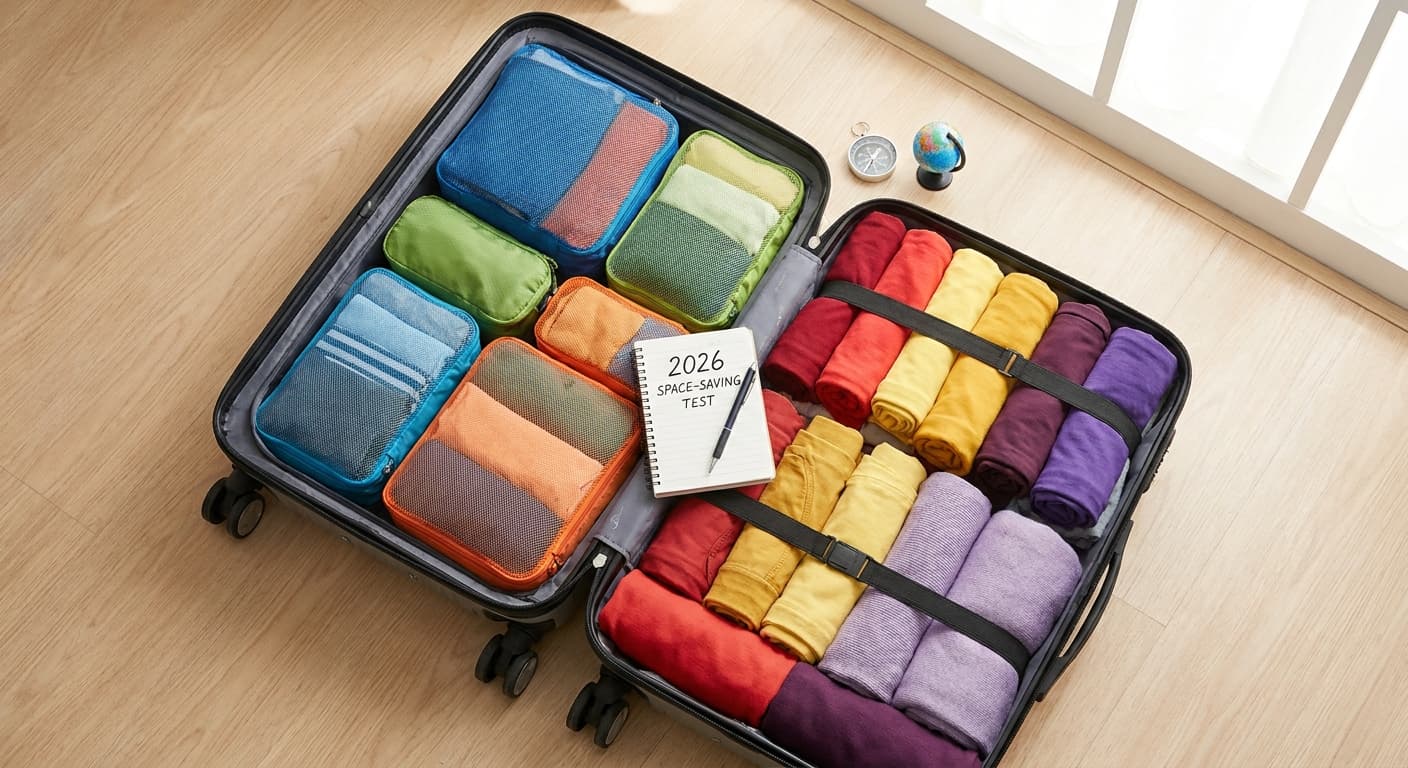
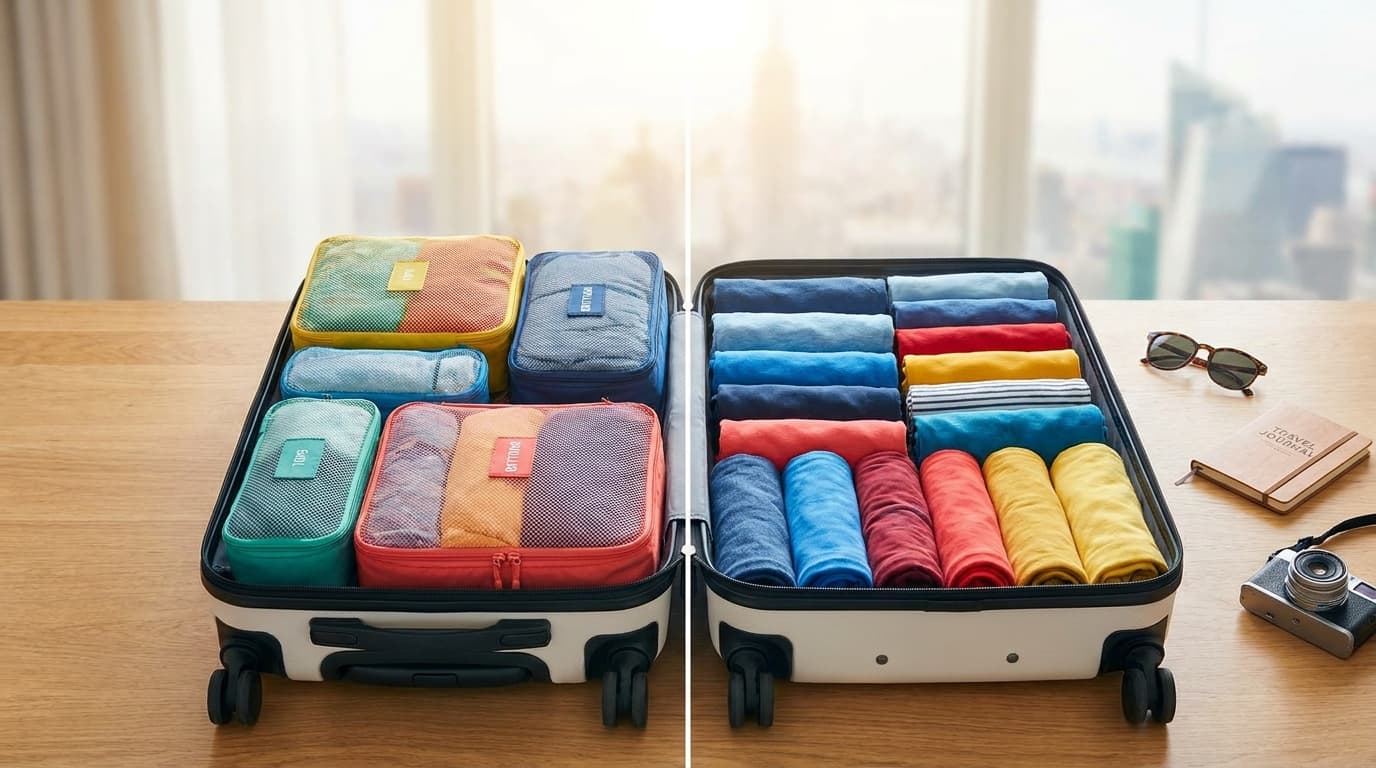
Packing Cubes vs. Rolling Your Clothes: Which is the Best Way to Maximize Luggage Space in 2026?
Packing Cubes
$45.00Packing cubes are a purpose-built travel system that excels at organization, accessibility, and space-saving through compression, making them an essential investment for most travelers.
Overall Score
Top Picks
Packing Cubes (System)
Packing cubes win on almost every front, offering a complete system for efficient, organized travel. Their only drawback is the initial cost, but the long-term benefits in time and space saved provide excellent value.
The Rolling Method (Technique)
The rolling method is a powerful, free technique that excels in value and performs well in space-saving. However, it requires practice and offers virtually no organizational features, and its performance can degrade as you live out of your suitcase.
Comparison
Design
Performance
Value for Money
Ease of Use
Durability
Features
The eternal traveler's dilemma: how to fit two weeks' worth of clothes into a carry-on without sitting on it to close the zipper. For decades, the debate has raged in hostels, airport lounges, and travel forums, centered on two core packing philosophies. In one corner, we have the meticulous, time-honored technique of rolling clothes into tight, compact logs. In the other, the modern, gear-driven solution: packing cubes. Both promise to be the ultimate answer to maximizing luggage space and minimizing chaos. But which one truly delivers?
This isn't just about saving space. It's about organization, accessibility, wrinkle prevention, and the overall stress level of your travel experience. We're diving deep into a data-driven, real-world comparison to settle the score once and for all. We'll analyze every angle, from the physics of compression to the practicalities of a multi-city trip, to help you decide which method will transform your packing from a chore into a science.
| Feature | Packing Cubes | Rolling Method |
|---|---|---|
| Overall Rating | 8.8 / 10 | 7.5 / 10 |
| Space Savings | Excellent (especially compression cubes) | Good to Very Good |
| Organization | Exceptional | Poor to Fair |
| Wrinkle Prevention | Very Good (if packed correctly) | Good (for knits), Poor (for wovens) |
| Accessibility | Excellent | Fair |
| Cost | $20 - $70+ (one-time investment) | Free |
| Weight Added | Minimal (2-10 oz per set) | None |
| Best For | Organized travelers, families, long trips, over-packers, business travel. | Budget travelers, minimalists, short trips, backpackers filling gaps. |
| Pros | Modular organization, compression, easy to pack/unpack, keeps clothes contained. | No cost, no added weight, versatile for filling small gaps in a bag. |
| Cons | Initial cost, can encourage overpacking, adds slight weight. | Time-consuming, poor organization, items can unroll, less effective for bulky items. |
| Check Price - Packing Cubes | Learn The Method |
Quick Verdict: Which Method Should You Choose?
For the vast majority of travelers, packing cubes are unequivocally the better choice. They represent a modest, one-time investment that pays massive dividends in organization, space efficiency, and reduced travel stress. The ability to compartmentalize your luggage into distinct, manageable units - a cube for shirts, a cube for underwear, a cube for electronics - transforms a chaotic suitcase into a tidy, portable dresser. Compression cubes take this a step further, actively squeezing out excess air to create space you never knew you had. This makes them ideal for anyone trying to travel with only a carry-on or for chronic over-packers needing to tame their wardrobe.
Choose Packing Cubes if: You value organization above all else. You're traveling for more than a few days, visiting multiple destinations, or packing for a family. You want to maximize space with compression features and find specific items without destroying your entire packed bag. Business travelers and anyone packing delicate or easily wrinkled clothing will also benefit immensely from the structure cubes provide.
Choose the Rolling Method if: Your primary concern is budget. You are a minimalist packer on a short weekend trip with a duffel bag. You're a backpacker who has mastered the art of stuffing small, rolled items into every nook and cranny of your pack. While it's an effective space-saving technique that costs nothing, rolling fails on the organizational front. It's a solid skill to have, but for overall packing superiority, it can't compete with the purpose-built functionality of cubes.
Which is Better: Packing Cubes or Rolling?
The direct answer is: Packing cubes are demonstrably better for the modern traveler seeking a combination of maximum space, organization, and convenience. While rolling is an effective, free technique for compressing individual items, it fails to address the larger challenge of luggage management. Packing cubes, on the other hand, are a complete packing system. They function as modular drawers for your suitcase, allowing you to not only pack more efficiently but also to live out of your bag without creating a mess. The advent of specialized cubes, particularly compression cubes, has widened this gap, offering space savings that even the tightest rolling can't match.
Think of it this way: rolling clothes is like neatly stacking files on a desk. It looks organized initially and saves some surface area. Packing cubes are like putting those files into labeled folders and placing them in a filing cabinet. The latter system is more robust, scalable, and infinitely easier to navigate when you need to find a specific document - or, in this case, that one clean pair of socks. The structure provided by the cubes prevents the inevitable entropy that occurs during travel, where one frantically searched-for item can undo an entire suitcase's worth of meticulous rolling.
The superiority of cubes becomes most apparent during a trip. When you arrive at your hotel, you can transfer the cubes directly into the drawers or leave them in your open suitcase as organized compartments. Need your gym clothes? Grab the designated cube. Time for bed? The pajama cube is right there. With a suitcase full of rolled items, these simple actions often require you to unearth and disrupt multiple other items, leading to a jumbled mess by day two. This organizational advantage translates into less time spent managing your belongings and more time enjoying your destination.
Furthermore, the argument that rolling is better for preventing wrinkles is highly dependent on fabric type. It works well for knit fabrics like t-shirts and sweaters but can introduce stubborn creases into woven fabrics like cotton dress shirts or linen trousers. Packing cubes, when used properly (by neatly folding or rolling items within the cube), provide a contained, structured environment that better protects clothes from the shifting and friction that cause wrinkles. For this combination of superior organization, accessibility, and often greater space savings, packing cubes earn the definitive title of the better packing method.
What Are The Key Differences? A Head-to-Head Breakdown
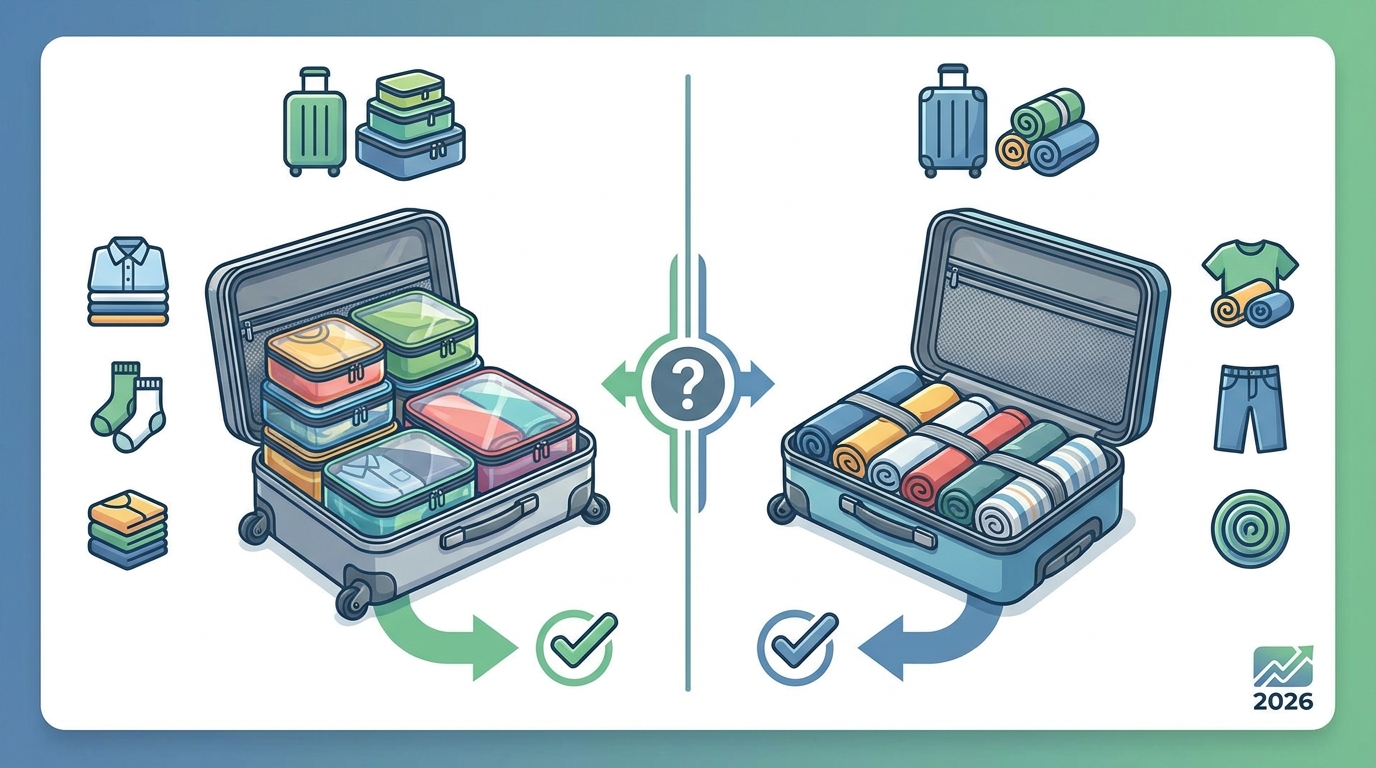
The key differences between packing cubes and rolling are compartmentalization, compression mechanics, cost, and accessibility. Packing cubes are a physical product designed to create order, while rolling is a manual technique focused solely on making individual clothing items smaller. Understanding these core distinctions is crucial to choosing the right strategy for your travel style. While both aim to save space, they achieve it in fundamentally different ways, leading to vastly different user experiences.
First and foremost is organization and compartmentalization. This is the single biggest advantage of packing cubes. They allow you to group like items together: all your tops in one, bottoms in another, underwear and socks in a third. This modular system is a game-changer. Rolling, by contrast, offers no inherent organization. You simply have a collection of two dozen fabric logs in your main compartment. While they may be packed tightly, they are not separated by category, making it difficult to find what you need without disturbing the entire arrangement.
Second is the method of compression. Rolling works by forcing out air as you create a tight cylinder of fabric. It's effective, especially for pliable items. However, compression packing cubes take this to another level. They use a second exterior zipper that cinches the entire cube, applying even pressure across all contents to expel trapped air far more efficiently. This mechanical advantage results in a denser, more compact package, often saving more volume than rolling alone. Standard cubes provide structure, while compression cubes provide both structure and active volume reduction.
Third, the obvious difference is cost and added weight. Rolling is entirely free and adds zero weight to your bag, a significant factor for ultralight backpackers or budget-conscious travelers. Packing cubes are a product you must purchase, with sets ranging from $20 for basic versions to over $70 for premium, ultralight, or compression models. They also add a few ounces of weight. While minimal, for those counting every gram, it's a consideration. However, this cost should be viewed as an investment in a reusable, long-lasting travel tool.
Finally, consider accessibility and unpacking. With cubes, unpacking is optional and lightning-fast. You can lift the cubes straight from your suitcase into hotel drawers. Finding an item mid-trip means opening one specific cube. With rolling, finding a single shirt from the bottom layer of your bag can trigger a luggage avalanche, requiring a partial or full repack. This ease of access makes cubes far more practical for trips involving multiple stops or for travelers who prefer to stay organized throughout their journey.
| Aspect | Packing Cubes | Rolling Method |
|---|---|---|
| Core Concept | A system of containers for organization | A technique for compressing individual items |
| Organization | Systematic; groups items by category | None; creates a collection of individual items |
| Compression | Mechanical (via zipper) and structural | Manual (by hand) |
| Best For Wrinkles | Protects folded items from shifting | Good for knits, bad for crisp fabrics |
| Unpacking | Fast and simple; transfer cubes to drawers | Can be messy; requires unrolling items |
Design & Build Quality Comparison
When comparing design and build quality, packing cubes offer engineered solutions with specific materials and construction, whereas the quality of the rolling method is entirely dependent on user skill and the fabric being rolled. One is a manufactured product with measurable attributes; the other is an intangible technique. A high-quality packing cube from a reputable brand is designed to withstand the rigors of travel for years, featuring durable fabrics, reliable zippers, and thoughtful features. A well-executed roll is a temporary state, its integrity contingent on the type of clothing and how much it's jostled in transit.
Let's dissect the design of a modern packing cube. Premium cubes are typically constructed from lightweight yet durable materials like ripstop nylon or silnylon, the same fabrics used in high-performance tents and backpacks. This ensures they add minimal weight while resisting tears and abrasion. The choice of zipper is critical; top brands like Eagle Creek and Peak Design often use YKK zippers, renowned for their smooth operation and snag-free durability. Design features often include a mesh panel for breathability and visibility, allowing you to see the contents without opening the cube. Some have grab handles for easy maneuvering, and specialized cubes feature internal dividers to separate clean and dirty clothes. The entire product is a result of intentional design choices aimed at solving specific packing problems.
In contrast, the "design" of rolling is about technique. The most basic roll involves simply folding an item in half and rolling it tightly. A more advanced technique, the "Ranger Roll," involves intricate folding and tucking to create a secure, self-contained bundle that is less likely to come undone. The "build quality" of this roll is a direct function of the user's proficiency. A loose, sloppy roll will unravel and fail to save space. A tight, consistent roll is effective but requires practice. Furthermore, the success is heavily influenced by the material. A cotton t-shirt will hold a roll beautifully, while a silk blouse or a technical polyester shirt will be prone to unspooling due to its smooth texture.
Ultimately, the comparison is between a reliable, manufactured tool and a variable, manual skill. A well-made packing cube will perform its function consistently every time you use it. Its seams will hold, its zippers will glide, and its structure will contain your clothes as intended. The rolling method's performance is not guaranteed. It varies from user to user, from garment to garment, and from the start of the trip to the end. For travelers who want a dependable, repeatable packing process, the engineered design and superior build quality of packing cubes make them the clear winner.
Performance Comparison: Real-World Use Cases
In real-world travel scenarios, compression packing cubes consistently outperform rolling in measurable space savings, while all packing cubes offer vastly superior performance in organization and accessibility. To truly understand the performance difference, we must move beyond the theoretical and place these methods into the context of actual trips, where factors like time, convenience, and luggage type come into play. A packing method that works for a weekend duffel bag may fail spectacularly in a 45-liter backpacking pack on a multi-country tour.
Scenario 1: The 10-Day European Backpacking Trip. The traveler is living out of a single, top-loading backpack and moving cities every two days. The primary goals are maximizing space and being able to access items quickly in a cramped hostel dorm. Here, packing cubes are a clear victor. The ability to pull out the "shirt cube" or the "sock cube" without emptying the entire contents of a deep, narrow pack is invaluable. It saves time and prevents the constant cycle of unpacking and repacking. While a backpacker can use rolling to stuff items into gaps, the pack's contents will inevitably become a jumbled mess after the first search for a clean shirt. Compression cubes are especially key here, shrinking bulky items like a fleece jacket or a travel towel to a fraction of their size.
Scenario 2: The 4-Day Business Conference. The traveler is using a hard-shell carry-on roller. The critical goal is to arrive with wrinkle-free dress shirts, a blazer, and slacks. This is a more nuanced contest. For the blazer and slacks, neither method is ideal; a dedicated garment folder is the best tool. For the dress shirts, a packing folder (a specialized type of cube) is again superior. However, when comparing just cubes vs. rolling for the remaining items (undershirts, casual wear, gym clothes), cubes provide better structure. Rolling can be effective for knit polo shirts, but a tightly rolled woven dress shirt can develop sharp, hard-to-remove creases along the roll. Carefully folding and placing shirts in a standard packing cube often yields better results by minimizing hard folds and protecting them from friction.
Scenario 3: The 7-Day Family Beach Vacation. The travelers are a family of four using one large checked suitcase. The main challenge is not just space, but segregation and order. This is where packing cubes are not just a preference but a necessity. Assigning a different color of cubes to each family member is a classic organizational hack. It allows parents to quickly find a specific child's swimsuit or pajamas without digging through a mountain of clothes. It also simplifies unpacking at the destination. The rolling method would result in a chaotic, multi-person jumble of clothing that would be impossible to navigate. Cubes also excel at quarantining items - a wet swimsuit can go in a water-resistant cube, or dirty laundry can be consolidated, keeping it separate from clean clothes.
Across these diverse scenarios, a clear pattern emerges. While rolling is a viable technique for compressing a single item, it falls short as a holistic packing strategy. The performance of packing cubes - in saving space, maintaining order, protecting clothes, and saving time - makes them the more powerful and versatile tool for virtually any type of trip.
Features Comparison: An In-Depth Look
Packing cubes offer a suite of purpose-built features that rolling, as a technique, simply cannot match, including compression systems, specialized compartments, material innovations, and enhanced usability. The evolution of the packing cube has moved it from a simple zippered pouch to a sophisticated piece of travel gear. Analyzing these features reveals how they directly address the pain points of packing in ways that rolling cannot.
The most significant feature of modern cubes is the compression zipper. Found on compression cubes, this is a secondary zipper that runs around the perimeter of the cube. After you've packed the cube, you zip this second track, which constricts the cube's gusset, forcing out air and reducing its volume by up to 50%. This is an active, mechanical compression that is far more powerful and consistent than the manual compression of rolling. It allows you to pack bulky items like sweaters and jackets in a carry-on, a feat that is often impossible with rolling alone.
Another key feature is the clean/dirty compartment. Pioneered by brands like Eagle Creek, these cubes have an internal divider, often made of a water-resistant, odor-blocking material. You start the trip with all your clean clothes on one side. As you wear them, you move them to the other side. This simple but brilliant design keeps soiled, smelly, or damp clothes completely isolated from your fresh ones. This is particularly useful for gym-goers, beach-goers, or anyone on a long trip without regular laundry access. Rolling offers no such solution; dirty clothes are typically just shoved into a plastic bag or mixed in with the clean.
Material science also plays a huge role. Cubes are not just made of any fabric. High-end options use ultralight materials like 30D or 40D ripstop silnylon, which is incredibly strong, water-resistant, and weighs next to nothing. This addresses the concern that cubes add weight to luggage. Other features enhance usability, such as see-through mesh panels that let you identify contents at a glance, and sturdy grab handles that make it easy to pull the cubes from your bag. The rectangular shape itself is a feature, designed to tessellate perfectly within a suitcase, eliminating the wasted space that can occur between round, rolled items - a concept known as improving packing density.
The rolling method, by its nature, is featureless. Its primary attribute is its adaptability. Its "feature" is that it requires no gear and can be applied to almost any piece of clothing. Advanced rolling techniques like the Ranger Roll add a self-locking mechanism, which is a clever way to prevent unrolling. However, this solitary benefit pales in comparison to the multi-faceted, problem-solving features engineered into a quality set of packing cubes. From active compression to laundry separation, cubes are designed as a comprehensive solution, not just a space-saving trick.
Discover Top-Rated Packing Cube Sets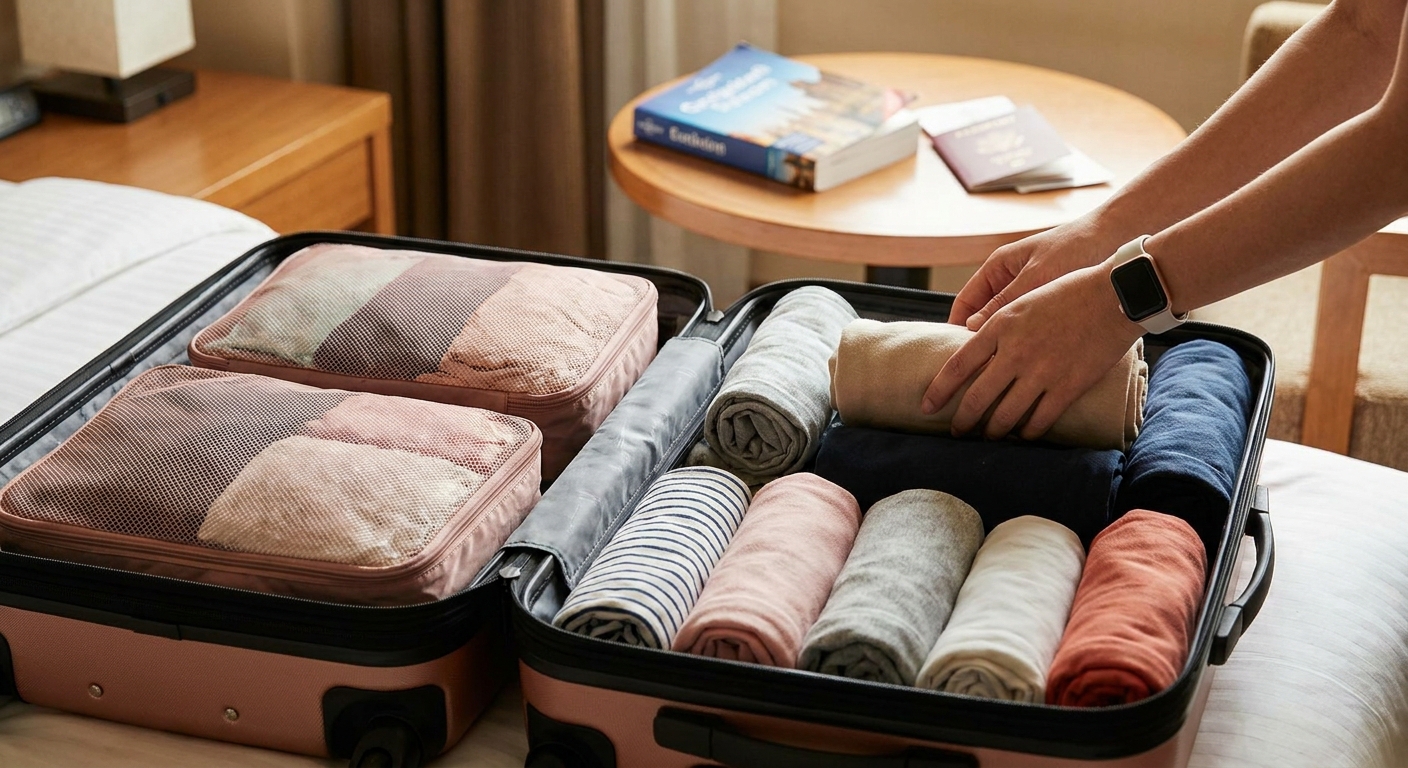
Pricing & Value for Money
While rolling clothes is undeniably free, packing cubes provide exceptional value for money by functioning as a reusable, long-term investment that saves time, space, and stress on every trip. The debate over value isn't simply about the upfront cost versus zero cost; it's about the return on that investment. For anyone who travels more than once a year, the tangible benefits of cubes quickly justify their modest price tag, reframing them from an expense to an essential piece of travel infrastructure.
Let's break down the cost of packing cubes. The market offers several tiers. You can find budget-friendly sets on Amazon from brands like AmazonBasics or Veken for as little as $20-$30. These are perfectly functional and a great entry point for new users. Mid-range options from established travel brands like eBags or Travelon typically cost between $30-$50 and offer better materials and more durable zippers. At the premium end, brands like Eagle Creek, Peak Design, and Away offer sets for $50-$70+, featuring ultralight materials, lifetime warranties (a massive value proposition), and innovative features like compression or clean/dirty compartments. If a $50 set from Eagle Creek with a lifetime warranty is used on just 10 trips, the cost per trip is a mere $5 - a small price for a perfectly organized, stress-free packing experience.
The rolling method, of course, costs $0. This is its most compelling attribute and makes it the default choice for the ultra-budget traveler. However, it's important to consider the hidden or non-monetary costs. There's the "time cost" of meticulously rolling every single item, which can be significantly longer than folding and placing items in a cube. There's the "stress cost" of trying to find an item in a disorganized bag. And there's the potential "repacking cost" - the time and effort spent reorganizing a suitcase that has devolved into chaos mid-trip. For many, saving these frustrations is well worth the price of a set of cubes.
The true value of packing cubes emerges over time. They are a durable good, not a consumable. A quality set can last for a decade or more of consistent travel. The ability to use a smaller suitcase (potentially avoiding checked bag fees) thanks to the space saved by compression cubes can mean the cubes literally pay for themselves in just one or two flights. When you factor in the longevity, the organizational benefits, the time saved, and the potential to avoid airline fees, the value proposition of packing cubes becomes overwhelmingly positive. They are not a frivolous accessory; they are a force multiplier for efficient travel.
Pros and Cons: A Detailed Breakdown
The core trade-off is simple: packing cubes offer unparalleled organization and compression at a financial cost, while rolling provides good compression for free but creates organizational chaos. A detailed look at the pros and cons of each method highlights their distinct strengths and weaknesses, making it easier to align a choice with your personal packing priorities - whether that's order, budget, speed, or space.
Packing Cubes: The Pros and Cons
Pros:
- Unmatched Organization: This is the number one benefit. By creating a modular "drawer system" in your luggage, you always know exactly where everything is. It makes packing and unpacking systematic and stress-free.
- Superior Space Savings (with Compression): Compression cubes actively remove air, allowing you to fit significantly more into your luggage. Even standard cubes improve packing density by creating stackable blocks.
- Effortless Accessibility: Need to grab one item? Just pull out the relevant cube. The rest of your luggage remains perfectly packed. This is a lifesaver on multi-stop trips or in tight spaces like hostel rooms.
- Containment and Protection: Cubes keep your clothes neatly folded or rolled, protecting them from shifting around and getting wrinkled. They also contain spills and can separate dirty or wet clothes from clean ones.
- Versatility: They can be used in any type of luggage, from carry-on spinners to hiking backpacks to duffel bags, bringing order to any container.
Cons:
- Initial Cost: Unlike rolling, cubes are a product that must be purchased. This can be a barrier for budget-conscious travelers.
- Can Encourage Overpacking: The incredible space-saving ability of compression cubes can tempt you to pack more than you need, potentially leading to a heavier bag.
- Adds Minor Weight and Bulk: While usually negligible, the cubes themselves do add a few ounces and take up a tiny amount of space when empty.
The Rolling Method: The Pros and Cons
Pros:
- Completely Free: The most significant advantage. It requires no gear and can be done by anyone, anywhere.
- No Added Weight: As it's just a technique, it adds zero weight to your luggage, which is a key factor for ultralight travel.
- Good Space Compression: Rolling clothes tightly does compress them and can save a significant amount of space compared to simply folding them.
- Fills Irregular Gaps: Small, rolled items like socks or t-shirts are perfect for stuffing into the empty spaces inside shoes or around the edges of a suitcase.
Cons:
- Zero Inherent Organization: It creates a pile of fabric logs. Finding one item without disrupting the others is nearly impossible, leading to a messy suitcase very quickly.
- Time-Consuming: Properly rolling each individual item can take much longer than quickly folding items and placing them into a packing cube.
- Items Can Unroll: Especially with smoother fabrics, rolls can easily come undone during transit, defeating the purpose and creating a mess.
- Inefficient for Bulky Items: Rolling a thick sweater or a stiff jacket is awkward and often creates a bundle that is larger and more unwieldy than if it were folded and compressed in a cube.
Which is Best for Beginners?
For packing beginners, packing cubes provide a significantly easier and more rewarding entry into the world of efficient travel, offering a structured, foolproof system that delivers immediate results. The rolling method, while seemingly simple, has a steeper learning curve to master effectively. The immediate organizational clarity and visual progress provided by cubes make them the hands-down winner for anyone new to packing strategy or looking to upgrade from chaotic, last-minute packing.
Imagine a first-time solo traveler packing for a big trip. Their main concerns are likely to be forgetting something, not being able to fit everything, and living out of a suitcase for the first time. Handing them a set of packing cubes provides an instant framework for success. The process becomes intuitive: put shirts here, pants there, smalls in this one. It breaks down the overwhelming task of packing an entire wardrobe into a series of small, manageable steps. The cubes act as a visual checklist. When the "shirt cube" is full, you know you've packed enough shirts. This structured approach builds confidence and reduces pre-trip anxiety.
Conversely, telling a beginner to "just roll everything" can lead to frustration. They might roll too loosely, failing to save any space. They might roll fabrics that are prone to wrinkling, arriving at their destination with a wardrobe that needs serious ironing. They will almost certainly struggle with organization, facing the dreaded "suitcase explosion" the first time they need to find something at the bottom of their bag. Mastering the perfect, tight roll - especially the Ranger Roll - takes practice and an understanding of how different fabrics behave. It's a skill, not an out-of-the-box solution.
Packing cubes offer a shortcut to proficiency. They enforce good habits from the very first use. The simple act of zipping a cube closed provides a sense of completion and order that is deeply satisfying and encouraging for a novice. It's a system with guardrails. You can't really do it wrong. You simply fold or roll your clothes, place them inside, and zip it up. The cube's structure and compression do the heavy lifting. This ease of use and the immediate, tangible benefit make packing cubes the ideal tool for empowering beginners to pack like seasoned pros from their very first trip.
Use-Case Segmentation: Who Should Choose What?
The optimal packing strategy is not one-size-fits-all; it depends entirely on the traveler and the trip. Choose packing cubes if you are an organizer, a family, or a long-haul traveler who needs structure. Choose rolling if you are a minimalist, a budget backpacker, or a short-trip packer who values flexibility over order. By breaking down the choice by traveler archetype, we can provide clear, actionable recommendations.
The Family Vacationer: Winner - Packing Cubes (Non-Negotiable). Managing multiple people's wardrobes from a single suitcase is a logistical nightmare without compartmentalization. Assigning a color-coded set of cubes to each family member is the single most effective strategy for maintaining sanity. It simplifies finding clothes for specific children and makes it easy to separate laundry.
The Business Traveler: Winner - Packing Cubes (Specifically Packing Folders). The primary goal is minimizing wrinkles in formal wear. A packing folder, which is a rigid, structured cube, is the best tool for keeping dress shirts and slacks crisp. For other items, standard cubes maintain organization within a carry-on, ensuring a professional and put-together appearance upon arrival.
The Backpacker / Hostel Hopper: Winner - A Hybrid Approach. This traveler needs both maximum compression and some organization. The ideal setup is using one or two large compression cubes for the bulk of their clothes and then using the rolling technique for individual items like a rain jacket or a towel to stuff into the remaining nooks and crannies of their pack. The cubes provide the core organization needed for life in a top-loading pack.
The Minimalist / Weekend Traveler: Winner - Rolling Method. When you're only packing a few outfits into a duffel bag or a small carry-on for a 2-3 day trip, the advanced organizational features of cubes can be overkill. Rolling a handful of items is quick, easy, and provides sufficient compression for a short journey. The lack of structure is less of an issue when you have so few items to manage.
The Chronic Over-packer: Winner - Compression Packing Cubes. For the traveler who always wants to bring one more outfit "just in case," compression cubes are a revelation. They provide the psychological permission to pack those extra items by creating the physical space for them. They impose order on a potentially chaotic wardrobe and are often the difference between being able to close the suitcase and having to leave things behind.
| Traveler Type | Recommended Method | Primary Reason |
|---|---|---|
| Family Vacationer | Packing Cubes | Segregation and organization per person. |
| Business Traveler | Packing Cubes / Folders | Wrinkle prevention and professional organization. |
| Backpacker | Hybrid (Cubes + Rolling) | Core organization with flexible space-filling. |
| Minimalist Weekender | Rolling Method | Simplicity and speed for a small number of items. |
| Over-packer | Compression Cubes | Maximum space creation and enforced order. |
Are There Any Alternatives?
Yes, beyond packing cubes and rolling, travelers can use vacuum-sealed compression bags for ultimate space-saving or packing folders for superior wrinkle prevention. While cubes and rolling are the two most popular methods, these alternatives serve specific niche purposes and can be valuable additions to a packer's toolkit, especially when dealing with extreme situations like bulky winter gear or delicate formal wear.
Compression Bags: These are heavy-duty plastic bags with a one-way valve. You place your clothes inside, seal the bag, and then roll it up to force all the air out through the valve. Some versions even use a vacuum cleaner for maximum air removal. The result is an incredibly dense, rock-hard brick of clothing that takes up the minimum possible volume. Pros: Unbeatable compression, perfect for bulky items like ski jackets, puffer vests, and sleeping bags. Cons: They induce severe, deep-set wrinkles in most fabrics. The resulting dense brick can be heavy and awkward to fit in a suitcase. They are also prone to failure (leaks) and can be noisy to use. They are a tool for raw compression, not for organization or clothing care.
Packing Folders: A packing folder is a specialized type of packing cube designed for structured, woven garments. It typically consists of a rectangular, semi-rigid board with wings that fold over. You fold your dress shirts or slacks around the board, and the folder's structure protects them from compression and shifting, which are the main causes of wrinkles. Pros: The absolute best method for keeping collared shirts, blazers, and trousers nearly wrinkle-free. Cons: They do not save a significant amount of space and can be a bit bulky. They are a specialized tool for a specific job, not an all-purpose packing solution.
The KonMari Folding Method: Popularized by Marie Kondo, this method involves folding clothes into small, rectangular packets that can stand up on their own. It's primarily designed for organizing drawers at home but can be adapted for travel. Pros: Creates a very tidy and visually appealing layout where you can see every item at once. Cons: It's generally less space-efficient than rolling or using compression cubes. The small, folded packets can also come apart more easily than a tightly rolled item during the rough and tumble of travel. It's an organizational philosophy more than a space-saving one.
Find Your Perfect Packing SolutionFinal Verdict: The Definitive Choice for Smarter Travel
After a comprehensive, data-driven analysis of every angle - from space savings and organization to cost and real-world usability - the verdict is clear. Packing cubes, particularly compression cubes, are the superior method for the vast majority of travelers in 2026. While the free, age-old technique of rolling clothes remains a valuable skill for specific situations, it has been largely surpassed by the engineered efficiency and organizational power of modern packing systems. The debate is no longer just about fitting more stuff in a bag; it's about upgrading the entire travel experience.
The rolling method's primary appeal is its cost - it's free. It is a good way to compress individual items and is a valid strategy for minimalists on short trips. However, its benefits end there. It fails completely on the crucial front of organization, creating a system that is inherently prone to chaos. The time spent meticulously rolling each item is often undone the first time you need to retrieve something from the bottom of your bag. It is a single-purpose tool in a world that demands a multi-faceted solution.
Packing cubes, on the other hand, are that multi-faceted solution. They are a one-time investment that transforms packing from a dreaded chore into a streamlined, almost satisfying, process of logical organization. They don't just help you pack; they help you travel. They allow you to stay organized for the duration of your trip, find what you need instantly, and keep your clean and dirty clothes separate. The introduction of compression technology has given them a decisive edge in the space-saving arena, allowing travelers to confidently downsize to smaller luggage, often saving them hundreds of dollars in checked bag fees over the long run.
The best strategy of all is often a hybrid one, employed by the most seasoned travelers: using packing cubes as the primary organizational structure for the bulk of your clothes, while still rolling a few small items to tuck into the final remaining gaps. But if you must choose only one philosophy to guide your packing, the choice is simple. Invest in a quality set of packing cubes. It is one of the highest-leverage, lowest-cost upgrades you can make to your travel gear. It's a purchase you will not regret, and one that will pay for itself with every organized, stress-free trip you take.
Frequently Asked Questions
Yes, packing cubes save space in two ways. Standard cubes create Tetris-like blocks that improve packing density and eliminate wasted air pockets. Compression cubes go a step further, using an extra zipper to actively compress clothing and reduce its volume by up to 50%, saving a significant amount of space.
For maximum space-saving, rolling clothes before placing them inside a packing cube is the ultimate combination. The rolling compresses each item, and then the cube's compression zipper compresses the entire bundle further. For wrinkle-prone items, however, neatly folding them inside the cube is a better strategy.
No, most packing cubes add negligible weight. A standard set typically weighs only a few ounces. For travelers where every gram counts, ultralight packing cubes made from materials like silnylon are available and weigh even less, making them a favorite among backpackers and carry-on only flyers.
For pure space-saving, yes, compression cubes are superior. They are ideal for bulky items like fleeces and sweaters. However, the intense compression can cause more wrinkles than regular cubes. Standard cubes are often better for general organization and for more delicate fabrics where wrinkle prevention is a priority.
Absolutely. Packing cubes are arguably most valuable for carry-on only travel. They allow you to fit more items into a small, regulation-sized bag, which can be the difference between needing to check a bag and being able to fly carry-on. The organization they provide is also crucial in a smaller piece of luggage.
The key is a tight, consistent roll. For slippery synthetic fabrics that are prone to unrolling, use the 'Ranger Roll' technique. This method involves folding in the sides of the garment and then tucking one end into a cuff you create at the other end, creating a secure fabric log that won't come undone.
Yes, most packing cubes made from nylon or polyester are machine washable. It's best to use a gentle cycle with cold water and place them in a mesh laundry bag. Afterward, they should be air-dried, as high heat from a dryer can damage the fabric and zippers. Always check the manufacturer's care label first.