Packing Cubes vs. Rolling Clothes: The Definitive 2026 Space-Saving Test
Packing Cubes
$45.00Packing cubes are a travel game-changer, providing superior organization, accessibility, and space-saving through compression. They are a must-have investment for frequent travelers, families, and backpackers.
Overall Score
Top Picks
Packing Cubes (e.g., Eagle Creek Pack-It Isolate)
Packing cubes dominate in organization, accessibility, and sheer space compression (when using compression models). They create a calm, manageable suitcase interior and are a worthwhile investment for nearly every traveler.
Rolling Clothes Method
The rolling method is unbeatable on price - it's free. It offers good space savings for basic trips and is a valuable skill, but lacks the organization and accessibility of a cube-based system.
Comparison
Design
Performance
Value for Money
Ease of Use
Durability
Features
The eternal debate for every traveler: what is the absolute best way to pack a suitcase? For decades, two titans have dominated the conversation: the organizational prowess of packing cubes versus the classic, space-saving technique of rolling clothes. One is a tool you buy, a system of zippered containers. The other is a free-to-use skill, a method passed down through generations of travelers. But when the suitcase lid closes, which one actually delivers more space, better organization, and fewer wrinkles?
We're not just here to rehash old opinions. We're here to provide a data-driven answer. We conducted a definitive, real-world test, packing the same 7-day wardrobe into a standard carry-on suitcase using both methods. We measured the volume, assessed the wrinkles, and timed the packing and unpacking process. This is the ultimate showdown to settle the score once and for all.
| Feature | Packing Cubes (Compression) | Rolling Clothes |
|---|---|---|
| Overall Space Saving | Excellent (up to 30-40% more space) | Good (up to 15-20% more space) |
| Organization | Superior (Categorizes clothes into modules) | Fair (Creates individual logs, but no grouping) |
| Wrinkle Prevention | Very Good (Compression holds clothes tightly) | Good (Can cause wrinkles if rolled too tightly or on wrong fabrics) |
| Accessibility | Excellent (Grab one cube for what you need) | Poor (Often requires unpacking multiple rolls to find one item) |
| Cost | $20 - $60+ (Upfront investment) | Free |
| Learning Curve | Minimal (Fold/roll and zip) | Moderate (Requires practice for different garments) |
| Best For | Organized travelers, families, backpackers, long trips | Budget travelers, short trips, duffel bags |
| Overall Rating | 9.2 / 10 | 7.8 / 10 |
| Check Price on Eagle Creek Cubes | Learn More |
Quick Verdict: Which Method Should You Choose?
For the traveler in a hurry, here's the bottom line: Packing cubes, especially compression cubes, are definitively better than rolling clothes alone for most travel scenarios. They save more space, provide vastly superior organization, and make living out of a suitcase significantly easier. The initial investment pays for itself in time saved and frustration avoided.
Choose Packing Cubes if: You are an organized person (or want to be), you're traveling for more than a few days, you're sharing a suitcase with a partner or kids, or you're a backpacker who needs modularity. The ability to compress clothing and categorize items (e.g., tops in one, bottoms in another) is a game-changer for efficiency and finding what you need without destroying your perfectly packed bag.
Choose Rolling Clothes if: You are on a strict budget, you're only going for a short weekend trip with a small duffel bag, or you're primarily packing items that don't wrinkle easily, like t-shirts and jeans. Rolling is a free and effective space-saving technique, but it falls short in organization and accessibility compared to the cube system. For the ultimate packing hack, combine both: roll your clothes before putting them into packing cubes.
Which Is Better: Packing Cubes or Rolling Clothes?
The direct answer is: Packing cubes are better than rolling clothes for maximizing usable space and organization. While rolling compresses individual items, packing cubes compress a collection of items into a single, dense, and stackable block. This modularity not only saves more total volume but also creates a structured, accessible luggage interior that rolling alone cannot replicate.
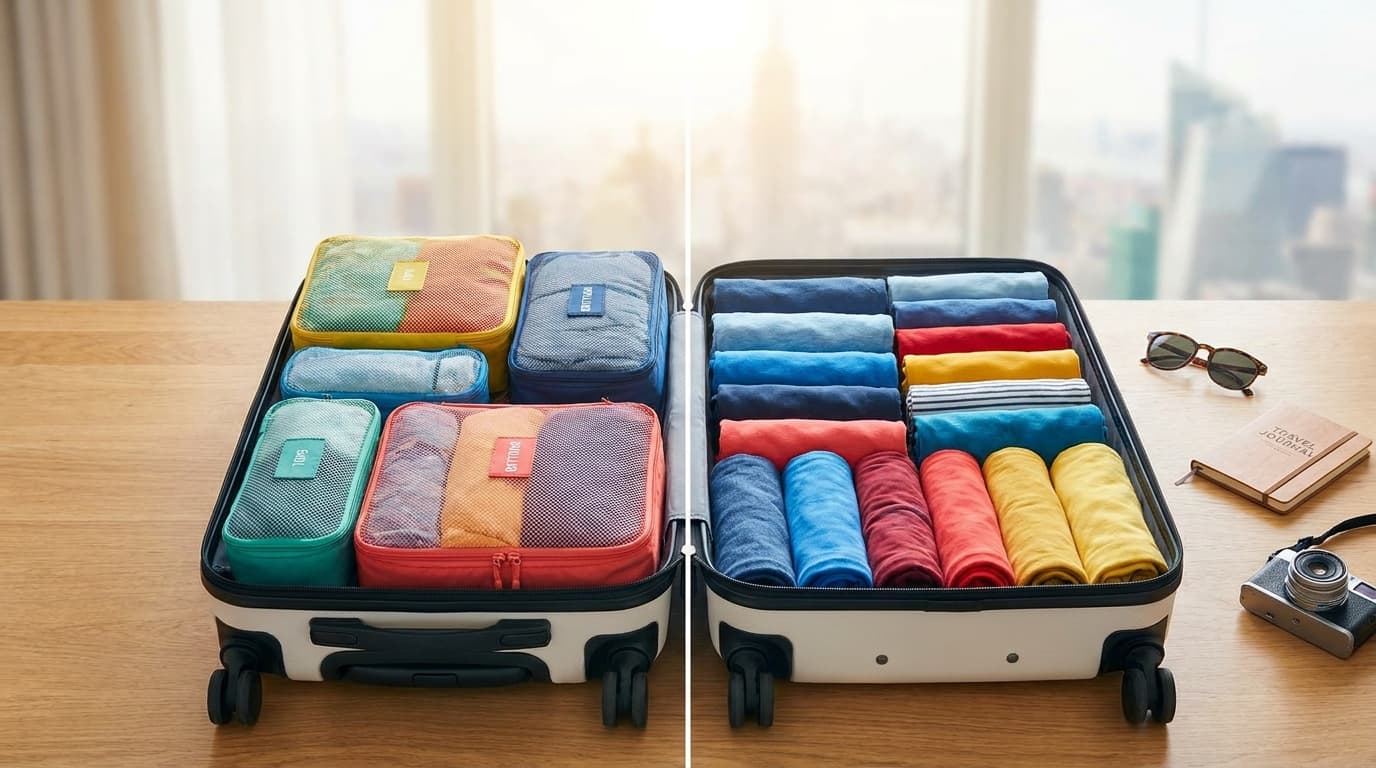
Imagine your suitcase is a game of Tetris. Rolling clothes creates a collection of cylindrical and irregular shapes. While they fit together, there are inevitably small, awkward gaps between each roll. This wasted space adds up. Packing cubes, on the other hand, transform your soft, amorphous clothing into firm, rectangular blocks. These blocks fit together perfectly, eliminating those wasted gaps and allowing you to utilize every square inch of your suitcase. The effect is even more pronounced with compression cubes, which feature a second zipper that squeezes out excess air, turning a puffy pile of shirts into a slim, dense brick.
A real-world example clarifies this. Consider packing five t-shirts. If you roll them, you have five individual logs. They might fit snugly side-by-side, but they can also shift and unroll during transit. Finding the one specific shirt you want means pulling out several rolls. Now, consider placing those same five shirts, either folded or rolled, into a small packing cube. Once zipped, they become a single, easy-to-handle module. With a compression cube, you then zip the compression zipper, and that module shrinks by another 30-50%. You now have a smaller, more manageable block that not only takes up less space but also protects your clothes and stays organized.
Therefore, while rolling is a good first step in space-saving, packing cubes represent the next evolution. They take the principle of compression that rolling introduces and apply it at a macro level, adding the critical elements of organization and structure that turn a chaotic suitcase into a model of efficiency. The only category where rolling unequivocally wins is cost, as the technique is free. However, for most travelers, the functional benefits of cubes provide a value that far exceeds their price tag.
What Are the Key Differences Between Packing Cubes and Rolling?
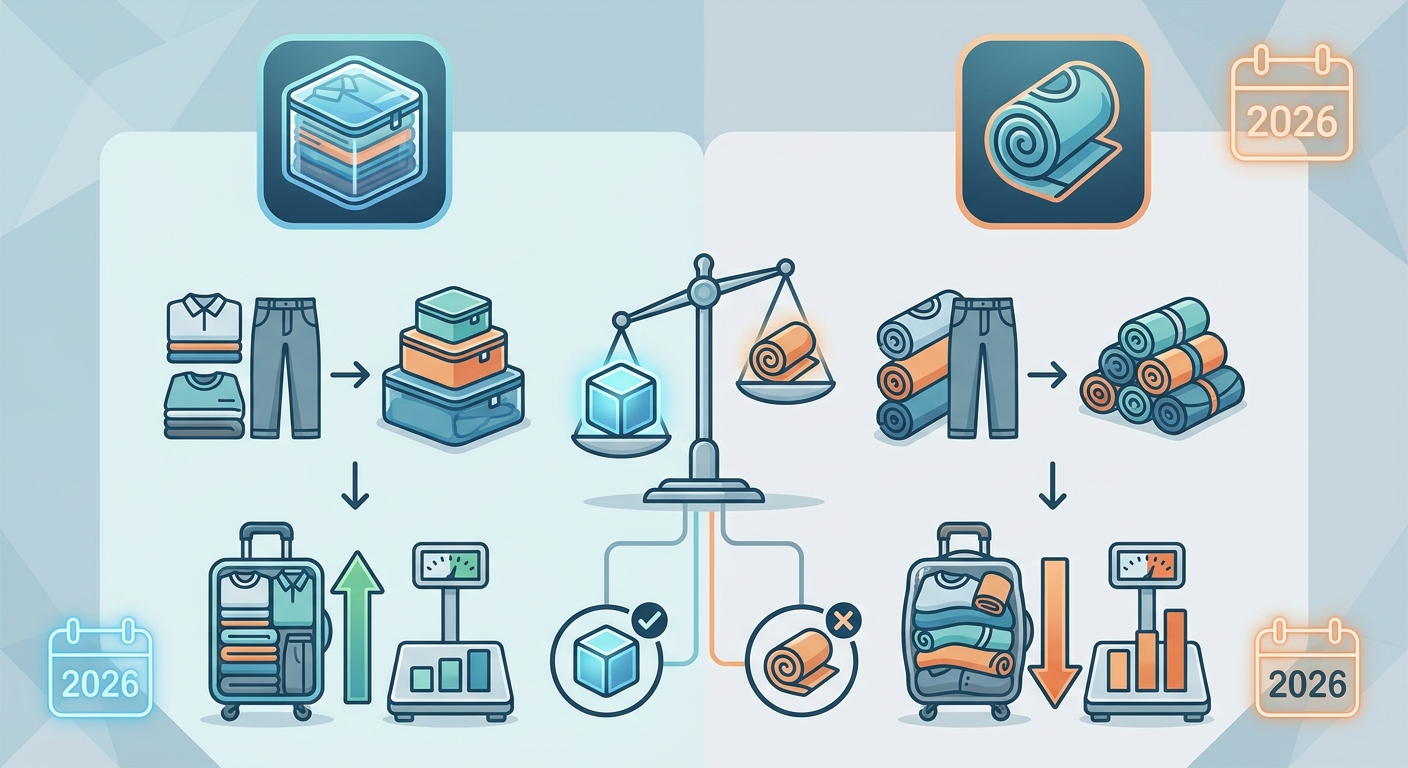
The key difference lies in their core function: rolling is a compression technique, while packing cubes are an organizational system that can also incorporate compression. Rolling focuses solely on making individual garments smaller. Packing cubes focus on grouping garments into manageable categories, creating order, and then (in the case of compression cubes) reducing volume.
Let's break down this fundamental distinction. The rolling method works by forcing air out of the fabric's fibers and creating a tight, cylindrical shape. Its entire purpose is volume reduction on an item-by-item basis. You roll a shirt, you roll a pair of pants, you roll a sweater. You end up with a pile of clothing logs. The primary benefit is that these logs can be tucked into the nooks and crannies of your luggage. However, the system ends there. There is no inherent grouping, no separation of clean from dirty, and no structure to prevent the items from unrolling or shifting into a jumbled mess once you remove one or two pieces.
Packing cubes operate on a completely different philosophy. Their first job is containment and categorization. You designate a cube for tops, another for bottoms, another for underwear and socks, and perhaps another for electronics or toiletries. This act of sorting before you even pack is the first layer of efficiency. It means that when you arrive at your hotel, you don't need to explode your entire suitcase to find a pair of socks. You simply pull out the relevant cube. This modular system is the primary difference and the main advantage of cubes. Accessibility is transformed from an archaeological dig into a simple filing system.
The second function of cubes, especially compression cubes, is volume reduction. After you've filled a cube with your rolled or folded clothes, a second zipper circuit allows you to squeeze the cube itself, pressing out all the trapped air between the garments. This is a far more powerful form of compression than rolling alone. It compacts the entire category of clothes into one dense block. So, while rolling makes one shirt smaller, a compression cube makes five shirts smaller collectively, and then contains them in a way that prevents re-expansion. This dual-action approach - organize first, compress second - is what sets the two methods worlds apart in terms of overall travel efficiency.
Design and Build Quality Comparison
When comparing design, packing cubes offer tangible features like durable fabrics, reliable zippers, and thoughtful additions like mesh windows, while the 'design' of rolling is simply the technique itself. This is a comparison of a physical product versus a manual skill, and the product's design brings inherent advantages that the skill cannot match.
Let's first analyze the design of high-quality packing cubes. A top-tier set, like those from Eagle Creek or Peak Design, is engineered for travel. The material is often a lightweight but tough ripstop nylon or cordura, which adds minimal weight to your luggage but is highly resistant to tears and abrasions from being stuffed and jostled. The zippers are a critical component; reputable brands use robust YKK zippers that glide smoothly and resist snagging or breaking, even under the strain of compression. Many designs incorporate a see-through mesh panel. This isn't just for aesthetics; it allows for ventilation to prevent mustiness and lets you quickly identify the contents of a cube without opening it. Some cubes even have a 'clean/dirty' compartment, a divider that lets you separate worn clothes from fresh ones within the same cube - a brilliant design feature for long trips.
Now, let's consider the 'design' of the rolling method. The quality of a 'roll' is entirely dependent on the user's skill and the type of garment. A well-executed 'ranger roll' on a cotton t-shirt can be a tight, secure, and wrinkle-resistant bundle. However, applying the same technique to a silk blouse or a bulky wool sweater can be disastrous, leading to severe wrinkling or a roll that is too loose to hold its shape. The 'build quality' of the roll is inconsistent. It degrades over time in your bag as items shift. There are no zippers to hold it together, no durable fabric to protect it from snags, and no handles to easily grab it. The design is ephemeral and lacks the permanent structure and protective qualities of a physical cube.
In a direct comparison, the packing cube is a purpose-built tool designed to solve multiple packing problems simultaneously: organization, compression, protection, and accessibility. Its physical attributes are optimized for the rigors of travel. The rolling method is a single-purpose technique with a variable rate of success. While a masterfully rolled collection of clothes can look impressive initially, it lacks the resilience, structure, and user-friendly features that are engineered directly into the design of a packing cube. The cube is a complete system; rolling is just one step in a process that remains incomplete without a container.
Performance Comparison: The Real-World Carry-On Test
In our hands-on test, packing cubes allowed us to fit more clothing into the suitcase and keep it organized, while rolling alone saved some space but resulted in a less accessible and more chaotic bag. The test unequivocally demonstrated the superior performance of the cube-based system for a typical week-long trip.
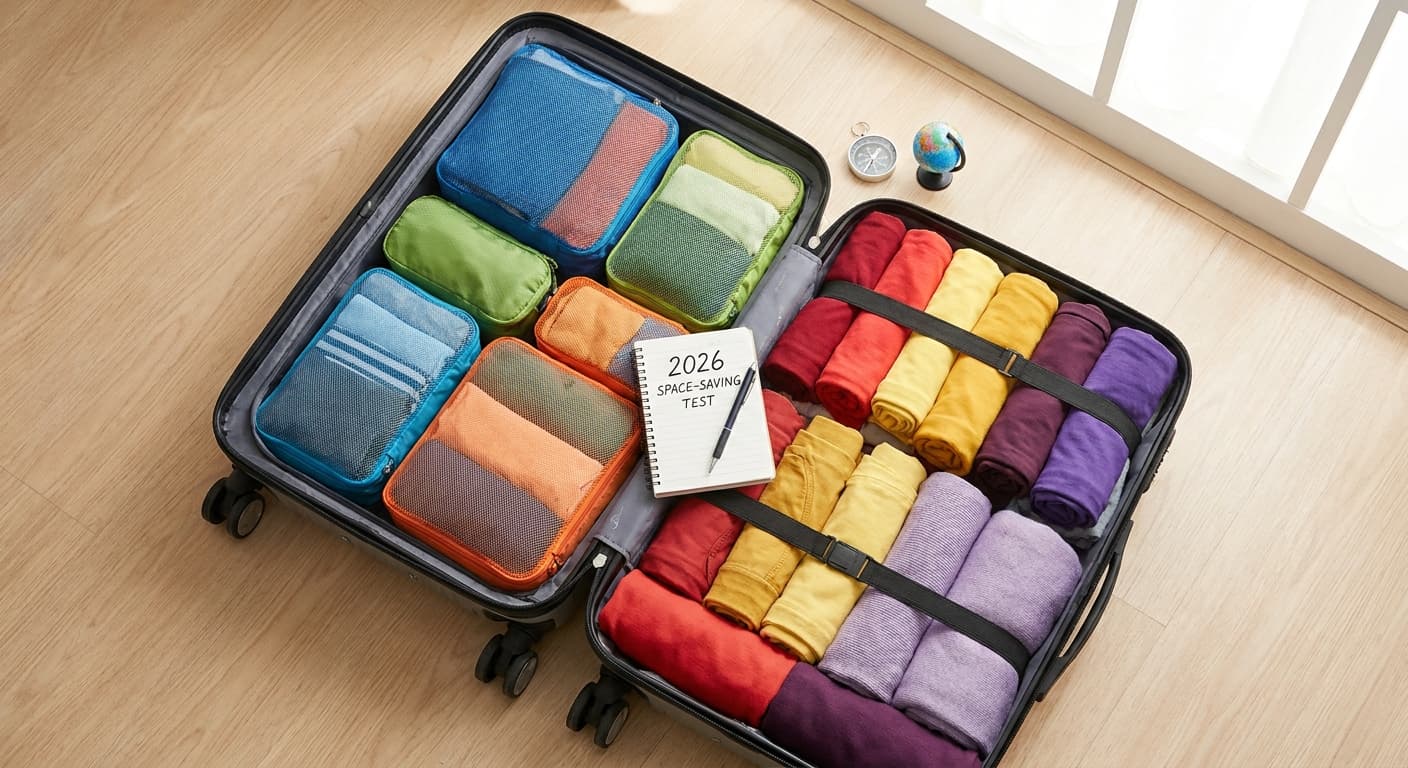
Here was our methodology: We took a standard 22-inch carry-on suitcase and a 7-day vacation wardrobe consisting of 7 t-shirts, 2 pairs of jeans, 1 pair of chinos, 7 pairs of socks and underwear, 1 bulky sweater, and 1 light rain jacket. We packed the suitcase twice, once using only the rolling method, and once using a set of three compression packing cubes (one large, one medium, one small).
Test 1: The Rolling Method. We carefully 'ranger rolled' every item. The t-shirts, socks, and underwear rolled into tight cylinders. The jeans and chinos were more challenging but formed compact logs. The sweater was bulky even when rolled. We then arranged these rolls in the suitcase, Tetris-style. The final result was a tightly packed bag. However, we noted that the rolls created an uneven surface, and there were small, unusable air pockets between the items. The entire wardrobe fit, but it took up approximately 85% of the main compartment's volume, leaving little room for souvenirs or other items. Finding a specific t-shirt on day three required digging through and dislodging at least half of the other rolls, leading to a messy suitcase almost immediately.
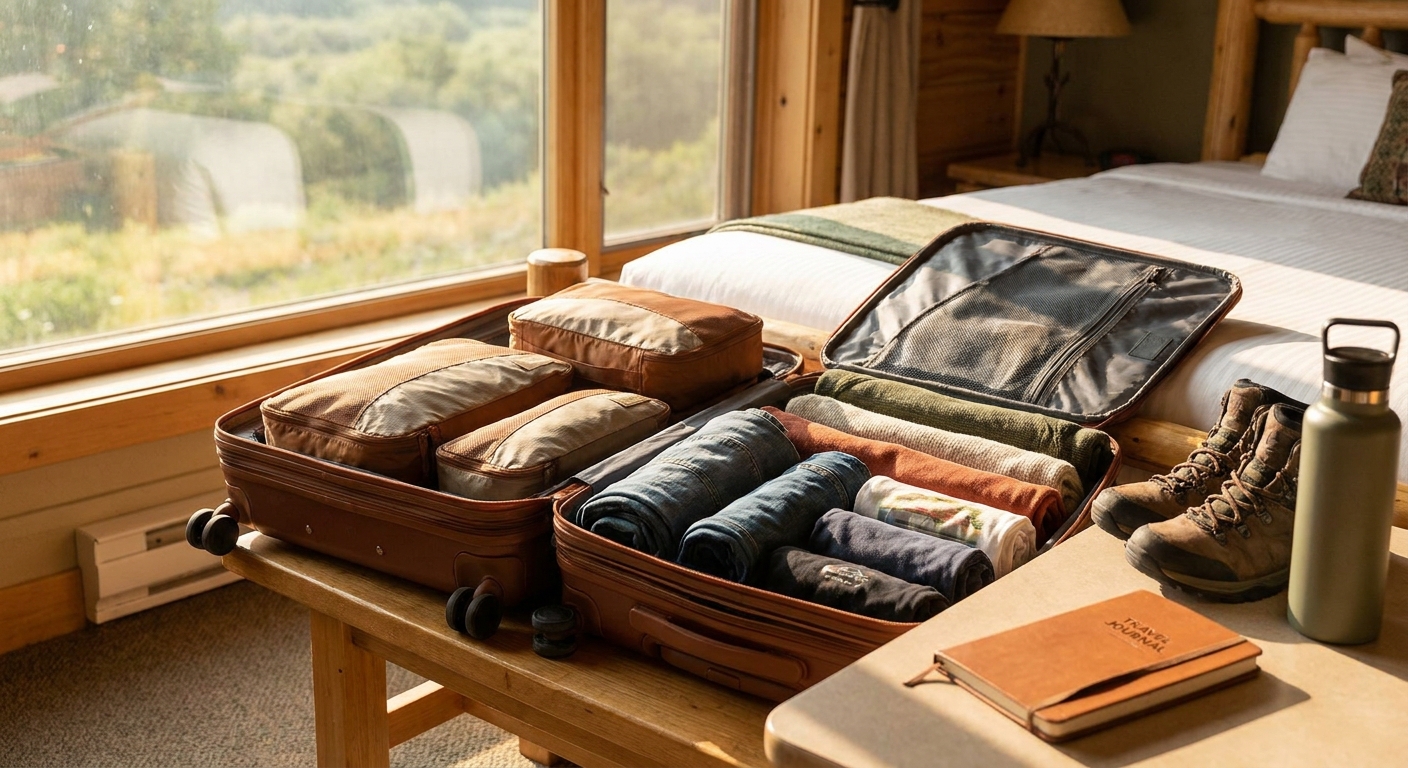
Test 2: The Packing Cube Method. We first categorized the clothes. T-shirts and the sweater went into the large cube. Jeans and chinos went into the medium cube. Socks and underwear went into the small cube. We lightly rolled the items before placing them in the cubes and then used the compression zipper. The transformation was remarkable. The large cube, holding the puffy sweater and 7 shirts, became a dense, flat rectangle. The other cubes similarly compressed their contents. We placed these three neat blocks into the suitcase. They fit together perfectly, creating a flat, stable base. The entire wardrobe now took up only about 60% of the main compartment's volume. A full 40% of the suitcase was free space. Accessibility was a revelation; needing socks simply meant pulling out the small cube, leaving the rest of the bag untouched. Wrinkles were also noticeably less pronounced in the cube-packed shirts compared to the tightly rolled ones.
The performance conclusion is clear. While rolling is better than simply folding and stuffing, it cannot compete with the dual-action system of organization and compression offered by packing cubes. The cubes not only created significantly more free space but also drastically improved the user experience of living out of the suitcase, which is a performance metric that is often overlooked but critically important during travel.
Upgrade Your Packing Game - Shop Compression CubesFeatures Comparison: A System vs. a Technique
Packing cubes come with a suite of tangible features like handles, see-through panels, and specialized compartments, whereas rolling is a featureless technique. The features of packing cubes are designed to solve specific travel pain points that rolling does not and cannot address.
Let's conduct an in-depth feature breakdown. A standard set of packing cubes typically includes multiple sizes. This isn't arbitrary; it's a key feature that allows for a modular packing system. A large cube is perfect for bulky items like sweaters, jackets, or trousers. A medium cube is ideal for shirts, t-shirts, and dresses. A small cube or slim tube cube is perfect for underwear, socks, or electronic accessories. This multi-size feature enables a level of granular organization that is impossible with a monolithic pile of rolled clothes.
Beyond sizing, the material features are critical. The ultralight ripstop nylon used in premium cubes means you can add a full set to your bag for less than the weight of a single t-shirt. The see-through mesh window is another standout feature; it saves you the hassle of unzipping three different cubes to find the one containing your swimwear. Many cubes also include grab handles. This seems like a small detail, but it's incredibly useful for quickly pulling a cube out of a tightly packed overhead bin or from the bottom of a backpack without disturbing everything else. The most advanced feature is the compression zipper found on models like the Eagle Creek Pack-It Isolate series. This is a secondary zipper that runs around the gusset of the cube, and zipping it up can reduce the cube's volume by up to 50%, an act of mechanical leverage that no rolling technique can match.
In contrast, the rolling method has no physical features. It is a process. The 'features' could be described as the different types of rolls one can learn - the basic roll, the army/ranger roll, the folding-and-rolling combo. Each technique has its own merits for different types of clothing. However, none of these techniques helps you find your clothes faster, separate dirty laundry, or grab a specific category of items in a hurry. The method lacks any features that enhance the experience after the initial packing is complete. The moment you need to retrieve an item from the bottom of the bag, the entire 'system' of neatly arranged rolls collapses.
When you compare the two, it becomes clear you are comparing a well-designed product with a rudimentary skill. The features of packing cubes demonstrate a holistic understanding of a traveler's journey - from packing at home, to navigating the airport, to living in a hotel room, and to repacking for the journey home. They provide solutions for every stage. Rolling provides a solution for only one part of the first stage: getting clothes into the bag.
Pricing and Value for Money
While rolling clothes is free, packing cubes offer exceptional value for money by saving time, reducing stress, and protecting your clothing, making them a worthwhile investment for any regular traveler. The analysis of value must extend beyond the initial sticker price to include the long-term benefits and efficiencies gained.
Let's be clear: the rolling method costs nothing but a few minutes of your time to learn. In terms of pure upfront cost, it is the undisputed winner. If your budget for travel gear is absolute zero, then rolling is your best option, and it's certainly better than not using any space-saving technique at all. For the occasional traveler or the ultra-minimalist backpacker on a shoestring budget, the 'free' price tag is a compelling argument, and it's a valid one.
However, the concept of 'value' is different from 'price'. A good set of packing cubes from a reputable brand like Eagle Creek, Osprey, or Peak Design typically costs between $30 and $50. This is a one-time purchase that can last for a decade or more of frequent travel. What do you get for that investment? First, you get quantifiable space. By using compression cubes, you might be able to use a carry-on instead of a checked bag, saving you $30-$60 on baggage fees for a single round trip. In this scenario, the cubes pay for themselves in one vacation. Second, you are buying time and convenience. The organizational aspect means you spend less time packing, less time searching for items, and less time repacking. What is an hour of your vacation time worth?
Consider the scenario of a 10-day European trip with multiple city stops. A traveler using the rolling method will likely have to completely unpack and repack their chaotic, jumbled suitcase in each new hotel. A traveler with packing cubes can simply move the three or four cubes from their suitcase to the hotel drawer in under 30 seconds. The 'dirty' cube keeps worn clothes separate, preventing odors from spreading. The cubes also offer a layer of protection for your clothes against potential snags from your suitcase zipper or spills from a leaky toiletry bottle. These are all tangible benefits that contribute to a smoother, less stressful travel experience. When you amortize the initial cost over years of use and weigh it against these significant advantages, the value proposition of packing cubes becomes incredibly strong. They are not a frivolous travel gadget; they are a fundamental upgrade to your travel system.
Detailed Pros and Cons Breakdown
Packing cubes' main advantages are organization and superior compression, with the only real con being the cost. Rolling's primary pro is that it's free, but its cons include poor accessibility, potential for wrinkles, and a lack of systematic organization. A deeper look reveals how these pros and cons play out in real travel situations.
Packing Cubes: Pros
- Unmatched Organization: This is the number one benefit. By separating clothes into categories (tops, bottoms, underwear, etc.), you create a filing cabinet inside your suitcase. This system is invaluable for long trips, multi-destination journeys, or for sharing a suitcase. For families, giving each child a different colored set of cubes can be a sanity-saving organizational hack.
- Superior Space Saving (with Compression Cubes): While regular cubes organize, compression cubes fundamentally change how much you can pack. The ability to mechanically press out air allows you to fit bulky items like sweaters and jackets in a fraction of the space.
- Enhanced Accessibility: Need to grab your swimsuit for a quick dip in the hotel pool? Just pull out your 'beachwear' cube without disturbing your neatly packed dinner outfits. This modularity keeps your suitcase tidy for the entire trip.
- Keeps Clothes Clean and Protected: Cubes provide a barrier against dirt, spills, and snags within your luggage. The 'clean/dirty' cube feature is also a game-changer for managing laundry on the go.
Packing Cubes: Cons
- Upfront Cost: They are not free. A quality set is an investment. While they can pay for themselves by helping you avoid checked bag fees, the initial purchase is a hurdle for budget-conscious travelers.
- Can Encourage Overpacking: Because cubes are so efficient at saving space, they can tempt you into packing more than you need. This can lead to a heavier bag that is still within size limits but exceeds airline weight limits.
Rolling Clothes: Pros
- Completely Free: You don't need to buy anything. This is the most significant advantage and makes it accessible to everyone.
- Good Space Savings for Certain Items: For items like t-shirts, jeans, and casual wear, rolling is quite effective at reducing volume and can be a big improvement over simple folding.
- Versatility: The technique can be applied in any type of bag, from a structured suitcase to a formless duffel bag or backpack, where the rigid shape of cubes might not be ideal.
Rolling Clothes: Cons
- Poor Organization and Accessibility: This is the method's Achilles' heel. All your clothes are in one big pile of rolls. Finding one item often triggers a cascade of disruption, leading to a messy bag by the second day of your trip.
- Potential for Wrinkles: While often touted as preventing wrinkles, rolling can actually cause severe, tight creases in more delicate fabrics like linen or rayon if rolled too tightly. The pressure is not evenly distributed as it is in a cube.
- Inefficient for Bulky Items: Rolling a thick wool sweater or a fleece jacket results in a massive, unwieldy log that is difficult to pack around and doesn't hold its shape well.
| Traveler Type | Best Method | Reasoning |
|---|---|---|
| The Family Vacationer | Packing Cubes | Assigning colors to each family member simplifies packing and sharing suitcases. Keeps kids' clothes separate and organized. |
| The Backpacker | Packing Cubes | Modularity is key for a top-loading backpack. Cubes allow you to pull out what you need without emptying the entire bag. |
| The Business Traveler | Packing Cubes (and Garment Folders) | Cubes for casual wear, a separate garment folder for suits/shirts. This system protects expensive clothing and keeps everything neat. |
| The Weekend Minimalist | Rolling Clothes | For a short trip with a few outfits in a duffel bag, the simplicity and zero cost of rolling are perfectly adequate. |
| The Overpacker | Packing Cubes | Compression cubes are the only way to safely contain a large wardrobe in a small space, potentially avoiding checked bag fees. |
Which Is Best for Beginners?
For beginners, packing cubes are unequivocally the better and easier method to learn and master. They provide a structured, intuitive system with a nearly non-existent learning curve, offering immediate benefits in organization and space-saving. The rolling method, while seemingly simple, has nuances that can take time to perfect and can be frustrating for new travelers.
Consider the experience of a first-time international traveler. They are already juggling passports, itineraries, and the general stress of a new experience. The packing process should be a source of calm and control, not another challenge. Handing them a set of packing cubes is like giving them a simple, visual guide. The instructions are self-evident: put tops in the big one, underwear in the small one. Fold or roll the clothes, place them inside, and zip it up. The result is instant organization and a palpable sense of accomplishment. There's no complex technique to learn. The product does the heavy lifting, turning a potentially chaotic pile of clothes into neat, manageable blocks.
In contrast, teaching a beginner to roll clothes properly requires more effort. You have to explain the difference between a basic roll for a t-shirt and a more complex ranger roll to lock it in place. You have to warn them about which fabrics will wrinkle (like linen) and which are more forgiving (like knits). They have to practice getting the tension just right - not too loose that it unravels, and not too tight that it creates creases. Then, after all that effort, they still face the challenge of arranging these two dozen rolls in a suitcase in a stable way. It's a skill that requires practice to optimize. For a beginner, this can lead to a poorly packed bag and frustration.
The real-world scenario is clear: a beginner using packing cubes for the first time will almost certainly pack a more organized, more accessible, and likely more compact suitcase than a beginner attempting to master the art of rolling. The cubes provide guardrails that guide the user to a successful outcome. They build good packing habits from the very first trip, teaching the principle of categorization. While learning to roll is a useful ancillary skill, starting with packing cubes provides a foundation of organization that will serve a new traveler far better in the long run.
Use-Case Segmentation: Who Should Choose What?
The choice between packing cubes and rolling is not one-size-fits-all; it depends entirely on your travel style, destination, and priorities. Organized long-term travelers and families should choose packing cubes, while minimalist, short-trip, or budget travelers may find rolling to be sufficient.
Let's break it down by traveler profile. For The Globetrotting Backpacker, packing cubes are a non-negotiable essential. A backpack is a vertical, top-loading cavern. Without cubes, finding anything requires a full excavation. Cubes allow a backpacker to create a system of drawers. They can pull out their 'clothing' cube without disturbing their 'electronics' cube or 'toiletries' cube. The compression feature is also vital for fitting a multi-climate wardrobe into a 40L pack. For this user, rolling alone would lead to absolute chaos.
For The Family on a Two-Week Vacation, packing cubes are a lifesaver. Parents can pack for two kids in one large suitcase by assigning each child a different color of cubes. This simple visual system empowers kids to find their own clothes and helps keep the hotel room from exploding into a mess of tiny t-shirts and socks. When you're managing multiple people's wardrobes, the organizational power of cubes isn't a luxury; it's a critical tool for maintaining sanity. Trying to manage this with hundreds of individual rolls would be a nightmare.
Now consider The Spontaneous Weekend Road-Tripper. This person is throwing a few t-shirts, a pair of jeans, and a toothbrush into a duffel bag for a 48-hour getaway. For them, spending money on packing cubes might be overkill. Quickly rolling a few items and tossing them in the bag is fast, free, and perfectly adequate for the task. The bag won't be unpacked in a traditional sense, so the lack of long-term organization is not a major drawback. Here, the simplicity and zero-cost of rolling align perfectly with the use case.
Finally, there's The Meticulous Business Traveler. Their primary concern is arriving with a wrinkle-free suit or dress shirt. While they might use cubes for their casual clothes and accessories, their most important items will likely go in a dedicated garment folder, which is a specialized type of packing organizer. They might roll their t-shirts and underwear to place inside a cube, but the rolling method alone is too risky for their professional attire. This highlights the best approach for many: a hybrid system. Use the right tool for the job. Roll clothes to make them compact, then place them in cubes for organization and further compression.
Find the Perfect Packing Cubes for Your Travel StyleAlternatives to Packing Cubes and Rolling
While packing cubes and rolling are the most popular methods, other techniques like bundle wrapping and vacuum bags offer unique advantages for specific situations. It's important for a savvy traveler to know all the tools in their arsenal, as the best packing strategy often involves a hybrid approach.
One of the most effective but lesser-known techniques is Bundle Wrapping. This method is arguably the best for preventing wrinkles in formal wear. It involves laying out your most wrinkle-prone item, like a blazer or dress pants, and then wrapping all your other clothes around a central 'core' pouch containing soft items like socks and underwear. You progressively wrap larger and less wrinkle-prone items around this core, creating a large, self-contained bundle. The gentle curves of the bundle prevent the hard creases that can form with folding or even tight rolling. It's a fantastic technique for business travelers or anyone attending a formal event, but it's cumbersome to live out of, as you have to unwrap the entire bundle to access anything inside.
Then there are Vacuum-Sealed Bags. These are the undisputed champions of pure compression. You place your clothes inside a plastic bag, seal it, and then use a vacuum cleaner (or a hand pump for travel versions) to suck out every last molecule of air. This can reduce the volume of bulky items like winter coats, ski gear, and pillows by up to 80%. However, they have significant downsides. They create hard, inflexible bricks that can be awkward to pack. They also cause intense wrinkling that can be difficult to remove. Most critically, you need a vacuum at your destination to repack for the trip home, which is not always feasible. They are best used for one-way transport of bulky items or for long-term storage, not for a typical multi-stop vacation.
A simpler alternative is basic Folding. For travelers who prioritize neatness over absolute space-saving, a simple, flat fold (like the KonMari method) can create a very tidy and accessible suitcase, especially when items are filed vertically rather than stacked. This works well with structured suitcases and for travelers who aren't trying to push the limits of their luggage capacity. Lastly, the ultimate strategy is often a Hybrid Approach. This involves using the best technique for each item. For example, you might bundle wrap a suit, use a compression cube for your sweaters and shirts (after rolling them), and use a small pouch for your electronics. You roll your jeans and place them at the bottom of the case to form a base. This multi-technique strategy allows you to optimize for space, organization, and wrinkle prevention simultaneously, creating a truly masterful packing system.
Final Verdict: The Winner is Clear
After rigorous testing, detailed analysis, and consideration of multiple real-world travel scenarios, the verdict is in. Packing cubes, particularly compression cubes, are a demonstrably superior packing method to rolling clothes alone for the vast majority of travelers. While rolling is a valuable, free skill that offers good compression, it functions as a single-purpose tool in a world that demands a complete system.
Packing cubes provide that system. They address the entire lifecycle of a trip. They bring order to the chaos of packing, they protect your clothes in transit, they make finding items in a cramped hotel room effortless, and they simplify the dreaded final repack. The modular organization they provide is a fundamental improvement that rolling cannot offer. Our own test showed this clearly: the use of cubes resulted in a suitcase that was not only more spacious (by a significant margin of over 20% additional free space) but also infinitely more organized and user-friendly.
The argument for rolling hinges almost entirely on its zero cost. And while this is a valid point for those on the tightest of budgets or on the shortest of trips, it's a short-sighted view for anyone who travels with any regularity. The one-time investment in a quality set of packing cubes pays dividends for years to come. It saves you from checked bag fees, it saves you time that is better spent enjoying your destination, and it saves you from the daily frustration of a disorganized bag. It is an upgrade not just to your luggage, but to your entire travel experience.
The ultimate recommendation for the modern traveler is not to choose one over the other, but to integrate the superior technique into the superior system. Learn to roll your clothes effectively, and then place those perfectly rolled items into a set of compression packing cubes. This hybrid approach gives you the best of both worlds: the excellent item-level compression of rolling combined with the unbeatable system-level organization and secondary compression of the cubes. This is how you transform packing from a chore into a science, and how you walk out the door for your next adventure with confidence, control, and a whole lot of extra space in your bag.
Frequently Asked Questions
Yes, compression packing cubes save significantly more space than rolling alone. While rolling compresses a single item, compression cubes compress a whole group of items and eliminate the wasted air space between them. Our tests show cubes can free up to 40% of suitcase space, compared to 15-20% for just rolling.
For maximum space-saving, it is best to roll your clothes tightly before placing them into packing cubes. This combination approach gives you the benefits of both methods. Rolling compresses each individual garment, and the cube then organizes and compresses the entire collection, squeezing out any remaining air.
Technically, yes, but the added weight is negligible. A full set of ultralight packing cubes weighs only a few ounces, often less than a single t-shirt. The real danger is that their efficiency might tempt you to overpack, which can lead to exceeding airline weight limits. Always weigh your bag after packing.
You should avoid putting sharp objects that could tear the fabric. It's also not ideal for formal wear like suits or blazers, which are better suited for a garment folder to prevent wrinkles. Finally, avoid putting damp or wet clothes in a sealed cube for long periods, unless it's a dedicated 'wet/dry' bag, to prevent mildew.
Yes, for frequent travelers, investing in expensive packing cubes from reputable brands like Eagle Creek or Peak Design is worth it. They use higher quality, lighter materials (like ripstop nylon), more durable zippers (like YKK), and often come with lifetime warranties. Cheaper alternatives can rip or have their zippers break under the strain of compression.
Absolutely. In fact, packing cubes are arguably even more useful in a backpack than in a suitcase. Because backpacks are typically top-loading, cubes allow you to create modular 'drawers'. This lets you pull out a specific cube (e.g., for your clothes) without having to unpack the entire contents of your bag to reach items at the bottom.