Kiwi vs Google Flights: Which Should You Use First?
Kiwi
Kiwi is an online travel agency (OTA) specializing in virtual interlining, combining flights from different, often low-cost, airlines to create unique and frequently cheaper itineraries. It's best for adventurous, budget-focused travelers willing to manage complex self-transfer logistics for maximum savings on multi-city or international journeys.
View DealOverall Score
Top Picks
Kiwi
Kiwi is an online travel agency (OTA) specializing in virtual interlining, combining flights from different, often low-cost, airlines to create unique and frequently cheaper itineraries. It's best for adventurous, budget-focused travelers willing to manage complex self-transfer logistics for maximum savings on multi-city or international journeys.
Google Flights
Google Flights functions as a metasearch engine, aggregating flight data from numerous airlines and OTAs. It's ideal for transparent price comparison, flexible date searches, and direct booking links, making it the best choice for travelers prioritizing ease of use and direct airline support.
Comparison
Price Competitiveness & Value
Transparency & Hidden Fees
Search & Discovery Experience
Booking Coverage & Options
Flexibility & Policy Clarity
Customer Support & Disruption Handling
Navigating the complex world of online travel booking in 2026 requires smart tools to find the best deals and itineraries. For many travelers, the choice often comes down to two prominent platforms: Kiwi and Google Flights. While both aim to simplify travel planning, they operate with fundamentally different models and cater to distinct traveler needs. This in-depth comparison is designed for buyers researching a purchase in the Travel & Booking niche, from budget-conscious explorers to those seeking the most efficient routes, helping you make a confident decision without feeling overwhelmed by options.
Kiwi, an online travel agency (OTA), is renowned for its innovative virtual interlining technology, which combines flights from different airlines, often including low-cost carriers, to create unique and frequently cheaper itineraries. It's a powerful tool for finding unconventional routes, especially for complex multi-city or international journeys where cost savings are paramount. However, this flexibility often comes with increased complexity in terms of baggage, transfers, and customer support, as you're dealing with multiple distinct bookings.
Google Flights, on the other hand, functions as a metasearch engine. It doesn't sell tickets directly but aggregates flight information from hundreds of airlines and OTAs, directing users to the booking provider. Its strength lies in its intuitive interface, powerful flexible date search tools, price tracking, and direct links to airline websites. Google Flights is a research powerhouse, ideal for comparing prices, understanding fare trends, and ensuring you book directly with the airline or a trusted partner, simplifying post-booking support.
This article will delve into their core differences, evaluate their strengths and weaknesses across critical dimensions like pricing, flexibility, search experience, and customer support, and provide clear use-case recommendations for 2026. By the end, you'll understand which platform aligns best with your travel style and booking priorities, helping you decide whether Kiwi's adventurous cost-saving approach or Google Flights' transparent, direct booking facilitation is your ideal starting point.
Quick Verdict
For most travelers in 2026, Google Flights is the safer and more transparent starting point for flight research and direct booking. Its strengths lie in its comprehensive price comparison, intuitive interface, and direct links to airlines, minimizing potential post-booking complications. However, Kiwi excels for adventurous, budget-driven travelers willing to manage complex itineraries, especially those involving self-transfers and multiple low-cost carriers, to unlock significant savings.
- Choose Kiwi if: You are a budget traveler prioritizing the absolute lowest fare, even if it means complex self-transfer itineraries, and you are comfortable with managing potential disruptions across multiple carriers. It's ideal for multi-city, multi-country trips where virtual interlining can uncover routes no other platform finds.
- Choose Google Flights if: You value transparency, ease of comparison, and the confidence of booking directly with an airline or a major OTA. It's excellent for finding the best dates, tracking prices, and understanding the market without committing to an intermediary for support.
- Choose neither if: You require maximum flexibility with easy, no-questions-asked refunds and 24/7 human support for every step of your journey. In such cases, booking directly with a full-service airline or a premium, full-service travel agent that offers comprehensive support and insurance might be a better fit, though often at a higher price point.
Overall, Google Flights offers a more straightforward and less risky experience for the majority, providing robust research tools without becoming the merchant of record. Kiwi, while offering potentially significant savings, introduces a higher level of complexity and risk, making it better suited for experienced and adaptable travelers.
Compare live prices on Kiwi | Check available dates on Google Flights
Short Answer
In 2026, Google Flights is generally superior for initial flight research, price comparison, and direct booking confidence due to its transparent metasearch model. It empowers users to find the best deals and book directly with airlines or trusted OTAs, minimizing intermediary complications. Kiwi, conversely, is a powerful online travel agency (OTA) specializing in virtual interlining to create unique, often cheaper, multi-carrier itineraries, making it ideal for budget-conscious travelers comfortable with managing more complex self-transfer risks for potentially greater savings. The choice between Kiwi vs Google Flights 2026 ultimately hinges on whether you prioritize booking simplicity and direct airline support (Google Flights) or maximum cost savings on complex routes with increased self-transfer responsibility (Kiwi).
Rating Summary
Here's how Kiwi and Google Flights score across key travel dimensions for 2026:
Kiwi Rating Breakdown
Google Flights Rating Breakdown
Where Kiwi wins: Kiwi clearly leads in Booking Coverage & Options and Search & Discovery Experience when it comes to finding unconventional, often cheaper, multi-carrier routes. Its virtual interlining capability is unmatched, allowing it to piece together itineraries that traditional search engines or OTAs simply won't display. This often translates to a strong advantage in Price Competitiveness & Value for those specific, complex itineraries.
Where Google Flights wins: Google Flights excels in Transparency & Hidden Fees, providing a clear breakdown of costs and directing users to the merchant of record. Its Search & Discovery Experience is also top-tier for standard routes, offering intuitive flexible date calendars and price alerts. Furthermore, by facilitating direct bookings, it inherently offers better Flexibility & Policy Clarity and more straightforward Customer Support & Disruption Handling, as you deal directly with the airline.
Where the decision depends on user preference: The trade-off between price and complexity is entirely subjective. A traveler comfortable with potential re-checking baggage, navigating different terminals, and handling separate tickets might find Kiwi's value proposition irresistible. Conversely, a traveler who prioritizes a seamless experience, direct airline communication, and simplified support will lean heavily towards Google Flights, even if it means missing out on some of Kiwi's more obscure low-cost routes.
Which scoring category matters most for this niche: For flight booking, Transparency & Hidden Fees often matters most. A seemingly cheap flight can quickly become expensive with unexpected baggage fees, service charges, or complex cancellation policies. While Kiwi can offer lower base prices, the total cost and potential risks associated with its self-transfer itineraries demand careful scrutiny, making Google Flights' upfront clarity a significant advantage for many.
Which Is Better: Kiwi or Google Flights?
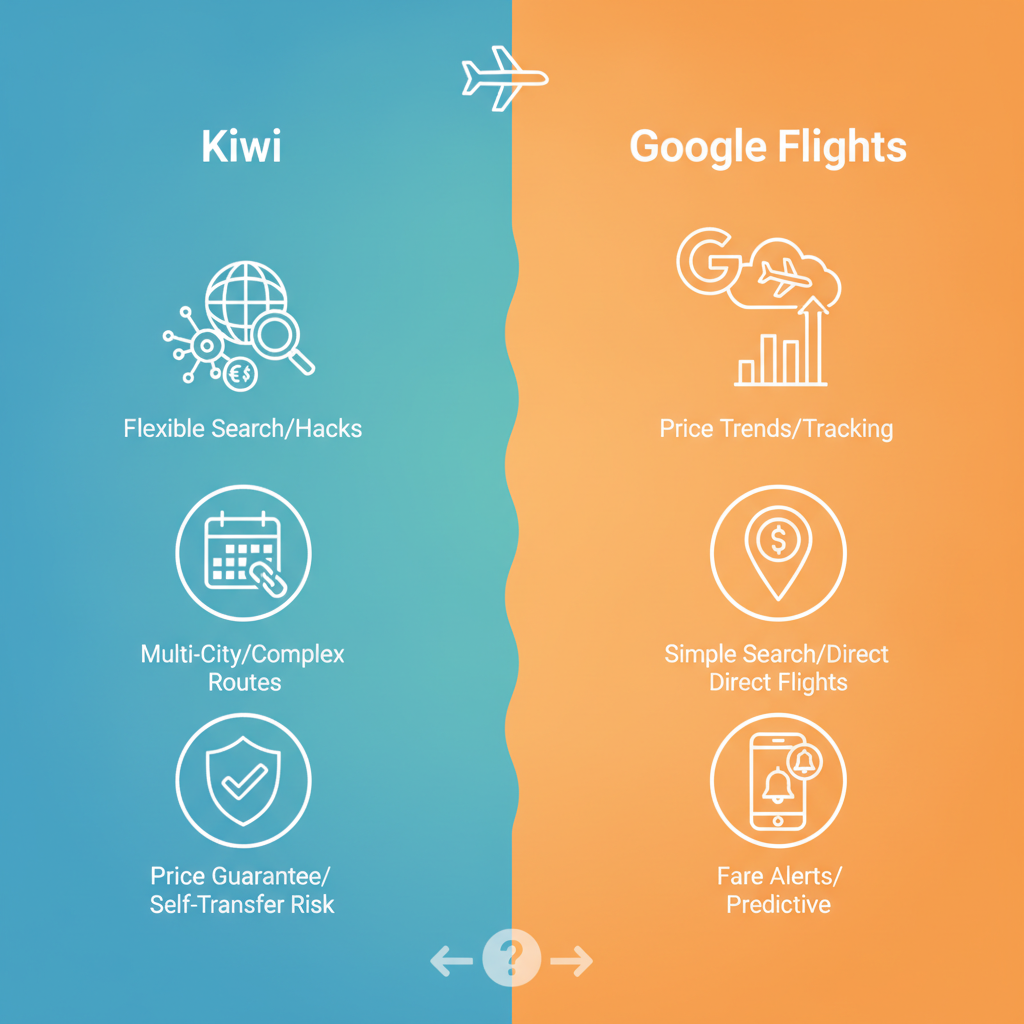
When asking which platform is better between Kiwi and Google Flights in 2026, the answer largely depends on your travel philosophy, budget, and tolerance for risk and complexity. There isn't a single universal winner; instead, each excels in different domains, catering to distinct segments of the traveling public. Understanding your own priorities is the first step to making the right choice.
Overall Winner for Most People: Google Flights. For the vast majority of travelers seeking to find and book flights, Google Flights offers a more balanced, user-friendly, and transparent experience. It acts as a powerful research tool, aggregating data from numerous sources and presenting it clearly, allowing users to compare options and then book directly with the airline or a reputable online travel agency. This direct booking model means fewer intermediaries if issues arise, leading to simpler customer support and clearer policy adherence.
Best for Advanced Users and Budget Buyers: Kiwi. If your primary goal is to unearth the absolute cheapest possible itinerary, especially for complex multi-leg or international journeys that involve mixing airlines (including low-cost carriers), Kiwi is unparalleled. Its virtual interlining technology can construct routes that other platforms simply won't find, offering significant savings. However, this demands a traveler who is comfortable with managing separate tickets, baggage re-checks, and potential visa requirements during self-transfers. Advanced users appreciate the granular control and unique flight combinations Kiwi provides.
Best for Long-Term Ownership (Research Tool): Google Flights. As a long-term research companion, Google Flights shines. Its price tracking features, flexible date calendars, and intuitive interface for exploring destinations by budget make it an invaluable tool for planning future trips, even if you don't book through one of its linked partners every time. It helps users understand market trends and identify optimal booking windows without any commitment.
Best Choice Per the Most Important Niche Dimensions:
- Price Competitiveness & Value: Kiwi often wins for unique, complex itineraries; Google Flights for transparent, standard routes.
- Transparency & Hidden Fees: Google Flights is superior, clearly showing final prices and linking directly to airline terms.
- Search & Discovery Experience: Both are excellent, but Kiwi for obscure routes, Google Flights for intuitive date flexibility and market overview.
- Booking Coverage & Options: Kiwi's virtual interlining gives it an edge in sheer route combinations.
- Flexibility & Policy Clarity: Google Flights, by linking to direct airline policies, offers more straightforward terms.
- Customer Support & Disruption Handling: Google Flights facilitates direct airline support, which is generally more reliable than an OTA for complex issues.
In summary, Google Flights is the go-to for straightforward, low-risk flight comparison and direct booking, while Kiwi is the specialist tool for experienced budget travelers willing to embrace complexity for maximum savings on unconventional routes.
Key Differences Between Kiwi and Google Flights
Understanding the fundamental distinctions between Kiwi and Google Flights is crucial for selecting the right tool for your travel needs in 2026. While both aim to help you find flights, their underlying business models, inventory sourcing, and traveler support mechanisms diverge significantly, leading to vastly different user experiences and risk profiles.
Product Philosophy and Business Model
- Kiwi: Operates as an Online Travel Agency (OTA). Its core philosophy revolves around 'virtual interlining' - combining flights from different, often unaffiliated, airlines (including low-cost carriers) to create unique, frequently cheaper itineraries that wouldn't appear on traditional search engines. Kiwi acts as the merchant of record, meaning you purchase tickets directly from them, not the individual airlines. This model prioritizes cost savings and route discovery above all else.
- Google Flights: Functions as a metasearch engine. It does not sell tickets directly. Instead, it aggregates flight data from hundreds of airlines and other OTAs, displaying a comprehensive overview of options. Its philosophy is to empower users with information and then direct them to the original booking source (airline or another OTA) to complete the purchase. Google Flights is a research and comparison tool, not a vendor.
Inventory Sourcing and Route Coverage
- Kiwi: Its strength lies in its ability to combine flights from virtually any airline, regardless of partnership agreements. This includes major carriers, regional airlines, and a vast network of low-cost carriers that might not appear on other aggregators. This leads to an exceptionally broad range of unique, often self-transfer, routes.
- Google Flights: Pulls data from a wide array of major airlines, alliance partners, and established OTAs. While comprehensive for standard routes and major carriers, it typically doesn't perform virtual interlining or combine non-partnered low-cost flights in the same way Kiwi does. It shows the best options available from its integrated partners.
Booking Confirmation and Merchant of Record
- Kiwi: When you book with Kiwi, you are booking with Kiwi. They issue the tickets, and your contract is with them. This means any changes, cancellations, or issues will be handled by Kiwi's customer support, which can sometimes be more complex than dealing directly with an airline, especially with multi-carrier itineraries.
- Google Flights: After selecting a flight, Google Flights redirects you to the airline's website or a third-party OTA (like Expedia, Trip.com, etc.) to complete the booking. The actual purchase contract is then with that airline or OTA, making them the merchant of record. This simplifies post-booking support as you have a direct relationship with the entity that holds your booking.
Risk Profile and Self-Transfer Scenarios
- Kiwi: Due to its virtual interlining, Kiwi frequently generates self-transfer itineraries. This means you have separate tickets for each leg of your journey, requiring you to collect and re-check baggage, clear customs/immigration, and re-enter security at layover airports. If one flight is delayed or canceled, you risk missing subsequent flights, and Kiwi's 'Kiwi.com Guarantee' aims to provide some protection, but it has specific terms and limitations.
- Google Flights: Primarily focuses on direct flights or traditional connecting flights booked on a single ticket (or within a single airline's partnership). While it might show separate ticket options, it clearly labels them, and the onus is on the user to understand the risks. By directing to direct bookings, it generally leads to lower self-transfer risk unless the user specifically seeks out and understands such complex options.
HTML Feature Breakdown Table: Kiwi vs Google Flights (2026)
| Feature | Kiwi | Google Flights |
|---|---|---|
| Business Model | Online Travel Agency (OTA) | Metasearch Engine |
| Merchant of Record | Kiwi.com | Airline or Third-Party OTA |
| Primary Goal | Finding cheapest, unique multi-carrier itineraries | Comprehensive price comparison & direct booking links |
| Virtual Interlining | Yes (Core feature, combines non-partnered airlines) | No (Primarily shows traditional connections) |
| Self-Transfer Risk | Higher (Common in itineraries, mitigated by guarantee) | Lower (Clearly labeled if present, user books direct) |
| Price Tracking/Alerts | Yes | Yes (Excellent, intuitive) |
| Flexible Date Search | Good (Month view, date range) | Excellent (Calendar view, cheapest month, explore map) |
| Customer Support | Directly from Kiwi for all booking issues | From the airline/OTA you book with |
| App Experience | Full booking & itinerary management | Search, tracking, alerts (booking external) |
| Fare Transparency | Visible at checkout, but check baggage carefully | High, directs to final merchant with clear breakdown |
| Where to Buy | View Deal |
These key differences highlight that while Google Flights serves as an excellent starting point for transparent research and direct booking, Kiwi offers a specialized service for those willing to navigate complexity for potentially significant cost savings on unique routes.
Design, Interface, and User Experience
The user experience (UX) of a flight booking platform can significantly impact the efficiency and enjoyment of planning a trip. In 2026, both Kiwi and Google Flights offer robust interfaces, but they cater to different user flows and priorities, which is reflected in their design and functionality.
Google Flights: Intuitive Clarity and Powerful Research
Google Flights is renowned for its clean, intuitive, and highly responsive interface. Its design prioritizes clarity and speed, making it exceptionally easy for users to find the information they need quickly. Key aspects of its UX include:
- Flexible Date Search: This is arguably Google Flights' strongest feature. The interactive calendar view immediately shows the cheapest days to fly for a given month, and the date grid allows for quick comparison of various departure and return date combinations. This visual approach is invaluable for flexible travelers.
- Explore Map: For travelers unsure where to go, the 'Explore' feature on a map allows users to input their departure city and budget, then see various destinations and their flight prices. This discovery tool is excellent for spontaneous or budget-driven travel inspiration.
- Advanced Filters: Google Flights offers a comprehensive set of filters, including stops, airlines, departure/arrival times, duration, and even aircraft type. These are logically organized and easy to apply, allowing users to quickly narrow down options without feeling overwhelmed.
- Price Alerts: Setting up price alerts is straightforward, with notifications sent via email when fares change for a tracked route. The historical price graph also provides insight into typical price fluctuations, helping users decide when to book.
- Speed and Responsiveness: The platform is consistently fast, with search results loading almost instantly, even for complex queries. This responsiveness contributes significantly to a positive user experience.
The overall experience with Google Flights is one of empowerment through information. You get a clear, unbiased view of the market, allowing you to make an informed decision before being handed off to the booking provider. The lack of direct booking means less clutter and fewer upsells on the Google Flights interface itself, focusing purely on the search and comparison.
Kiwi: Granular Control for Complex Itineraries
Kiwi's interface, while also modern and functional, is designed to handle the complexity of its virtual interlining model. It provides granular control and detailed information necessary for managing multi-carrier, self-transfer itineraries. Its UX strengths include:
- Nomad Search: This unique feature allows users to input multiple destinations they want to visit and the duration for each stay. Kiwi then finds the cheapest possible multi-city itinerary, often involving unconventional routes. This is a game-changer for digital nomads or backpackers.
- Anywhere Search: Similar to Google Flights' 'Explore' feature, Kiwi also allows users to search for flights to 'Anywhere' within a specified budget and dates, encouraging destination discovery, particularly for budget travelers.
- Detailed Itinerary Breakdown: For self-transfer flights, Kiwi provides crucial details such as estimated transfer time, baggage re-check requirements, and even visa warnings for layover countries. This level of detail is essential for managing the inherent risks.
- Customizable Filters: Kiwi offers robust filtering options, including carriers, stops, duration, and even specific transfer airports. While extensive, the sheer volume of options can sometimes be a bit much for novice users.
- Booking Flow: The booking process on Kiwi is direct, as you are booking with them. It is generally straightforward, though it includes options for their 'Kiwi.com Guarantee' and other add-ons, which can make the checkout longer than a simple redirect.
Kiwi's UX is about providing the tools and information to manage complexity. It acknowledges the challenges of virtual interlining and tries to equip the user with the necessary details, albeit with a slightly steeper learning curve for those unfamiliar with such booking types. While not as universally clean as Google Flights, it serves its specific purpose effectively.

Pricing and Value for Money
The core promise of both Kiwi and Google Flights is to help travelers find the best prices. However, their approaches to pricing, fee structures, and the ultimate value they deliver differ significantly in 2026, reflecting their distinct business models.
Kiwi: The Hunt for Unconventional Savings
Kiwi's primary value proposition is its ability to find exceptionally low prices by leveraging virtual interlining. This often means combining flights from different airlines that do not have codeshare agreements, including numerous low-cost carriers. For complex multi-city or international itineraries, Kiwi can frequently unearth routes that are significantly cheaper than those found on traditional OTAs or even direct airline websites.
- Base Price: Often very competitive, particularly for self-transfer routes. Kiwi is designed to find the lowest possible combination of flights.
- Service Fees: As an OTA, Kiwi charges its own service fees, which are built into the displayed price or added at checkout. These are usually transparently shown before final payment.
- Baggage Fees: This is where caution is crucial. Many of Kiwi's cheapest itineraries involve low-cost carriers, which almost always charge separately for checked baggage and often for carry-on luggage beyond a small personal item. These fees are not always fully integrated into the initial price displayed by Kiwi and must be checked carefully for each leg of a multi-carrier journey.
- Add-ons: Kiwi offers various add-ons, including the 'Kiwi.com Guarantee' (protection against missed connections due to delays), seat selection, and travel insurance. While these can add value, they increase the total cost.
- Currency Conversion: Prices are displayed in your local currency, but the final transaction might be processed in a different currency, potentially incurring bank conversion fees if not managed carefully.
The value from Kiwi comes from its unique ability to stitch together cheap, complex itineraries. However, travelers must be diligent in calculating the total cost, including all baggage fees, transfer costs (e.g., airport transfers between terminals), and any desired add-ons. The lowest advertised price is rarely the final price a traveler pays for a complete, comfortable journey.
Google Flights: Transparent Comparison and Direct Booking Value
Google Flights, as a metasearch engine, doesn't add its own fees. Its value lies in its comprehensive comparison capabilities and its transparency in directing users to the final booking source. It aims to show you the best available prices from airlines and other OTAs, allowing you to choose where to book.
- Base Price: Google Flights aggregates prices from numerous sources, often displaying competitive fares. It's excellent for quickly seeing the price range for a given route and date.
- Taxes and Service Fees: Google Flights generally includes taxes and mandatory fees in its displayed prices. When it directs you to an airline or OTA, the final price on that site should closely match what Google Flights showed, though minor discrepancies can occur due to real-time changes or specific payment method fees.
- Baggage Fees: Google Flights has improved its transparency regarding baggage. It often displays a general warning about baggage fees for basic economy fares and may provide links to airline baggage policies. However, the exact cost of checked bags is ultimately determined by the airline or OTA you book with.
- Hidden Costs: Google Flights is generally very transparent. Any additional fees (like seat selection or insurance) are typically added by the final booking provider, not by Google Flights itself.
- Price Trends: A unique value proposition is its ability to show price trends, informing you whether prices are likely to rise or fall, helping you decide when to book for optimal savings.
The value from Google Flights is in its efficiency as a research tool. It empowers users to find the best deal from a reliable source and book directly, potentially avoiding intermediary fees and complexities. While it might not find Kiwi's ultra-cheap virtual interlining routes, it provides a clearer, more predictable total cost for standard bookings.
HTML Pricing and Value Table: Kiwi vs Google Flights (2026)
Prices, availability, fees, and cancellation rules can change by route, date, supplier, and country. Always confirm the final terms at checkout before booking.
| Aspect | Kiwi | Google Flights |
|---|---|---|
| Price Aggregation | Virtual interlining for lowest possible combinations | Comprehensive metasearch from airlines & OTAs |
| Merchant Fees | Kiwi's own service fees (built into price or added) | None (redirects to merchant) |
| Baggage Transparency | Requires careful manual checking for multi-carrier legs | General warnings, links to airline policies |
| Total Cost Clarity | Can be complex due to multiple carriers & add-ons | High, directs to final merchant with clear breakdown |
| Price Trend Tools | Basic price alerts | Excellent historical data & prediction |
| Best for Savings | Unconventional, complex, self-transfer itineraries | Standard routes, identifying optimal booking times |
| Where to Buy | View Deal |
View current offers on Kiwi | Compare prices on Google Flights
Pros and Cons
Every travel booking platform comes with its own set of advantages and disadvantages. For Kiwi and Google Flights, these often reflect their core business models and target audiences. Weighing these pros and cons carefully in 2026 is essential for making an informed decision about which tool best suits your travel style and priorities.
Kiwi: Pros and Cons
- Pros:
- Unbeatable Price Discovery: Kiwi's virtual interlining often finds the absolute cheapest flight combinations, particularly for complex, multi-leg international itineraries that other platforms miss.
- Extensive Route Coverage: By combining flights from non-partnered airlines, including numerous low-cost carriers, Kiwi offers an incredibly vast array of unique routes and connections.
- Nomad & Anywhere Search: Innovative tools for travelers with flexible destinations and dates, making trip planning for multi-city adventures or spontaneous getaways highly efficient.
- Kiwi.com Guarantee: Offers some protection against missed connections due to delays or cancellations on self-transfer itineraries, which is a significant value-add for this high-risk booking type.
- Comprehensive App: A fully functional app for booking, managing itineraries, and receiving updates, essential for complex trips.
- Flexible Search Filters: Granular control over search parameters, allowing users to fine-tune their results.
- Cons:
- High Complexity & Risk: Self-transfer itineraries often involve separate tickets, baggage re-check, and potential visa issues, increasing the logistical burden and risk of missed connections despite the guarantee. This is a deal-breaker for many.
- Customer Support Challenges: As an intermediary, resolving issues with multiple airlines can be slower and more complicated than dealing directly with a single carrier, especially during urgent disruptions.
- Hidden Costs (Baggage): The lowest prices often exclude baggage fees, which can significantly inflate the final cost, especially on multi-carrier trips where each leg might have different rules.
- Cancellation & Refund Process: Can be more complex and slower than direct airline refunds, as Kiwi must act as an intermediary, adhering to the policies of multiple carriers.
- Less Transparency on Policy: While Kiwi has its own guarantee, interpreting and applying policies across multiple airlines can lead to confusion.
- Potential for Stress: The inherent complexity of virtual interlining can be a source of stress for less experienced or risk-averse travelers.
Google Flights: Pros and Cons
- Pros:
- Superior Price Research & Transparency: Excellent for comparing prices from various airlines and OTAs, with high transparency on what's included and a clear handoff to the booking provider.
- Intuitive User Experience: Clean, fast, and easy-to-use interface with powerful flexible date tools, price calendars, and an 'Explore' map for destination discovery.
- Direct Booking Confidence: By linking directly to airline websites, Google Flights ensures you book with the primary vendor, simplifying customer support and loyalty program benefits.
- Reliable Price Tracking & Alerts: Robust and accurate price alert system with historical data, helping users identify optimal booking times.
- Minimal Hidden Fees (from Google): As a metasearch, Google Flights doesn't add its own booking fees, and it tries to be upfront about potential baggage costs before redirecting.
- Excellent for Standard Routes: Consistently finds competitive prices and convenient schedules for direct and traditional connecting flights.
- No Merchant of Record Risk: You don't have an intermediary between you and the airline for most bookings, simplifying issue resolution.
- Cons:
- No Virtual Interlining: It won't find the highly unconventional, ultra-cheap multi-carrier itineraries that Kiwi specializes in, potentially missing out on significant savings for complex trips.
- Limited for Niche Low-Cost Carriers: While it covers many, some very small or regional low-cost airlines might be overlooked compared to Kiwi's exhaustive search.
- Not a Booking Platform: You still need to go to another site to complete the booking, which adds an extra step.
- Less Direct Control Over Itinerary Components: Primarily shows fixed itineraries; less ability to mix and match individual legs from different providers than Kiwi.
- No Intermediary Guarantee: If you book separate tickets through different links found on Google Flights, you bear the full risk of missed connections, unlike Kiwi's guarantee.
- No Dedicated Customer Support: As a search engine, it doesn't offer direct customer support for bookings, as issues are handled by the airline or OTA you ultimately choose.
For most travelers, Google Flights' pros of transparency and ease of use outweigh its cons, making it the preferred initial search tool. However, for a specific segment of budget-focused, adventurous travelers, Kiwi's unique ability to unlock extreme savings on complex routes makes its cons manageable trade-offs.
Use-Case Segmentation: Who Should Choose Which?
Choosing between Kiwi and Google Flights in 2026 isn't about one being universally superior, but rather about aligning the platform's strengths with your specific travel needs and preferences. Each tool caters to a distinct type of traveler and journey.
HTML Use-Case Comparison Table: Kiwi vs Google Flights (2026)
| Traveler Type / Use Case | Choose Kiwi If... | Choose Google Flights If... |
|---|---|---|
| Budget Traveler (Extreme Savings) | You prioritize the absolute lowest price and are willing to manage complex self-transfer itineraries, separate baggage, and potential disruptions across multiple airlines. | You want competitive prices but prefer the transparency and reduced risk of booking directly with an airline or a well-known OTA. |
| Family Travel | You are traveling with older, adaptable children and are highly budget-conscious, accepting the logistical challenges of self-transfers for savings. | You need straightforward connections, clear baggage rules, and direct airline support for a smoother, less stressful journey with young children or multiple family members. |
| Business Travel | Your company policy strictly mandates the lowest possible fare, and you are an experienced traveler comfortable with fast-paced, multi-leg, self-transfer journeys. | You need reliable, direct flights, clear policies for expense reporting, and the ability to earn loyalty points directly with an airline, prioritizing efficiency and simplicity. |
| Flexible Traveler (Dates/Destinations) | You want to visit multiple cities with open dates and are looking for the cheapest possible multi-stop itinerary (e.g., using Nomad search). | You have flexible dates for a specific destination and want to easily visualize the cheapest days to fly using a calendar view or explore destinations by budget. |
| Complex International Itineraries | You are planning a round-the-world trip or a multi-country tour, and need to piece together flights from various low-cost and major carriers to maximize savings. | You are flying long-haul but prefer traditional, single-ticket connections or direct flights, prioritizing convenience and airline-guaranteed transfers. |
| Low-Risk / First-Time Traveler | You are extremely adventurous, highly adaptable, and have a high tolerance for potential travel disruptions and self-managed solutions. | You seek peace of mind, clear policies, and direct customer support, preferring to avoid the complexities and potential risks associated with virtual interlining. |
| App-Centric Traveler | You want a single app for booking, managing complex multi-leg itineraries, and receiving real-time updates for all your disparate flight segments. | You use an app primarily for flight search, price tracking, and alerts, then prefer to complete the booking on an airline's dedicated app or website. |
Ultimately, Google Flights serves as a robust, low-risk starting point for nearly all travelers, providing comprehensive market insight. Kiwi, conversely, is a powerful specialist tool for those with very specific needs for extreme budget optimization on complex, self-managed routes.

Real-World Scenarios
To further illustrate which platform is best suited for different situations, let's consider a few real-world scenarios that travelers might encounter in 2026. These examples highlight how the distinct features and business models of Kiwi and Google Flights play out in practical terms.
Scenario 1: The Spontaneous Weekend Getaway
Traveler: Sarah, a young professional, wants to find a cheap flight for a spontaneous weekend trip from London to anywhere in Europe next month. Her dates are flexible, and she's open to various destinations, prioritizing the lowest possible round-trip fare.
- Google Flights Approach: Sarah would use Google Flights' 'Explore' map feature. She'd input London as her departure city, select her flexible dates, and browse the map to see prices to various European cities. The calendar view would quickly show her the cheapest specific days. Once she finds a destination and price she likes, Google Flights would link her directly to the airline (e.g., a low-cost carrier like Ryanair or easyJet) or a major OTA to complete the booking. This process is quick, visual, and transparent, allowing her to book directly with the carrier for a simple, single-ticket journey.
- Kiwi Approach: Sarah could use Kiwi's 'Anywhere' search with flexible dates. Kiwi would also show her various destinations and prices. However, if Kiwi found a cheaper option involving a self-transfer (e.g., London to Berlin via a separate ticket to Amsterdam), it would present that. While potentially cheaper, for a simple weekend trip, the added complexity of a self-transfer might not be worth the minimal savings, especially if she has baggage or tight connection times.
Verdict: For a spontaneous, simple weekend getaway, Google Flights is the clear winner due to its intuitive discovery tools, transparency, and direct booking links, which minimize complexity for a short trip.
Scenario 2: The Multi-Country Backpacking Adventure
Traveler: Alex, a backpacker, is planning a three-month trip through Southeast Asia in 2026, starting in Bangkok, then flying to Hanoi, then to Kuala Lumpur, and finally back to London. His dates between cities are somewhat flexible, and his absolute priority is finding the cheapest possible flights between each stop, even if it means unconventional routes.
- Kiwi Approach: Alex would leverage Kiwi's powerful 'Nomad' search. He'd input his multi-city itinerary (Bangkok, Hanoi, Kuala Lumpur, London) and his desired duration for each stay. Kiwi's virtual interlining would then work its magic, piecing together flights from various low-cost Asian carriers and potentially a budget long-haul airline for his return. This could involve self-transfers at obscure airports, but the savings could be substantial for such a complex trip. Alex would be prepared to manage baggage re-checks and understand the 'Kiwi.com Guarantee' for peace of mind.
- Google Flights Approach: While Google Flights can handle multi-city searches, it would primarily show traditional connections or direct flights from major carriers and their partners. It wouldn't combine non-partnered low-cost flights in the same way Kiwi does. Alex might find competitive prices for individual legs, but he'd have to manually search each segment and piece them together, potentially missing out on Kiwi's unique, ultra-cheap combinations. Booking each leg separately through Google Flights' links would also mean he'd bear the full risk of missed connections without an intermediary guarantee.
Verdict: For a complex, multi-country backpacking adventure where maximum savings and unconventional routes are key, Kiwi is the superior tool, thanks to its Nomad search and virtual interlining.
Scenario 3: The Business Traveler Booking a Domestic Flight
Traveler: Maria, a business traveler, needs to book a round-trip flight from New York to Chicago next month for a client meeting. Her dates are fixed, she needs a reliable airline, and prefers to book directly to earn loyalty points and ensure seamless support if her schedule changes.
- Google Flights Approach: Maria would input her fixed dates and route into Google Flights. The platform would quickly display a wide range of options from major airlines, along with their prices, flight times, and fare types (e.g., basic economy, main cabin). She could easily filter by airline, departure time, and even aircraft type. Once she selects her preferred flight, Google Flights would provide a direct link to the airline's website, allowing her to book directly, enter her loyalty number, and be confident in direct support if the flight is delayed or canceled.
- Kiwi Approach: Kiwi would also show options for New York to Chicago. It might even find a slightly cheaper option involving two different airlines or an extended layover. However, for a straightforward business trip on fixed dates, the marginal savings might not be worth the potential complexity of two separate tickets, especially given the need for reliability, direct airline communication, and loyalty benefits. Booking through an OTA like Kiwi would also mean her loyalty points might not be credited as easily, and support would be through Kiwi, not the airline.
Verdict: For a straightforward business trip prioritizing reliability, direct airline benefits, and simple support, Google Flights is the optimal choice.
These scenarios demonstrate that while Google Flights is the more versatile and generally safer option for most common travel needs, Kiwi fills a crucial niche for those who actively seek out and are prepared to manage the intricacies of highly optimized, budget-driven, complex itineraries.
Trust, Safety, and Traveler Risk
In the realm of online travel booking, trust, safety, and understanding potential risks are paramount. In 2026, both Kiwi and Google Flights operate with different levels of inherent risk, primarily due to their distinct business models and how they handle bookings and customer support.
Google Flights: High Trust, Low Booking Risk
As a metasearch engine, Google Flights inherently carries a high degree of trust and a low booking risk. Here's why:
- Brand Reputation: Google is a globally recognized and trusted brand. While Google Flights is a service, not a booking platform, its association with Google lends it immense credibility.
- Merchant of Record: Crucially, Google Flights is not the merchant of record. It directs you to the airline's official website or a reputable third-party OTA (like Expedia, Booking.com, etc.) to complete your purchase. This means your contract is directly with the airline or the chosen OTA, not with Google. This simplifies accountability if issues arise.
- Payment Safety: Since you're redirected, payment security is handled by the final booking provider (airline or OTA), which typically employs robust encryption and security protocols. Google Flights itself does not handle your payment information.
- Data Privacy: Google has comprehensive privacy policies, and while it collects search data, your personal booking data (post-redirect) is managed by the airline or OTA you choose.
- Direct Airline Policies: When you book directly via a Google Flights link, you are subject to the airline's official terms and conditions for cancellations, changes, and refunds, which are generally clear and accessible.
- Low Itinerary Complexity Risk: Google Flights primarily shows traditional, airline-guaranteed connections or direct flights. While it might sometimes show separate ticket options, these are typically clearly labeled, and the platform's default is to present lower-risk, single-ticket itineraries.
The primary risk with Google Flights is if you choose to book through a less reputable third-party OTA that Google Flights links to, or if you manually piece together separate tickets without understanding the associated transfer risks. However, Google Flights generally prioritizes linking to official airline sites or well-established OTAs, making it a reliable starting point for low-risk bookings.
Kiwi: Value with Elevated Risk and Complexity
Kiwi, as an OTA specializing in virtual interlining, offers incredible value but comes with an inherently higher level of risk and complexity compared to direct airline bookings. While Kiwi has mechanisms to mitigate some of these, travelers must be fully aware of the trade-offs.
- Brand Reputation: Kiwi is a legitimate and established OTA with a significant global presence. However, like many OTAs that deal with complex itineraries, it receives a mixed bag of customer reviews, often due to the challenges associated with its business model, rather than outright fraud.
- Merchant of Record: Kiwi is the merchant of record. Your booking contract is with them. This means any changes, cancellations, or rebooking needs must go through Kiwi, not directly through the individual airlines involved in your itinerary. This adds an intermediary layer that can complicate urgent situations.
- Payment Safety: Kiwi processes payments securely using standard encryption protocols. However, some users report issues with payment processing or unexpected charges, which often relate to currency conversion or specific bank policies rather than a lack of security.
- Data Privacy: Kiwi has its own privacy policy, and as the booking platform, it handles your personal and payment data directly.
- High Itinerary Complexity Risk (Self-Transfer): This is the biggest risk. Many of Kiwi's cheapest deals are self-transfer flights, meaning separate tickets for each leg. If one flight is delayed or canceled, you risk missing subsequent flights, and the next airline has no obligation to rebook you for free.
- Kiwi.com Guarantee: To address self-transfer risks, Kiwi offers its 'Kiwi.com Guarantee'. This promises rebooking or a refund if you miss a connection due to airline delays or cancellations. However, it has specific terms, conditions, and claim processes that travelers must understand. It's not always a seamless solution and requires traveler action.
- Visa Risk: Self-transfers can also involve passing through immigration or needing a transit visa in a country you weren't planning to enter, which is a critical risk that travelers must research independently. Kiwi provides warnings but the ultimate responsibility lies with the traveler.
- Policy Clarity: While Kiwi has its own policies, these interact with the policies of multiple individual airlines, creating a complex web of rules for cancellations, changes, and refunds.
In essence, Kiwi offers a higher-risk, higher-reward proposition. It's safe in terms of payment and legitimacy, but the operational risks of its complex itineraries and the reliance on an intermediary for support introduce significant challenges that demand a well-informed, prepared, and adaptable traveler.
App and In-Trip Experience
The mobile experience and in-trip functionality of a travel platform are increasingly vital in 2026, offering convenience and real-time support for travelers on the go. Both Kiwi and Google Flights provide mobile solutions, but their apps serve different purposes, reflecting their core business models.
Kiwi App: Your Comprehensive Itinerary Manager
Kiwi's mobile app is designed to be a full-service companion for your entire journey, especially useful for its typically complex itineraries. It offers a robust and feature-rich experience, aiming to keep all your travel details in one place.
- Full Booking Functionality: You can search, compare, and book flights directly through the app, mirroring the desktop experience.
- Itinerary Management: The app excels at organizing multi-leg, multi-carrier itineraries. It displays all flight segments, departure gates, terminal changes, and layover durations in a clear, chronological order. This is particularly crucial for self-transfer bookings.
- Real-time Updates and Alerts: Kiwi's app provides push notifications for flight status changes, gate assignments, delays, and cancellations. For self-transfer flights, these alerts are vital for managing potential disruptions.
- Offline Access: Important itinerary details, including boarding passes and booking confirmations, can often be accessed offline, which is invaluable when traveling without consistent internet access.
- Customer Support Access: The app typically offers in-app chat or direct links to customer support, making it easier to get help, especially for urgent issues during transit.
- Document Storage: You can often store boarding passes and other travel documents within the app for easy retrieval.
The Kiwi app is built for active trip management, acknowledging the inherent complexity of its bookings. It aims to empower travelers to navigate their intricate itineraries with confidence, providing all necessary information and support access on their mobile device.
Google Flights App: The Smart Search and Tracking Companion
Google Flights does not have a standalone app in the traditional sense; its functionality is integrated into the main Google app or accessible via a mobile web browser, offering a highly optimized mobile experience. Its focus is primarily on search, discovery, and price tracking rather than active booking management.
- Optimized Mobile Web: The Google Flights website is exceptionally well-designed for mobile browsers, offering a fast, responsive, and intuitive experience that mirrors its desktop counterpart.
- Seamless Search and Discovery: All the powerful search features, including flexible date calendars, 'Explore' map, and advanced filters, work flawlessly on mobile, allowing for efficient on-the-go research.
- Price Tracking and Alerts: Users can set up and manage price alerts directly from their mobile device, receiving push notifications or emails when prices change for their tracked routes.
- No Direct Booking: Since Google Flights is a metasearch engine, the app/mobile site will always redirect you to an airline's or OTA's website to complete the booking. This means your actual booking management (check-in, boarding passes, etc.) will happen on a different app or website.
- Integration with Google Ecosystem: For users logged into their Google account, searches and tracked flights can sync across devices, and flight information might integrate with Google Calendar or Google Assistant.
- Lightweight and Fast: Without the overhead of being a full booking platform, the Google Flights mobile experience is incredibly fast and efficient, focusing purely on information delivery.
The Google Flights mobile experience is an excellent research and planning tool. It excels at helping you find the right flight and track prices, but it steps aside once you're ready to book, leaving the in-trip management to the airline or OTA you ultimately choose. This means you'll likely need the airline's app for your actual boarding passes and live flight updates.
Customer Support and Disruption Handling
When travel plans go awry, reliable customer support and clear disruption handling policies become critical. In 2026, the fundamental difference in business models between Kiwi and Google Flights dictates vastly different experiences in this crucial area, particularly when dealing with urgent travel issues.
Google Flights: Empowering Direct Support
As a metasearch engine, Google Flights does not provide direct customer support for bookings because it is not the merchant of record. Its role is to connect you to the airline or OTA that actually sells the ticket. This model inherently simplifies support in one major way:
- Direct Line to the Source: When you book through a link on Google Flights, your contract is directly with the airline or the third-party OTA you choose. This means if your flight is delayed, canceled, or you need to make changes, you contact that specific airline or OTA directly. This often leads to clearer communication and faster resolution, as there's no intermediary to navigate.
- Airline Policies Apply: All changes, cancellations, and rebooking options are governed by the policies of the airline or OTA you booked with. These policies are generally well-documented on their respective websites.
- No Intermediary Delays: There's no additional layer of communication to slow down the process. You get real-time information and direct assistance from the entity responsible for your flight.
The main 'disruption handling' Google Flights offers is providing accurate, real-time flight status information (when available) and helping you find alternative flights if your original one is canceled, but it won't intervene in your booking. For travelers who value direct communication and clear accountability, Google Flights' approach to support is a significant advantage.
Kiwi: Intermediary Support with a Guarantee
Kiwi, as an OTA, is your direct point of contact for all booking-related issues. This can be a double-edged sword, especially for its complex multi-carrier itineraries:
- Centralized Support: You contact Kiwi for all issues, regardless of which airline is involved. This can be convenient for managing multiple segments through one channel.
- Support Channels: Kiwi typically offers various support channels, including a help center, email, and sometimes live chat or phone support. The availability of human support, especially during peak times or urgent situations, can vary.
- Complexity of Multi-Carrier Issues: When a delay on one airline causes you to miss a connection on another (a common scenario with virtual interlining), Kiwi acts as the intermediary. They must coordinate with multiple airlines, which can be a time-consuming and frustrating process.
- Kiwi.com Guarantee: This is Kiwi's primary disruption handling mechanism. If a delay or cancellation causes you to miss a connection on a self-transfer itinerary, the guarantee offers rebooking or a refund. However, it's crucial to understand its terms: you must contact Kiwi immediately, follow their instructions, and be aware of the specific conditions and limitations. It's a safety net, but not always a seamless, instant fix.
- Refund Process: Requesting refunds through Kiwi can be more protracted than direct airline refunds. Kiwi must first secure the refund from the airline(s) and then process it to you, which can take weeks or even months, depending on the airline's policies and the complexity of the case.
- Complaint Patterns: Third-party review platforms often show mixed reviews for Kiwi's customer support, with some travelers praising their assistance and others reporting long wait times, difficulties in communication, or challenges with the guarantee claim process, particularly for complex or high-value disruptions.
For urgent travel disruptions, especially those involving self-transfers, Kiwi's intermediary role and the reliance on its guarantee can add layers of stress and uncertainty. While the guarantee offers valuable protection, it requires active engagement from the traveler and may not always provide the instant resolution that direct airline support might.
Check Kiwi's customer support options | Find direct airline support contacts
Flexibility, Cancellations, and Refunds
The ability to change plans, cancel bookings, and secure refunds is a critical consideration for travelers in 2026. The flexibility and clarity around these policies differ significantly between Kiwi and Google Flights, primarily due to their operational models.
Google Flights: Policy Clarity Through Direct Links
Google Flights, as a metasearch engine, does not have its own cancellation or refund policies. Instead, it directs you to the booking provider (airline or OTA) whose policies will apply. This means:
- Direct Supplier Policies: When you book directly with an airline via Google Flights, you are subject to that airline's specific fare rules, cancellation windows, and refund processes. These are generally clear and accessible on the airline's website.
- Refundable vs. Non-Refundable Rates: Google Flights often highlights whether a fare is refundable or non-refundable. When you click through to book, the selected airline or OTA will clearly state the terms associated with your chosen fare class.
- Change Fees: Any fees for date changes, route alterations, or name changes are determined by the airline and its specific fare rules.
- Simpler Refund Process: If you've booked a refundable fare directly with an airline, the refund process typically involves contacting the airline directly. While still potentially taking time, it avoids an intermediary step.
- Identifying Flexible Options: Google Flights' filters often allow you to specifically search for refundable fares, making it easier to find options that offer more flexibility.
The primary advantage of Google Flights is the transparency and directness of the policies. You know exactly whose rules you are operating under, and you can consult the official source for precise terms. This gives travelers a clearer understanding of their options and potential costs for changes or cancellations.
Kiwi: Intermediary Policies and Guarantee Complexity
Kiwi, as an OTA, has its own set of policies that govern changes, cancellations, and refunds, which then interact with the policies of the multiple airlines involved in its virtual interlining itineraries. This can lead to a more complex and potentially less flexible experience.
- Kiwi's Flexi Ticket Options: Kiwi offers various 'Flexi Ticket' options at the time of booking, which allow for changes or cancellations with varying degrees of flexibility (e.g., 'Flexible Ticket' for date/time changes, 'Flexible Ticket Plus' for cancellations). These come at an additional cost. Without such an add-on, standard tickets are typically non-refundable or subject to strict airline and Kiwi fees.
- Cancellation Process: To cancel a booking, you must go through Kiwi. They then process the cancellation with each individual airline involved in your itinerary. This multi-step process can be time-consuming, and the refund amount (if any) will depend on the individual airline's fare rules for each segment, minus any Kiwi service fees.
- Refund Speed: Refunds through an intermediary like Kiwi can take significantly longer than direct airline refunds. Kiwi must receive funds from the airlines before they can process your refund, and this can be a protracted process, often extending to several weeks or even months.
- Change Fees: If you need to change a flight without a Flexi Ticket, you will likely incur both the airline's change fees for each segment and Kiwi's administrative fees. This can quickly add up, sometimes making it cheaper to book a new flight.
- Kiwi.com Guarantee and Refunds: While the Kiwi.com Guarantee protects against missed connections due to airline issues, it's not a general cancellation policy. If you cancel voluntarily, the guarantee does not apply. If the guarantee is invoked, the rebooking or refund process follows its specific terms and can still involve a degree of effort and waiting from the traveler.
- Policy Clarity: Navigating Kiwi's own cancellation policies in conjunction with the fare rules of multiple, often low-cost, airlines can be complex. Travelers must read all terms carefully at checkout to understand their rights and potential costs.
For travelers prioritizing maximum flexibility and straightforward refund processes, Kiwi's intermediary model and the complexity of managing multiple airline policies can be a significant drawback. While its Flexi Ticket options offer some recourse, they come at an extra cost and don't always match the simplicity of direct airline refundable fares.
Final Verdict
In the dynamic landscape of travel booking in 2026, both Kiwi and Google Flights offer compelling, yet distinct, value propositions. The ultimate choice between them hinges entirely on your individual travel style, budget priorities, and tolerance for complexity and risk. There is no single answer for every traveler, but rather a strategic decision based on your specific needs.
For the vast majority of travelers, particularly those prioritizing transparency, ease of comparison, and direct access to airline policies and support, Google Flights stands out as the superior starting point. It's an unparalleled research tool, offering intuitive flexible date searches, reliable price tracking, and the confidence of booking directly with the airline or a trusted third-party provider. This approach minimizes intermediary complications, making it the best choice for beginners, families, business travelers, and anyone who values a straightforward booking and post-booking experience. Google Flights empowers you to make informed decisions without becoming a party to your booking contract, simplifying issues like cancellations, changes, and refunds.
However, for a specific niche of adventurous, highly budget-conscious travelers, Kiwi remains an indispensable tool. Its innovative virtual interlining technology can unearth incredibly cheap, complex multi-carrier itineraries that no other platform can match. If your primary goal is to minimize costs on multi-city, multi-country trips, and you are prepared to actively manage the logistics of self-transfers, baggage re-checks, and potential disruptions (supported by Kiwi's guarantee), then Kiwi can deliver significant savings. It's the best choice for experienced backpackers, digital nomads, or anyone with a high tolerance for complexity in pursuit of the absolute lowest fare.
Choose Google Flights if: You want a transparent, easy-to-use search engine for comparing flight prices, tracking deals, and booking directly with airlines for a simpler, lower-risk travel experience with clear support channels.
Choose Kiwi if: You are an experienced, budget-driven traveler willing to navigate complex multi-carrier itineraries and self-transfers to unlock unique, ultra-low fares and are comfortable with an intermediary for support.
Ultimately, both platforms have their place in the modern traveler's toolkit. For a low-risk, high-transparency search, start with Google Flights. For the deepest dives into budget-optimized, complex routes, turn to Kiwi. Whichever you choose, always verify the final price, baggage rules, and cancellation policies at checkout before confirming your booking in 2026.
Still comparing? Check the latest pricing on Kiwi before deciding.
Frequently Asked Questions
Kiwi often excels at finding the absolute cheapest flights, especially for complex, multi-city itineraries that involve virtual interlining between different airlines. This can result in significant savings that Google Flights might not uncover. However, these savings often come with increased complexity and self-transfer risks. Google Flights, while competitive, focuses on transparently showing prices from airlines and major OTAs for standard routes. So, Kiwi is better for extreme budget optimization, while Google Flights is better for transparent comparison and direct booking confidence.
Google Flights is generally considered safer for booking because it's a metasearch engine that redirects you to book directly with the airline or a reputable third-party OTA. This means your contract is with the primary vendor, simplifying support and ensuring clear policy adherence. Kiwi, as an OTA, is the merchant of record for its complex virtual interlining bookings. While legitimate, its self-transfer itineraries introduce higher inherent risk, despite the Kiwi.com Guarantee, making post-booking issues potentially more challenging to resolve.
Kiwi does not typically charge 'hidden' fees in the sense of undisclosed costs, but its lowest advertised prices for multi-carrier routes often do not include baggage fees for each separate airline, which must be manually calculated. It also has its own service fees. Google Flights, as a metasearch engine, does not add its own fees and strives for high transparency, directing you to the final merchant where all costs, including taxes and known fees, should be clearly displayed. Always check the final checkout price on both platforms.
Google Flights does not offer direct customer support for bookings, as it's a search engine. Support is handled directly by the airline or OTA you book with, which is often more straightforward. Kiwi provides customer support as the merchant of record for its bookings. While it offers various channels and a Kiwi.com Guarantee for disruptions, its intermediary role and the complexity of multi-carrier itineraries can lead to slower resolution times and more challenging communication during urgent travel issues, especially compared to direct airline support.
For specific travelers, Kiwi's virtual interlining can be worth the risk in 2026. It's highly valuable for budget-conscious, experienced travelers planning complex multi-city trips who are willing to manage the logistical challenges of self-transfers (baggage re-check, potential visa needs, tight connections). The Kiwi.com Guarantee offers some protection against missed connections, but understanding its terms and being adaptable are crucial. For simple, low-risk trips, the added complexity often outweighs the potential savings.
Both platforms offer excellent tools for flexible date searches and destination discovery, but Google Flights generally has a more intuitive and user-friendly experience for most. Its interactive calendar view and 'Explore' map are exceptionally good for visualizing cheapest dates and destinations by budget. Kiwi also offers 'Anywhere' and 'Nomad' searches for multi-city discovery, which are powerful for complex itineraries. For simple date flexibility and broad destination exploration, Google Flights often edges out Kiwi due to its seamless interface.
For most travelers, booking direct via a link from Google Flights is recommended. This provides maximum clarity, direct access to airline policies, and simpler customer support. Choose Kiwi's booking service if you are specifically seeking the ultra-low fares offered by its unique virtual interlining for complex multi-carrier routes, and you are prepared to manage the increased complexity and potential risks associated with self-transfers and intermediary customer support. Always weigh the potential savings against the ease of direct booking.