
Trip.com vs Booking.com: Which Is Better for Hotels and Travel Deals?
Trip.com
Trip.com excels in offering competitive flight deals and comprehensive package bundles, particularly for international and Asian-focused travel. It's a strong choice for budget-conscious explorers willing to navigate multi-component itineraries.
View DealOverall Score
Top Picks
Trip.com
Trip.com is best for travelers prioritizing flight deals and comprehensive packages, especially for Asian destinations. Its strong flight inventory and bundled savings are key advantages.
Booking.com
Booking.com is best for travelers seeking the widest selection of accommodations, flexible booking, and reliable support. Its unparalleled hotel inventory and user-friendly experience are standout features.
Comparison
Price & Value
Transparency & Fees
Search & Booking Experience
Coverage & Availability
Flexibility & Refunds
Customer Support & Reliability
Introduction: Navigating Your Travel Bookings in 2026
In the dynamic world of online travel, choosing the right booking platform can significantly impact your trip planning, budget, and overall experience. For 2026, two global giants, Trip.com and Booking.com, continue to stand out as leading contenders for travelers seeking everything from flights and hotels to vacation rentals and activities. Each platform brings its unique strengths to the table, catering to different traveler preferences and priorities. This comprehensive comparison aims to cut through the marketing claims and provide a data-driven, editorial-quality analysis of Trip.com versus Booking.com, focusing on which is truly better for hotels and travel deals.
Whether you are a budget-conscious backpacker, a family planning a complex itinerary, or a business traveler seeking efficiency, understanding the nuances of each platform is crucial. We will delve into their pricing structures, booking experiences, flexibility options, customer support, and overall value proposition. Our goal is to equip you with the insights needed to make a confident buying decision, ensuring your travel plans for 2026 are as smooth and cost-effective as possible. By the end of this article, you'll have a clear understanding of which platform aligns best with your specific travel needs, helping you secure the best deals and peace of mind for your next adventure.
The choice between Trip.com and Booking.com often comes down to specific use cases. Some travelers prioritize vast hotel inventory and flexible payment options, while others might lean towards platforms known for comprehensive flight deals and package bundles. We'll explore these distinctions in detail, helping you identify the optimal choice for your individual travel style in the current year. Our analysis is based on official policies, available platform information, and third-party review patterns, offering a realistic perspective on what travelers can expect from each service.
As we navigate the complexities of online travel in 2026, factors like transparent pricing, reliable customer support, and robust booking coverage have become more important than ever. This guide will serve as your trusted resource, breaking down the key aspects of each platform to ensure you make an informed decision for all your hotel and travel deal bookings.
Quick Verdict
For most travelers in 2026, Booking.com generally emerges as the stronger option for its unparalleled hotel inventory, flexible booking choices, and user-friendly interface that prioritizes transparent accommodation options. It excels in offering a vast selection of hotels, apartments, and unique stays with clear cancellation policies, making it ideal for those who value variety and peace of mind. However, Trip.com shines for travelers seeking competitive flight deals and comprehensive package bundles, especially for destinations with strong Asian market connections. Its integrated approach often yields better overall package pricing when flights and hotels are booked together, appealing to budget-savvy explorers.
Choose Trip.com if you are primarily looking for competitive flight prices, especially for international routes, or if you prefer bundling flights and hotels for potential savings. It's often better for those traveling to or from Asian markets where its inventory and pricing can be particularly strong. Choose Booking.com if your priority is finding the widest selection of accommodation types with flexible booking and payment options, clear reviews, and a generally intuitive interface for hotel-centric searches. It's the safer choice for most travelers due to its extensive global reach and consistent user experience.
Choose neither if you require direct booking benefits like airline loyalty points or direct hotel status recognition, or if you prefer to deal directly with suppliers for maximum control over complex itineraries. While both platforms offer significant convenience, booking directly with an airline or hotel can sometimes simplify issue resolution and ensure access to exclusive member perks. For beginners, Booking.com's straightforward hotel search and clear display of refundable rates make it slightly more approachable. For demanding users, both platforms offer advanced filters, but Booking.com's sheer volume of options can be an advantage. Booking.com often provides better value for money in terms of accommodation variety and flexibility, while Trip.com can offer superior value on flight+hotel packages. In terms of safety for most buyers, Booking.com's established reputation and robust customer support infrastructure give it a slight edge, particularly for hotel bookings. The stronger long-term case for Booking.com lies in its continuous expansion of unique accommodation types and its global user base, solidifying its position as a go-to for diverse travel needs.
Short Answer
For most travelers in 2026, Booking.com is generally better for hotel and accommodation bookings due to its extensive inventory and flexible options. It excels in offering a wide range of properties, from hotels to unique stays, often with clear cancellation policies. Trip.com, however, often provides superior value for flight deals and comprehensive travel packages, particularly for international and Asian-focused itineraries. The decision hinges on whether your priority is a vast selection of flexible accommodations (Booking.com) or competitive bundled flight and hotel deals (Trip.com).
Rating Summary
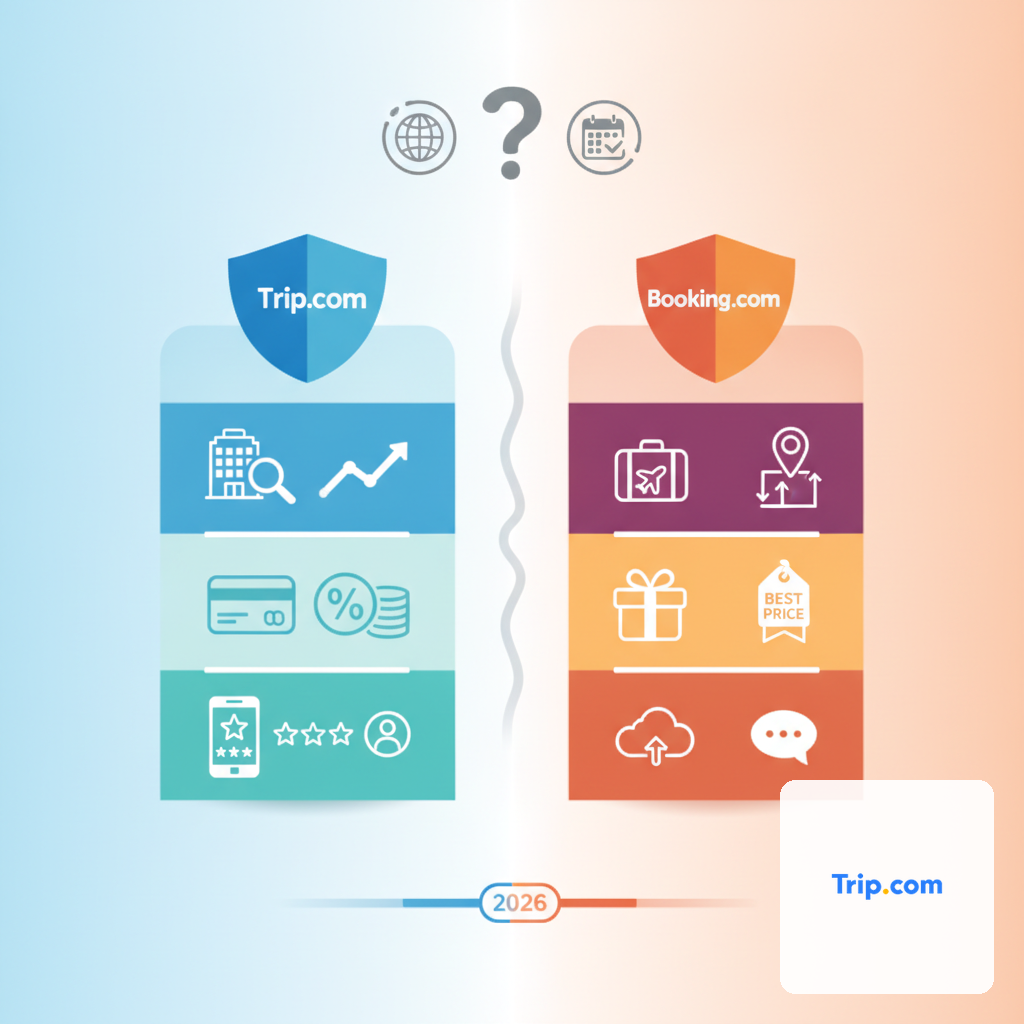
Here's a detailed rating breakdown for Trip.com and Booking.com based on key travel dimensions:
Trip.com Rating Summary
| Dimension | Score | Notes |
|---|---|---|
| Price & Value | 8.7/10 | Often highly competitive for flights and package deals, especially for specific routes. |
| Transparency & Fees | 7.9/10 | Generally clear, but travelers should scrutinize baggage and service fees at checkout. |
| Search & Booking Experience | 8.2/10 | Intuitive search with good filters, but checkout flow can feel slightly more complex for beginners. |
| Coverage & Availability | 8.5/10 | Strong flight inventory, competitive hotel coverage, particularly in Asian markets. |
| Flexibility & Refunds | 7.5/10 | Offers flexible options, but refund processing can be slower and more dependent on supplier terms. |
| Customer Support & Reliability | 7.8/10 | Multiple support channels available, but response times and resolution quality can vary. |
| Overall Rating | 8.1/10 | Best for: travelers prioritizing flight deals and comprehensive packages, especially for Asian destinations. |
Booking.com Rating Summary
| Dimension | Score | Notes |
|---|---|---|
| Price & Value | 8.5/10 | Competitive for accommodations, often with good deals and Genius loyalty discounts. |
| Transparency & Fees | 8.3/10 | Highly transparent with taxes and fees displayed upfront, though resort fees can be external. |
| Search & Booking Experience | 9.0/10 | Excellent filters, map search, and a very smooth, user-friendly booking flow for accommodations. |
| Coverage & Availability | 9.2/10 | Unmatched global inventory for hotels, apartments, and unique stays; growing flight and car rental options. |
| Flexibility & Refunds | 8.8/10 | Extensive free cancellation options and clear refund policies for most accommodation types. |
| Customer Support & Reliability | 8.5/10 | Robust 24/7 support with multiple channels and generally reliable issue resolution. |
| Overall Rating | 8.7/10 | Best for: travelers seeking the widest selection of accommodations, flexible booking, and reliable support. |
Where Trip.com Wins:
Trip.com often secures wins in the realm of flight pricing and package deals, particularly for routes connecting to or within Asia. Its strong relationships with Asian airlines can translate into exclusive fares. The platform's 'Price & Value' score reflects this strength, making it a go-to for budget-conscious travelers focused on the total cost of a bundled trip.
Where Booking.com Wins:
Booking.com dominates in accommodation coverage, search experience, and booking flexibility. Its 'Coverage & Availability' score is exceptionally high due to its unparalleled inventory of hotels, apartments, and unique stays globally. The intuitive 'Search & Booking Experience' with advanced filters and clear display of cancellation policies makes finding the perfect stay effortless. Furthermore, its 'Flexibility & Refunds' are generally more straightforward and reliable for accommodation bookings.
Where the Decision Depends on User Preference:
The choice between the two largely depends on your primary booking need. If flights are your main concern and you're open to bundling, Trip.com might be more appealing. If your trip is centered around finding the perfect hotel or vacation rental, Booking.com's strengths become more apparent. Both platforms offer decent 'Transparency & Fees' and 'Customer Support & Reliability', but individual experiences can vary based on the complexity of the issue and specific booking type.
Which Scoring Category Matters Most for This Niche:
For the travel and booking niche, Coverage & Availability and Flexibility & Refunds are often the most critical scoring categories. Travelers need confidence that they can find suitable options and that their bookings are protected if plans change. While price is always a factor, the ability to adjust or cancel a trip without undue penalty often outweighs minimal price differences, making these dimensions paramount for a confident buying decision in 2026.
Which Is Better: Trip.com or Booking.com?
Overall, for the majority of travel bookings in 2026, Booking.com edges out Trip.com as the slightly better platform, primarily due to its superior accommodation inventory and user-centric booking flexibility. Booking.com's extensive global reach, particularly in hotels, apartments, and unique stays, provides travelers with an unmatched breadth of options and transparent cancellation policies. This makes it the best for most people seeking reliable and diverse lodging. However, the 'better' choice is highly dependent on a traveler's specific needs.
For advanced users who are adept at comparing various travel components and optimizing for specific routes, Trip.com can be an excellent tool, especially when leveraging its strengths in flight and package deals. Its comprehensive integration of flights, hotels, and activities can lead to significant savings when bundled correctly. For budget buyers, the distinction becomes nuanced: Booking.com often has competitive accommodation-only prices, while Trip.com frequently wins on bundled flight+hotel deals. Therefore, budget buyers should compare both carefully based on their specific itinerary.
In terms of long-term ownership of your travel experience - meaning the ease of managing bookings, making changes, and getting support over time - Booking.com's established infrastructure and 24/7 support tend to offer a more consistent and reassuring experience. It is generally safer for most buyers due to its strong brand reputation and consistent service delivery across its core offerings. Trip.com, while reliable, can sometimes present more complexity in its refund processes, particularly for multi-component bookings where different supplier policies apply. Booking.com's stronger long-term case is rooted in its continuous innovation in accommodation types, loyalty program benefits (Genius), and localized support, ensuring a consistently positive user journey for diverse travel needs.
Key Differences Between Trip.com and Booking.com
While both Trip.com and Booking.com operate as online travel agencies (OTAs), their core philosophies, market strengths, and target user bases present distinct differences that significantly impact the booking experience. Understanding these disparities is crucial for making an informed decision in 2026. Trip.com, originating from China, has a particularly strong foothold in the Asian market and often excels in offering competitive flight deals and integrated packages. Booking.com, a European giant, is renowned globally for its vast accommodation inventory, spanning hotels, apartments, villas, and unique stays, with a strong emphasis on flexible booking options.
Their product philosophy diverges in emphasis: Trip.com aims to be a one-stop shop for all travel needs, often prioritizing bundled deals that combine flights and hotels, along with trains and activities. Booking.com, while expanding its flight and car rental offerings, remains primarily focused on accommodations, providing an unparalleled selection and a highly refined search experience for finding the perfect place to stay. This difference in focus leads to varying strengths in inventory and pricing across different travel segments. For instance, Trip.com might show more low-cost carrier options and aggressive flight-inclusive package pricing, whereas Booking.com will typically offer a deeper and more diverse selection of hotels and alternative lodging, often with more transparent display of cancellation terms.
Feature Breakdown: Trip.com vs Booking.com
| Feature Dimension | Trip.com | Booking.com |
|---|---|---|
| Primary Strength | Competitive flight deals, package bundles, Asian market focus | Vast accommodation inventory, flexible booking, user-friendly interface |
| Accommodation Types | Hotels, resorts, some apartments, hostels | Hotels, apartments, villas, hostels, B&Bs, unique stays (unmatched variety) |
| Flight Coverage | Extensive, strong for international & Asian routes, includes LCCs | Growing, good for major carriers, less focus on LCCs and complex routes |
| Package Deals | Excellent flight+hotel bundles, often with significant savings | Available, but often less competitive than dedicated flight+hotel specialists |
| Cancellation Flexibility | Varies by supplier/package; often stricter for flight-inclusive deals | Extensive 'free cancellation' options, very clear policies for accommodations |
| Loyalty Program | Trip.com Rewards (points, member tiers, exclusive offers) | Genius Loyalty Program (discounts, freebies, upgrades) |
| Customer Support Focus | Multi-language, 24/7, but resolution can be complex for bundles | 24/7 global support, strong for accommodation issues, multi-lingual |
| App Experience | Feature-rich, comprehensive travel management | Highly intuitive, excellent for accommodation management and discovery |
| Market Presence | Global, strong in Asia, rapidly expanding elsewhere | Global leader, particularly strong in Europe and North America |
| Where to Buy | View Deal |
The technical and non-technical concerns buyers care about also differ. For example, a buyer prioritizing the lowest possible flight price might find Trip.com's fare combinations more appealing, even if it means a slightly more complex booking flow or less direct control over airline-specific policies. Conversely, a buyer concerned with finding a unique stay with a very specific set of amenities and the ability to cancel without penalty will likely find Booking.com's detailed filtering and clear policy displays more reassuring. Performance differences are subtle but present: Trip.com's flight search can sometimes be faster in surfacing diverse routes, while Booking.com's hotel map search and instant booking confirmations are often industry-leading. Ultimately, the long-term fit for each platform depends on whether a traveler's core needs lean towards air travel optimization or accommodation diversity and flexibility.

Design, Interface, and User Experience
The design and user experience (UX) of a travel booking platform are paramount, directly influencing how easily and confidently a traveler can find, compare, and book their trip components. In 2026, both Trip.com and Booking.com offer polished interfaces, but their approaches and strengths differ, catering to slightly varied user preferences. Booking.com generally provides a more streamlined, intuitive, and visually uncluttered experience, especially for accommodation searches, making it highly accessible for all types of travelers. Trip.com, while comprehensive, can sometimes feel a bit more dense with information, reflecting its broader scope of services.
Booking.com's interface is celebrated for its clean layout, powerful filtering options, and highly effective map search functionality. When searching for hotels, users can easily pinpoint properties by location, price, rating, amenities, and even specific types of cancellation policies. The property pages are well-organized, with prominent display of photos, verified guest reviews, and clear breakdowns of room types and inclusions. The booking flow is typically quick and straightforward, minimizing friction from search to confirmation. This focus on clarity and ease of navigation is a significant advantage, particularly for travelers who prioritize finding the right accommodation quickly and without unnecessary distractions. The mobile app experience mirrors the desktop's efficiency, offering excellent itinerary management and notification features.
Trip.com, on the other hand, offers a robust and feature-rich interface that integrates flights, hotels, trains, cars, and activities seamlessly. Its strength lies in its ability to handle complex, multi-component itineraries within a single platform. The flight search, in particular, is highly sophisticated, offering flexible date options, multi-city searches, and detailed fare breakdowns. However, this comprehensiveness can sometimes lead to a slightly steeper learning curve for new users. While its hotel search is competent, it doesn't quite match Booking.com's depth of filters or the sheer volume of unique accommodation types. The visual design, while modern, occasionally presents more information simultaneously, which can be overwhelming for some users. For example, when comparing various flight options, the sheer number of parameters and potential add-ons requires careful attention. The app is also highly functional, offering similar integrated management capabilities.
Ultimately, the choice depends on what features matter most to buyers. If a buyer prioritizes a seamless, accommodation-focused search with clear visual cues and minimal steps to book, Booking.com is likely the preferred option. If the priority is a powerful, integrated tool for planning complex trips that heavily involve flights and possibly train travel, Trip.com's more feature-dense environment might be more beneficial. Both platforms excel at displaying real-time availability and prices, but Booking.com's consistent focus on user-friendly accommodation discovery gives it an edge in the overall user experience for hotel and lodging bookings.
Pricing and Value for Money
When it comes to pricing and value for money in 2026, both Trip.com and Booking.com are highly competitive, but their strengths often lie in different areas. Booking.com typically offers excellent value for accommodation-only bookings, often featuring a wide range of deals, loyalty discounts, and transparent pricing. Trip.com frequently provides superior value for flight bookings and bundled flight+hotel packages, making it a strong contender for those looking to save on the total trip cost. It's crucial for travelers to compare final checkout prices on both platforms, as advertised rates can sometimes differ significantly from the total amount due after all fees and taxes are applied.
Booking.com's pricing strategy for hotels is often characterized by its 'Genius' loyalty program, which offers tiered discounts (10-20% off), free breakfast, or room upgrades to repeat customers. This program significantly enhances value for frequent users. The platform is also known for its 'pay at property' options and extensive free cancellation rates, which, while sometimes slightly more expensive upfront, offer invaluable flexibility. Price transparency is generally high, with taxes and service fees usually integrated into the displayed price early in the booking process. However, travelers should always double-check for any local city taxes or resort fees that might be collected directly by the property upon arrival, as these are sometimes excluded from the initial online total, though Booking.com usually highlights such exclusions.
Pricing and Value Comparison: Trip.com vs Booking.com
| Pricing Aspect | Trip.com | Booking.com |
|---|---|---|
| Base Price Competitiveness | Very strong for flights and flight+hotel packages | Very strong for accommodation-only bookings |
| Taxes & Service Fees | Generally clear, but may add up for complex itineraries | Highly transparent, usually included upfront for accommodations |
| Hidden Cost Risk | Medium - baggage fees, specific payment surcharges can appear | Low for accommodations - watch for external resort/city fees |
| Loyalty Program Value | Trip.com Rewards offer points and member discounts | Genius Loyalty Program offers significant tiered discounts & perks |
| Payment Flexibility | Varied, pre-payment often required for best deals | Excellent, 'pay at property' and flexible cancellation common |
| Currency Conversion | Supports multiple currencies, check exchange rates carefully | Supports multiple currencies, generally transparent rates |
| Where to Buy | View Deal |
Prices, availability, fees, and cancellation rules can change by route, date, supplier, and country. Always confirm the final terms at checkout before booking.
Trip.com's value proposition often shines when booking flights, particularly international routes where it can undercut competitors. Its package deals, bundling flights and hotels, are frequently where the most significant savings can be found, making it attractive for travelers planning a complete vacation. However, travelers need to be diligent in checking what is included in these packages, such as baggage allowances and transfer fees, as these can add to the total cost. Trip.com's loyalty program, Trip.com Rewards, offers points that can be redeemed for future bookings and grants member-exclusive prices, providing incremental value for repeat users. While generally transparent, some specific payment methods or additional services might incur small, clear fees at checkout.
The "total trip cost" is where the real comparison lies. For a flight-heavy international trip, Trip.com might offer a lower overall price. For a domestic weekend getaway focused on a specific hotel, Booking.com is often more competitive and transparent. Therefore, the savvy traveler in 2026 should check both platforms for their specific itinerary, paying close attention to the final price displayed before confirming payment, and considering the value of flexibility and loyalty programs in their overall assessment.
Pros and Cons: Trip.com vs Booking.com
Understanding the strengths and weaknesses of each platform is key to choosing the right one for your travel needs in 2026. Both Trip.com and Booking.com offer compelling reasons to choose them, but also present certain trade-offs.
Trip.com
- Pros:
- Competitive Flight Prices: Often provides some of the best deals on flights, especially for international and Asian routes.
- Excellent Package Deals: Strong discounts when bundling flights and hotels, simplifying comprehensive trip planning.
- Robust Train Booking: Offers extensive train ticket options, particularly useful for travel within Europe and Asia.
- Global Coverage (Asia Focus): Particularly strong inventory and pricing for destinations in Asia, beneficial for regional travel.
- Integrated Platform: A true one-stop shop for flights, hotels, trains, cars, and tours, all within a single app.
- Loyalty Program (Trip.com Rewards): Earn points and access member-exclusive pricing and benefits.
- Multi-language Support: Customer service available in various languages, catering to a global user base.
- Detailed Flight Filters: Advanced options for searching specific airlines, layovers, and times.
- Cons:
- Accommodation Inventory: While good, it doesn't match Booking.com's sheer breadth and depth of unique properties.
- Refund Process Complexity: Can be slower and more reliant on individual supplier policies, especially for bundled trips. This can be a deal-breaker for travelers needing maximum refund flexibility.
- Customer Support Consistency: While 24/7, the quality and speed of resolution can sometimes vary based on the issue's complexity.
- User Interface Density: Can feel a bit cluttered with information, potentially overwhelming for beginners compared to Booking.com's clean layout.
- Hidden Cost Risk (Baggage): Travelers must carefully check baggage allowances and fees, especially with low-cost carrier flights in packages.
- Less Pay-at-Property Options: Fewer flexible payment options for hotels compared to Booking.com, often requiring upfront payment for best rates.
- Less Focus on Unique Stays: Stronger on traditional hotels than independent vacation rentals or boutique properties.
- Disruption Handling: Rebooking support for complex self-transfer flights or packages can be more challenging than direct airline bookings.
Booking.com
- Pros:
- Unrivaled Accommodation Inventory: Offers the widest selection of hotels, apartments, villas, hostels, and unique stays globally.
- Exceptional Flexibility: Abundance of 'free cancellation' and 'pay at property' options for accommodations.
- User-Friendly Interface: Clean, intuitive design with powerful filters and an excellent map search for hotels.
- Transparent Pricing: Generally shows total costs upfront for accommodations, reducing hidden fee surprises.
- Robust Guest Reviews: Verified, comprehensive reviews with detailed scoring, aiding confident decision-making.
- Genius Loyalty Program: Offers immediate and tangible benefits (discounts, upgrades) for repeat bookers.
- Reliable Customer Support: 24/7 global support, generally efficient for accommodation-related issues.
- Strong Mobile App: Seamless booking and in-trip itinerary management, notifications.
- Cons:
- Flight Deals: While improving, its flight prices and inventory are generally not as competitive as Trip.com or dedicated flight search engines. This can be a minor trade-off if flights are not your primary concern.
- Package Deal Value: Bundled flight+hotel packages often don't offer the same aggressive discounts as Trip.com.
- External Resort/City Fees: Occasionally, properties will charge additional fees (resort fees, city taxes) directly, which are disclosed but not included in the initial online payment. This is a minor trade-off, but requires awareness.
- Less Focus on Trains: Not a primary platform for train bookings outside of limited integrations.
- Limited Complex Itinerary Support: While good for individual components, complex multi-leg flights or self-transfers are not its strong suit.
- Less Aggressive on Low-Cost Carrier Flights: May not surface as many ultra-budget flight options as Trip.com.
- Car Rental Integration: Available, but often redirects to partner sites, not fully integrated.
- Potential for Overwhelm (Accommodation): While a pro for variety, the sheer number of options can sometimes be overwhelming for indecisive travelers.
Flexibility, Cancellations, and Refunds
The ability to modify or cancel travel plans without incurring significant penalties is a critical factor for many travelers, especially in 2026 where plans can change unexpectedly. Both Trip.com and Booking.com offer options for flexibility, but their approaches, clarity, and efficacy in handling cancellations and refunds differ significantly. Booking.com generally excels in offering superior flexibility and clearer refund processes for accommodation bookings, while Trip.com's flexibility can be more varied and complex, particularly for flight-inclusive packages.
Booking.com has built its reputation on providing extensive 'free cancellation' options for hotels and other accommodations. When searching, users can easily filter for properties that offer free cancellation up to a certain date, often just 24-48 hours before check-in. This gives travelers immense peace of mind, allowing them to book early to secure desired properties while retaining the option to change plans without financial loss. The platform clearly delineates refundable, partially refundable, and non-refundable rates, making it easy for travelers to understand the terms before committing. For 'pay at property' bookings, cancellation is often a straightforward process, directly managed through the platform or with the property. Refund processing for prepaid, refundable bookings is typically efficient, adhering to the stated policy timelines.
Trip.com also offers flexible booking options, but these are often more contingent on the specific supplier's policies and the type of booking (flight, hotel, package). For flights, flexibility depends heavily on the fare class purchased; cheaper economy fares are usually non-refundable or incur significant change fees. While Trip.com does offer 'flexible' flight options, these are generally more expensive. For hotels, free cancellation is available, but the availability and terms can sometimes be less pervasive or clearly highlighted than on Booking.com. When it comes to package deals, flexibility is often reduced, as changes or cancellations involve coordinating multiple suppliers (airline, hotel), leading to potential fees from each component. Refund eligibility and speed for Trip.com bookings can sometimes be a point of concern for travelers, with reports suggesting longer processing times, especially for complex or multi-component cancellations where the platform acts as an intermediary between multiple vendors. The refund process itself often requires submitting a request and waiting for supplier approval, which can introduce delays.
For travelers with uncertain plans, Booking.com's transparent and widespread free cancellation policies for accommodations make it the lower-risk option. Its clear policy pages and straightforward cancellation handling reduce ambiguity. Trip.com's strength in competitive pricing for less flexible options means travelers must be extra vigilant in reading the fine print, especially for bundled deals. Understanding the fare rules, cancellation deadlines, and potential fees upfront is paramount to avoid disappointment. The risk for Trip.com is higher if you anticipate needing to change or cancel a flight-heavy or package booking, as the process can be more involved and the outcomes less certain compared to Booking.com's accommodation-focused flexibility.
Customer Support and Disruption Handling
Effective customer support and robust disruption handling are non-negotiable for travel platforms, especially when urgent issues arise before or during a trip. Both Trip.com and Booking.com offer 24/7 customer support, but their approaches, response times, and efficacy in resolving complex problems can differ. Booking.com generally provides more consistent and reliable customer support, particularly for accommodation-related issues, with a strong emphasis on global accessibility. Trip.com's support is comprehensive but can face challenges with complex bundled bookings or during peak demand, potentially leading to varied resolution experiences.
Booking.com boasts a highly developed customer support infrastructure with 24/7 assistance available via phone, live chat, and a comprehensive help center. Their support staff are generally well-versed in handling accommodation-specific issues such as booking modifications, cancellations, payment problems, and overbooking scenarios. The platform often acts as a direct liaison between the traveler and the property, streamlining communication and problem-solving. In cases of disruption like a hotel cancellation or significant change by the property, Booking.com often provides rebooking support, helping travelers find alternative accommodations. Their multilingual support ensures that travelers can get help regardless of their location or native language, contributing to a sense of reliability and trust during urgent travel problems.
Trip.com also offers 24/7 customer support across multiple channels, including phone, email, and in-app chat. They are particularly responsive for flight-related queries and simpler booking changes. However, user reviews sometimes indicate that resolution for more complex issues, especially those involving multi-component package deals or self-transfer flight itineraries, can be more challenging. When a flight is delayed or cancelled, or a hotel booking goes awry within a package, Trip.com acts as an intermediary, and the resolution process often depends on coordinating with multiple suppliers, which can extend response times and complicate rebooking support. While they offer emergency support, the journey to a resolution might require more patience and persistence from the traveler. Their help center is extensive, but finding specific answers for nuanced disruption scenarios can sometimes be less intuitive.
For critical situations like missed connections due to self-transfer flights or last-minute changes from a supplier, the efficiency of customer support becomes paramount. Booking.com's focus on accommodations allows for a more direct and often quicker resolution for hotel-related problems. Trip.com's broader scope, while offering convenience, can introduce layers of complexity when things go wrong, as different supplier policies must be navigated. Travelers who prioritize guaranteed human support and a smooth resolution process for their bookings, especially high-value ones, might find Booking.com's support slightly more reassuring. Conversely, travelers using Trip.com for complex flight itineraries should be aware of the potential for more involved support interactions if disruptions occur, and consider additional travel insurance to mitigate risks.
Trust, Safety, and Traveler Risk
Trust, safety, and understanding traveler risk are foundational concerns when booking travel online in 2026. Both Trip.com and Booking.com are legitimate, established global brands, but the inherent risks associated with different booking types and their respective platform policies warrant careful consideration. Booking.com generally presents a lower risk profile for accommodation bookings due to its transparent policies, vast network of verified properties, and robust payment security. Trip.com is also safe, but its emphasis on complex flight itineraries and bundled packages can introduce higher risk elements related to self-transfer flights and multi-supplier dependencies.
Booking.com maintains a strong brand reputation and significant market presence, making it a trusted choice for millions of travelers. Its payment security measures are industry-standard, utilizing HTTPS and secure payment partners to protect sensitive data. For accommodations, the platform features verified guest reviews, which help travelers assess the legitimacy and quality of properties, reducing the risk of booking a subpar or fraudulent stay. While issues like overbooking can occur, Booking.com typically offers rebooking support or compensation, mitigating traveler impact. The risk of hidden costs for accommodations is generally low, provided travelers are aware of any potential external resort or city fees disclosed on the property page. Data privacy policies are clearly outlined, adhering to global regulations, further enhancing trust.
Trip.com also operates as a legitimate and secure platform, employing robust payment security and data handling practices. Its global presence and affiliations with major airlines and hotel chains underscore its credibility. However, some booking scenarios on Trip.com can carry a higher inherent risk. For example, its strength in surfacing competitive flight deals sometimes includes "self-transfer" or "virtual interlining" itineraries, where separate tickets are booked for connecting flights. If a delay on the first flight causes a missed connection, the traveler is typically responsible for rebooking the subsequent flights, potentially incurring significant costs and stress. This "transfer risk" is a critical factor for cautious or inexperienced travelers. Similarly, package bookings, while offering savings, can centralize risk: if one component (e.g., the airline) fails, the entire package may be affected, and resolution depends on Trip.com's ability to coordinate with multiple suppliers.
Booking directly with an airline or hotel often provides a simpler, lower-risk alternative, especially for straightforward itineraries, as it streamlines communication and issue resolution to a single entity. Using an OTA like Trip.com or Booking.com introduces an intermediary layer. For simple, direct hotel bookings, Booking.com's risk is comparable to booking direct, given its strong support. For complex flight itineraries or self-transfer risks, Trip.com users should exercise greater caution, consider travel insurance, and thoroughly understand the terms of their booking. Both platforms are generally safe for sensitive travel data and payments, but the complexity of the chosen itinerary significantly influences the overall traveler risk profile in 2026.
App and In-Trip Experience
The mobile app and the overall in-trip experience offered by a booking platform are increasingly vital for modern travelers, providing convenience, real-time information, and support on the go. Both Trip.com and Booking.com offer highly functional mobile applications, but their strengths and focus areas reflect their core service offerings. Booking.com's app provides a seamless and intuitive experience for managing accommodation bookings, with excellent itinerary tracking and push notifications. Trip.com's app is a comprehensive travel management hub, particularly strong for multi-component trips involving flights and trains, offering robust offline access and alerts.
Booking.com's app is a standout for its user-friendliness and efficiency, especially for hotel and accommodation management. Travelers can easily access their booking confirmations, check-in details, and property contact information directly within the app. The itinerary management feature is clean and straightforward, providing clear directions to properties and displaying key booking details. Push notifications are highly effective, reminding users of check-in times, special offers, and changes to their bookings. The app also facilitates easy communication with property hosts or customer support, making it invaluable for resolving on-the-spot issues. While it integrates flights and car rentals, its primary strength remains accommodation management, offering a highly optimized experience for finding and managing places to stay. User reviews consistently praise its speed, reliability, and ease of use during travel.
Trip.com's app is designed to be an all-encompassing travel companion, reflecting its 'one-stop shop' philosophy. It allows users to manage flights, hotels, trains, and activities from a single interface. Key features include real-time flight status updates, mobile boarding passes, hotel e-vouchers, and train tickets. A significant advantage is its robust offline access, allowing travelers to view their itineraries and important documents even without an internet connection, which is incredibly useful in areas with limited connectivity. The app also provides price alerts, helping users track fares for future trips, and offers destination recommendations. For travelers with complex itineraries involving multiple modes of transport, Trip.com's app provides a centralized hub for all their travel documents and updates. While its interface can feel slightly more feature-dense than Booking.com's, its comprehensive nature is a major benefit for those juggling various booking types.
The choice between the two apps depends on your travel style. If your trips are primarily focused on accommodations and you value a minimalist, highly efficient interface for managing your stays, Booking.com's app will likely serve you better. If you frequently book flights, trains, and multiple components, and appreciate a powerful, integrated tool that can handle diverse bookings and offers offline access, Trip.com's app provides a more comprehensive in-trip experience. Both apps offer in-app customer support access, ensuring that help is just a few taps away, though the efficacy of that support can vary as discussed in the previous section.
Use-Case Segmentation: Who Should Choose Which?
The optimal choice between Trip.com and Booking.com in 2026 largely depends on a traveler's specific needs, priorities, and booking patterns. Neither platform is universally superior; instead, each excels in catering to particular use cases. Understanding these segments helps travelers make the most confident and beneficial decision for their next journey.
Use-Case Comparison Table: Trip.com vs Booking.com
| If You Are/Want... | Choose Trip.com If... | Choose Booking.com If... |
|---|---|---|
| A Budget Traveler | You prioritize finding the absolute cheapest flight or flight+hotel package, especially for international routes. | You need competitive prices on a wide range of flexible accommodations, from hostels to budget hotels. |
| A Family Traveler | You are booking a comprehensive package deal (flight+hotel) and need to manage all components in one place. | You need a wide selection of family-friendly accommodations (apartments, villas) with clear amenities and room configurations. |
| A Business Traveler | Your priority is competitive flight prices and efficient booking of multi-leg air travel. | You need a vast selection of business hotels with flexible cancellation and transparent expensing options. |
| A Luxury Traveler | You are looking for premium flight deals or luxury package bundles to specific destinations. | You want access to a curated selection of high-end hotels, resorts, and unique luxury stays with exceptional flexibility. |
| A Solo/Backpacker | You are searching for budget-friendly flights and potentially integrated train travel for complex itineraries. | You need a diverse range of hostels, budget accommodations, and unique local stays with strong reviews. |
| A Flexible Traveler | You are comfortable with potential refund complexities for cheaper flight fares but want competitive air travel. | You need extensive 'free cancellation' options and 'pay at property' flexibility for your accommodations. |
| Booking a Complex Itinerary | Your itinerary involves multiple flights, possibly trains, and a desire to bundle them for potential savings. | Your complexity is in finding the perfect, unique accommodation across multiple cities with varying needs. |
| A Low-Risk Booker | You are booking straightforward flight-only trips or are comfortable with the terms of packaged deals. | You prioritize clear, reliable accommodation bookings with strong cancellation policies and direct property communication. |
| Traveling Internationally | You are traveling to/from or within Asia, or seeking competitive international flight routes. | You need a globally diverse selection of accommodations in any international destination. |
| Last-Minute Booker | You are scrambling for a last-minute flight deal, which Trip.com can sometimes surface aggressively. | You need immediate confirmation for last-minute hotel rooms, often with available flexible rates. |
For travelers who prioritize flight-centric travel and bundled savings, Trip.com often presents a more compelling option. Its strength in sourcing competitive airfares, particularly for international and Asian routes, makes it an indispensable tool for budget-conscious globetrotters. The integrated nature of its platform, allowing for seamless booking of flights, hotels, and trains, caters well to those planning a comprehensive trip through a single portal. However, these benefits come with the caveat that flexibility, particularly for bundled deals, might be less straightforward than booking individual components or using a platform specialized in accommodation flexibility.
Conversely, for individuals whose travel revolves primarily around finding the perfect accommodation with maximum flexibility and choice, Booking.com is the undisputed leader. Its unparalleled inventory, ranging from luxury hotels to quaint B&Bs and unique vacation rentals, ensures that every traveler can find a stay that meets their specific requirements. The transparent display of 'free cancellation' options and 'pay at property' flexibility provides significant peace of mind, making it ideal for those who anticipate potential changes to their plans. While Booking.com's flight offerings are improving, they are generally not its core strength, meaning travelers primarily focused on flight deals might need to look elsewhere or use it in conjunction with other platforms. Ultimately, the best choice is the one that most closely aligns with your primary booking need and risk tolerance in 2026.
Real-World Scenarios
To illustrate how the choice between Trip.com and Booking.com plays out, let's consider a few real-world traveler scenarios for 2026.
Scenario 1: The International Budget Explorer
Imagine Sarah, a budget-conscious student planning a two-week trip from London to Tokyo, including a few nights in Kyoto. Her main priority is finding the cheapest possible flights and affordable, clean hotels. She's willing to manage some complexity if it means significant savings. Sarah would likely start her search on Trip.com. She'd use its powerful flight search to compare various airlines, including low-cost carriers, and then look for flight+hotel packages. Trip.com's strong presence in the Asian market often gives it an edge for these routes and bundled deals. She would carefully review baggage allowances and any self-transfer risks for potential layovers, but the overall cost savings would be her driving factor. She might secure a package that includes a flight and her first few nights in Tokyo, then use Trip.com's train booking feature for her Kyoto leg. The potential for a slightly more complex refund process for the package is a known trade-off for her budget goals.
Scenario 2: The Family Vacation Planner
The Chen family (two adults, two young children) is planning a week-long summer vacation to a popular European beach destination. Their priorities are a spacious, family-friendly apartment or hotel with a pool, a good location, and flexible cancellation options in case one of the kids gets sick. They're also concerned about verified reviews to ensure the property is safe and suitable. For the Chens, Booking.com would be the clear choice. Its unparalleled inventory of apartments, villas, and hotels with robust filters for amenities (pool, kitchen, cribs, family rooms) allows them to pinpoint the perfect stay. Crucially, Booking.com's extensive 'free cancellation' options provide the peace of mind they need, allowing them to book well in advance without worrying about unforeseen circumstances. They would rely heavily on Booking.com's verified guest reviews to ensure the property meets their family's specific needs for comfort and safety. While they might check flights separately, their primary booking for accommodation would be through Booking.com.
Scenario 3: The Business Trip Organizer
David, a frequent business traveler, needs to book a flight and a hotel for a three-day conference in a major North American city. His priorities are a direct flight, a reputable hotel close to the convention center, and easy expense reporting. He values efficiency and reliable customer support if his schedule changes. For David's hotel booking, Booking.com would be his go-to. Its vast selection of business-friendly hotels, often with corporate rates or loyalty program benefits, and clear cancellation policies make it easy to manage. He can quickly filter by location, Wi-Fi availability, and business amenities. For his flight, he might compare on both Trip.com and Booking.com, but if Booking.com offers a direct flight with a major carrier at a comparable price, he'd likely stick with it for the integrated experience and the reliable support in case of flight changes. If Trip.com offered a significantly cheaper direct flight, he might opt for it but be mindful of its potentially more complex support for flight changes.
Final Verdict
In the evolving landscape of online travel in 2026, both Trip.com and Booking.com stand as formidable platforms, each carving out its niche with distinct strengths. However, after a thorough comparison across critical dimensions like pricing, flexibility, coverage, and user experience, Booking.com emerges as the overall winner for the vast majority of travelers, particularly those prioritizing accommodation bookings and peace of mind. Its unparalleled inventory of diverse lodging options, highly intuitive user interface, and robust flexible cancellation policies make it the most versatile and reliable choice for finding and managing places to stay globally. The transparent pricing and consistent customer support further solidify its position as the best for most people.
The best value pick largely depends on the component you're optimizing for. For accommodation-only bookings, Booking.com consistently offers superior value through its extensive deals, Genius loyalty program, and flexible payment options. However, for flight-centric travel and comprehensive flight+hotel packages, Trip.com often provides the best value, especially for international and Asian routes where its pricing can be aggressively competitive. There isn't a clear 'premium pick' as both cater to various segments, but Booking.com's curated selection of luxury hotels and resorts often comes with more flexible terms.
For beginners, Booking.com is the clear winner due to its straightforward interface and clear display of options, particularly for hotels. Its ease of navigation and transparent policies reduce the learning curve and potential for confusion. For a long-term pick, Booking.com's continuous investment in diverse accommodation types, loyalty benefits, and reliable global support gives it a slight edge in fostering continued user loyalty and satisfaction over multiple trips.
Choose Trip.com if: Your primary goal is to find the most competitive flight prices, especially for international or Asian routes, or if you are looking to book a comprehensive flight+hotel package with potential significant savings. It's also ideal if you need integrated train travel options within a single platform.
Choose Booking.com if: You prioritize the widest selection of accommodations - from hotels to unique stays - with extensive flexible cancellation options and transparent payment terms. It's best if you value a highly intuitive search experience, robust guest reviews, and consistently reliable customer support for your lodging needs.
Still comparing? Remember to check the latest pricing and specific terms for your desired dates and destinations on both platforms before making your final decision. The travel landscape is dynamic, and real-time comparison is always your best strategy for securing the ideal travel deal in 2026. Compare live prices on Trip.com and Check available dates on Booking.com.
Frequently Asked Questions
Yes, Trip.com is a legitimate and globally recognized online travel agency in 2026. It's safe for booking, utilizing standard payment security and data protection. However, travelers should be aware of potential complexities with self-transfer flights or multi-component package refunds, where the risk profile might be slightly higher than direct bookings. Always review the specific terms and conditions for your chosen itinerary.
Booking.com can often be cheaper than booking directly with a hotel due to its bulk purchasing power, exclusive deals, and Genius loyalty discounts. However, it's not always the case; some hotels offer direct booking perks like loyalty points or unique packages not found elsewhere. Always compare the final checkout price on Booking.com with the hotel's official website, considering all fees and inclusions, before making a decision.
If a flight or hotel is cancelled, the outcome depends on the supplier's policy and your booking terms. Both platforms act as intermediaries. For Booking.com hotel cancellations, if your rate was refundable, a refund is typically processed efficiently. For Trip.com, especially with flight or package cancellations, the process can be more complex and slower, as it often requires coordination with multiple suppliers. Both platforms offer support, but direct airline/hotel communication can sometimes be faster for urgent issues.
Booking.com generally has more consistent and reliable customer support, particularly for accommodation-related issues. Their 24/7 multilingual support is well-regarded for efficiency in resolving hotel problems. Trip.com also offers 24/7 support, but user experiences suggest that resolution for complex issues, such as bundled package disruptions or self-transfer flight problems, can sometimes be slower and more involved, requiring more patience.
Booking.com offers significantly better and more transparent cancellation options, especially for accommodations. It features a vast array of 'free cancellation' rates and 'pay at property' flexibility, clearly displayed during the search. Trip.com also offers flexible options, but these are often more dependent on specific supplier policies, particularly for flights and package deals, making the terms less universally straightforward or generous.
For international travel in 2026, the 'better' platform depends on your primary focus. Trip.com often excels for international flight deals, especially to/from Asian markets, and for bundled flight+hotel packages. Booking.com is superior for finding a vast and diverse range of international accommodations, from hotels to unique stays, in virtually any destination worldwide, often with excellent flexibility. Consider using Trip.com for flights and Booking.com for hotels.
Both platforms strive for price transparency, but travelers should always be vigilant. Booking.com generally displays taxes and fees upfront for accommodations, though some properties might charge external resort or city fees upon arrival (which are usually disclosed). Trip.com's flight bookings, especially low-cost carriers in packages, might have separate baggage fees or specific payment surcharges not immediately apparent in the initial search price. Always check the final checkout total before payment.
Travelers who prioritize maximum refund flexibility for complex itineraries, need guaranteed direct supplier support for flights, or are uncomfortable with the potential complexities of self-transfer flight bookings should approach Trip.com with caution. Those seeking the absolute widest variety of unique accommodation types might also find Booking.com to be a better fit.
Generally, yes. Trip.com often offers more competitive pricing and a wider selection for flights, particularly international routes and bundled flight+hotel packages. Booking.com, conversely, boasts an unparalleled inventory of accommodations, from traditional hotels to unique stays, along with superior filters and flexible booking options, making it the stronger choice for hotel and lodging bookings.