Trip.com vs Hopper: Which App Is Better for Cheap Flights and Hotels?
Trip.com
Trip.com offers a vast global inventory for flights, hotels, and trains, particularly strong for international and Asia-Pacific travel. It's a reliable one-stop shop for comprehensive booking, though its flexibility and customer support can be more traditional and less proactive than competitors.
View DealOverall Score
Top Picks
Trip.com
Trip.com is best for travelers prioritizing extensive global inventory and competitive international pricing, especially for Asia-Pacific routes and comprehensive package deals. It offers a familiar booking experience but its flexibility and support depend heavily on supplier policies.
Hopper
Hopper is best for price-conscious travelers who value flexible booking options and AI-driven insights for flights and hotels. Its unique price prediction and cancellation products provide significant peace of mind, making it ideal for those seeking smart savings and risk mitigation.
Comparison
Price & Value
Transparency & Fees
Booking Experience
Coverage & Availability
Flexibility, Changes & Cancellation
Customer Support & Reliability
Introduction
In the dynamic world of online travel booking, finding the best deals on flights and hotels can feel like a constant quest. As we navigate 2026, two platforms consistently vie for travelers' attention: Trip.com and Hopper. Both promise competitive pricing and streamlined booking experiences, but they cater to slightly different travel philosophies and offer distinct feature sets. This comprehensive comparison will dive deep into what makes each app unique, helping you decide which is better suited for your next adventure, whether you're chasing the absolute lowest fare or prioritizing flexible booking options.
For budget-conscious travelers, families planning intricate itineraries, or business professionals seeking efficiency, the choice between Trip.com and Hopper can significantly impact the overall value and convenience of a trip. Trip.com, a global online travel agency (OTA), offers a vast inventory of flights, hotels, trains, and activities, often leveraging its extensive network, particularly strong in Asia. Hopper, on the other hand, distinguishes itself with its predictive AI, which advises users on when to book or wait for price drops, alongside unique flexible booking products.
Our goal in this 2026 review is to break down their core functionalities, pricing structures, user experiences, and critical policies like cancellations and customer support. By examining these platforms through the lens of a modern traveler, we aim to provide actionable insights that empower you to make an informed decision. Which app truly delivers on its promise of cheap flights and hotels, and which offers the peace of mind necessary for confident travel planning? Let's explore the nuances to reveal the best fit for your travel needs.
Comparison Table
| Feature | Trip.com | Hopper |
|---|---|---|
| Best For | Extensive global inventory, particularly Asia-Pacific travel, and package deals. | Price prediction, flexible booking options, and budget-conscious travelers willing to wait for deals. |
| Price Range | Competitive; often good for international routes and hotel bundles. | Highly competitive with price drop predictions; can offer significant savings. |
| Key Strength | Broad selection of flights, hotels, and train tickets worldwide. | AI-powered price predictions and "freeze" options for flights and hotels. |
| Key Weakness | Customer support can be slow; less emphasis on flexible booking products. | Inventory can be narrower for certain niche routes; "buy now, pay later" features can add complexity. |
| Price & Value Rating | 8.8/10 | 8.5/10 |
| Transparency & Fees Rating | 8.0/10 | 8.2/10 |
| Booking Experience Rating | 8.5/10 | 8.8/10 |
| Coverage & Availability Rating | 9.0/10 | 8.0/10 |
| Flexibility & Cancellation Rating | 7.5/10 | 8.5/10 |
| Customer Support Rating | 7.0/10 | 7.8/10 |
| Overall Rating | 8.1/10 | 8.3/10 |
| CTA | Check Latest Prices on Trip.com | Compare Deals on Hopper |
Quick Verdict
For travelers seeking a wide array of options, particularly for international and Asia-focused routes, Trip.com is often the stronger choice. Its extensive global inventory for flights, hotels, and even train tickets means you're likely to find more choices and competitive package deals, making it a reliable one-stop shop for diverse travel needs. However, if your priority is leveraging advanced technology to secure the absolute best price, coupled with unique flexible booking features like price freezing and "cancel for any reason" options, then Hopper stands out as the superior platform. Its AI-driven predictions can lead to significant savings, especially for those with some flexibility in their travel dates.
Overall, Hopper edges out Trip.com for most North American users focused on flights and hotels, primarily due to its innovative price prediction and flexible booking products which directly address modern traveler anxieties about fluctuating prices. It's better for beginners thanks to its clear recommendations on when to book. Demanding users who prioritize maximum flexibility and potential savings will also find Hopper's unique features compelling. Trip.com, while offering good value through sheer breadth of options, especially in certain geographical markets, doesn't quite match Hopper's proactive approach to price management and risk mitigation for the average user. Therefore, for most buyers, Hopper presents a slightly safer and more innovative choice in 2026, assuming its inventory covers your desired routes.
Short Answer
For securing cheap flights and hotels in 2026, Hopper generally offers a more innovative and potentially cost-saving experience due to its AI-powered price predictions and flexible booking options like Price Freeze and Cancel for Any Reason. However, Trip.com excels with a broader global inventory, particularly strong in Asian markets, making it a better choice for travelers prioritizing extensive options and package deals. Your best app depends on whether you value predictive savings and flexibility (Hopper) or comprehensive global coverage (Trip.com).
Rating Summary
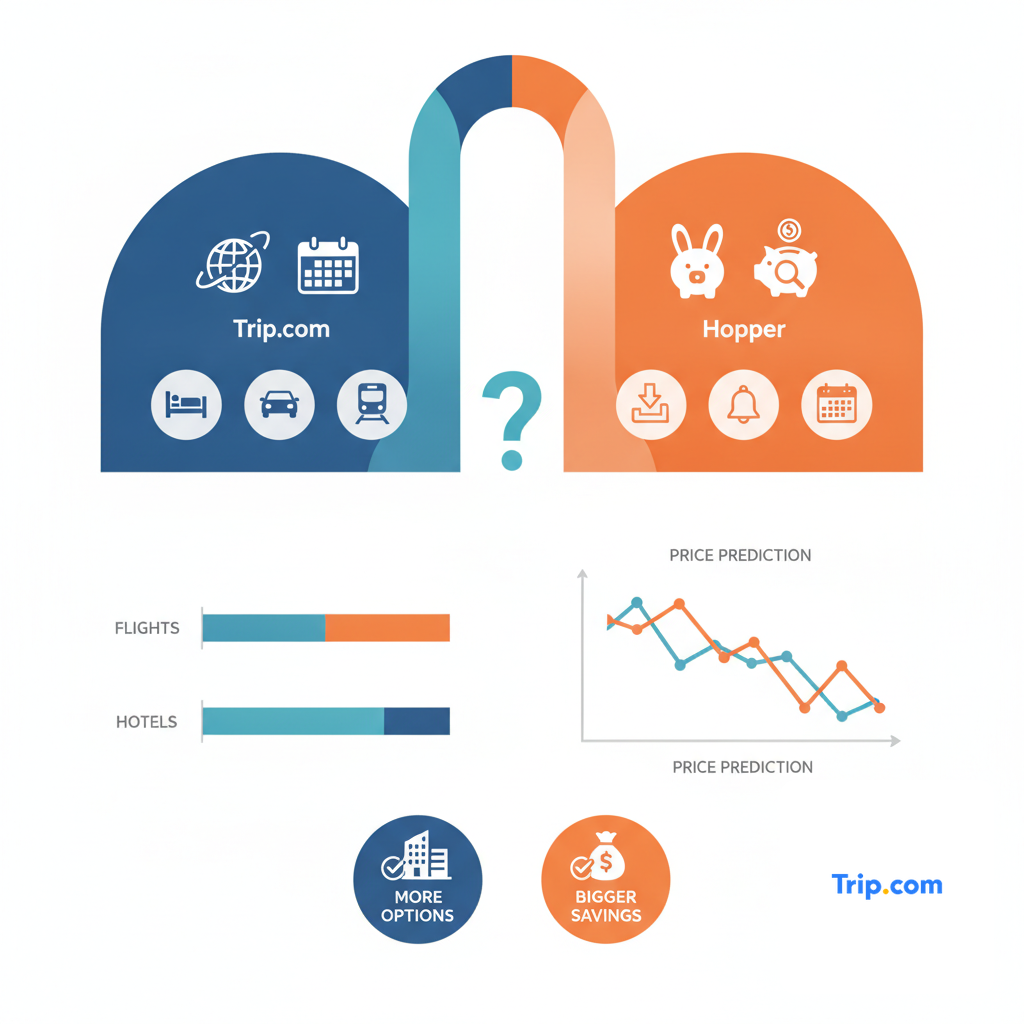
Understanding the strengths and weaknesses of Trip.com and Hopper requires a detailed look at their performance across key travel booking dimensions. While both aim to provide value, their approaches and outcomes differ significantly for various traveler profiles in 2026.
Trip.com Rating Breakdown
| Dimension | Score | Notes |
|---|---|---|
| Price & Value | 8.8/10 | Highly competitive, especially for international routes and package deals, but requires careful comparison. |
| Transparency & Fees | 8.0/10 | Generally clear at checkout, but travelers must actively review baggage and add-on costs. | Booking Experience | 8.5/10 | Smooth and intuitive process, though optional upsells are common. |
| Coverage & Availability | 9.0/10 | Exceptional breadth of flights, hotels, and train tickets globally, particularly strong in Asia-Pacific. |
| Flexibility, Changes & Cancellation | 7.5/10 | Standard OTA flexibility, which can be restrictive for cheaper fares; often depends on supplier policies. |
| Customer Support & Reliability | 7.0/10 | Available via multiple channels, but response times and resolution efficiency can vary. |
| Overall Rating | 8.1/10 | Best for: Travelers prioritizing extensive global inventory and competitive international pricing. |
Hopper Rating Breakdown
| Dimension | Score | Notes |
|---|---|---|
| Price & Value | 8.5/10 | Strong potential for savings through price predictions and unique features, but not always the lowest base price. |
| Transparency & Fees | 8.2/10 | Clear breakdown of costs, with optional add-ons like price freeze clearly explained upfront. |
| Booking Experience | 8.8/10 | User-friendly, gamified interface with clear guidance on booking decisions. |
| Coverage & Availability | 8.0/10 | Solid coverage for major routes and destinations, though sometimes less extensive than larger OTAs. |
| Flexibility, Changes & Cancellation | 8.5/10 | Innovative paid options like "Cancel for Any Reason" and "Change for Any Reason" enhance flexibility significantly. |
| Customer Support & Reliability | 7.8/10 | Primarily in-app support, generally responsive, but complex issues can still require patience. |
| Overall Rating | 8.3/10 | Best for: Price-conscious travelers who value flexible booking options and AI-driven insights. |
Where Trip.com Wins: Trip.com's primary strength lies in its expansive global reach and sheer volume of inventory. It consistently offers more choices for flights and hotels, particularly for destinations outside of North America and Europe, such as in the Asia-Pacific region. Its ability to bundle flights and hotels often results in competitive package pricing that can be hard to beat, making it ideal for travelers who prefer a comprehensive booking experience.
Where Hopper Wins: Hopper distinguishes itself with its innovative use of data and AI. Its price prediction feature is a game-changer for travelers looking to save money by timing their bookings perfectly. Furthermore, Hopper's unique paid flexibility products - like the ability to freeze a price or cancel a booking for any reason - directly address common traveler concerns, offering a level of peace of mind that Trip.com's standard OTA model doesn't inherently provide.
Where the Decision Depends on User Preference: The choice between Trip.com and Hopper largely depends on whether you prioritize breadth of choice and international focus (Trip.com) or cutting-edge price prediction and flexible booking options (Hopper). For a straightforward domestic trip, both can be excellent, but their unique value propositions shine in different scenarios.
Which Scoring Category Matters Most for This Niche: In the travel booking niche, Price & Value, closely followed by Flexibility, Changes & Cancellation, are arguably the most critical categories. While a low price is always appealing, the ability to modify or cancel a trip without significant penalty has become increasingly important in 2026, given the uncertainties that can arise. Hopper's strength in the latter category gives it a significant advantage for many modern travelers.
Which Is Better: Trip.com or Hopper?
Determining an overall winner between Trip.com and Hopper in 2026 depends heavily on a traveler's specific priorities. For the majority of users, especially those based in North America and looking for the most innovative tools to save money and manage risk, Hopper emerges as the slightly better platform overall. Its unique predictive algorithms and flexible booking options directly address modern travel anxieties, making it a compelling choice.
Best for Most People: Hopper's user-friendly interface, coupled with its price prediction and flexibility features, makes it incredibly accessible and reassuring for the average traveler. It guides users toward optimal booking times and offers tangible ways to mitigate the financial risk of changing plans. This focus on empowering the user with data-driven insights and control over their booking sets it apart for everyday travel planning.
Best for Advanced Users: Advanced users, who are comfortable with managing multiple booking elements and possibly more complex itineraries, might lean towards Trip.com for its sheer breadth of inventory. Its extensive network, particularly valuable for multi-country trips or less common routes, allows for more intricate searches and potentially unique combinations of flights and hotels that Hopper might not display. However, advanced users seeking to optimize price fluctuations will still find Hopper's unique features invaluable for specific legs of their journey.
Best for Budget Buyers: While both platforms aim for affordability, Hopper's predictive model and price drop alerts are explicitly designed for budget buyers. The ability to "watch" a trip and receive notifications when prices are expected to drop or rise, along with the option to "freeze" a price, gives budget-conscious travelers powerful tools to secure the lowest possible fare. Trip.com's competitive pricing often comes from its broad network and package deals, but it lacks Hopper's proactive price guidance.
Best for Long-Term Ownership (Repeat Use): Hopper's loyalty program, Carrot Cash, combined with its consistent innovation in flexible booking options, creates a stronger case for long-term engagement. Travelers who frequently book flights and hotels will find value in accumulating rewards and utilizing the app's evolving features. Trip.com also has a loyalty program, but its benefits are often tied to specific booking volumes and may not feel as universally impactful as Hopper's immediate savings tools.
Best Choice Per the Most Important Niche Dimensions: When we consider the most critical dimensions for travel booking in 2026 - Price & Value and Flexibility, Changes & Cancellation - Hopper makes a very strong case. While Trip.com offers excellent price points through its vast inventory, Hopper's proactive price management and unique flexibility products provide a distinct advantage in mitigating financial risk and ensuring peace of mind, which is increasingly important for travelers today. Therefore, for those prioritizing these core concerns, Hopper is the preferred choice.
Compare Flight & Hotel Deals on Hopper
Key Differences Between Trip.com and Hopper
While both Trip.com and Hopper are prominent players in the online travel booking space, their fundamental approaches, target users, and core feature sets present significant distinctions. Understanding these differences is crucial for selecting the platform that aligns best with your travel planning style in 2026.
Product Philosophy and Target Users
Trip.com operates primarily as a traditional Online Travel Agency (OTA) with a global footprint. Its philosophy centers on offering a comprehensive, one-stop shop for all travel needs, from flights and hotels to trains and local activities. Its strength lies in its vast inventory, particularly strong in Asian markets, making it ideal for travelers who value choice and often book international or multi-leg journeys. It targets a broad audience, from budget travelers to those seeking premium experiences, by aggregating numerous suppliers.
Hopper, conversely, positions itself as a price prediction and flexible booking app. Its core philosophy is to empower travelers to save money and reduce risk through data-driven insights. Utilizing sophisticated AI, Hopper predicts future price changes for flights and hotels, advising users whether to "Buy Now" or "Wait." Its unique features like Price Freeze, Cancel for Any Reason, and Change for Any Reason are designed to appeal to budget-conscious and flexibility-seeking travelers who want to mitigate the financial uncertainties of travel planning. It targets users who are comfortable with mobile-first booking and appreciate innovative financial protection.
Feature Differences
The most striking difference lies in their unique offerings. Trip.com provides a very traditional booking experience, focusing on a wide range of standard travel products. Hopper, however, innovates with its proprietary technology. Its "Price Prediction" feature uses historical data and market trends to forecast whether flight or hotel prices will rise or fall, offering actionable advice to users. The "Price Freeze" option allows users to pay a small fee to lock in a price for a certain period, and if the price goes up, Hopper covers the difference. Conversely, if the price drops, the user pays the lower amount. Similarly, "Cancel for Any Reason" and "Change for Any Reason" products, while adding to the overall cost, provide unparalleled flexibility, a feature not natively offered by Trip.com.
Pricing Differences
While both platforms aim to offer competitive pricing, their strategies differ. Trip.com's competitive edge often comes from its direct partnerships with a vast number of airlines and hotels, allowing it to sometimes offer exclusive rates or package deals. Hopper's pricing advantage stems from its ability to predict market movements, guiding users to book at optimal times. While Hopper might not always have the lowest initial price in search results, its recommendations and flexible products can lead to greater overall savings. Furthermore, Hopper's "Carrot Cash" loyalty program is more integrated and visible, providing clear incentives for repeat usage.
Performance Differences
In terms of performance, Trip.com generally excels in providing a comprehensive view of global travel options, making it efficient for researching diverse itineraries. Its search results are extensive, reflecting its large inventory. Hopper's performance shines in its speed of price prediction and the real-time accuracy of its recommendations. Its app is designed for quick decision-making, with clear visual cues for price trends. For users prioritizing speed of information on price changes, Hopper is often faster and more direct.
Long-Term Fit
For long-term fit, Trip.com serves as a reliable, consistent global OTA. Travelers who appreciate a familiar booking process and a vast selection will continue to find it useful. Hopper, with its innovative features, is constantly evolving. Its long-term fit is for travelers who embrace technology to enhance their travel planning, value flexibility, and are keen to leverage predictive analytics to save money. As travel becomes increasingly dynamic, Hopper's adaptive model might appeal more to future-focused travelers.
| Feature Aspect | Trip.com | Hopper |
|---|---|---|
| Core Model | Traditional Online Travel Agency (OTA) | Price Prediction & Flexible Booking App |
| Primary Value Prop | Vast global inventory, one-stop shop | AI-driven savings, risk mitigation |
| Key Differentiator | Extensive network, particularly in Asia | Price Freeze, Cancel for Any Reason, Price Prediction |
| Pricing Strategy | Competitive aggregation, package deals | Optimal timing recommendations, add-on flexibility products |
| Loyalty Program | Trip.com Rewards (points-based) | Carrot Cash (rewards for booking, price drops) |
| Market Focus | Global, strong in Asia-Pacific | Primarily North America, growing globally |
| Payment Options | Standard credit cards, some local options | Standard credit cards, "buy now, pay later" options |
| Mobile Experience | Comprehensive booking & itinerary management | Gamified, intuitive, notification-heavy |
| Where to Buy | View Deal |
User Experience: Design, Interface, and Navigation
The user experience (UX) of a travel booking platform is paramount, influencing everything from the ease of finding a deal to the confidence a traveler feels during the booking process. Both Trip.com and Hopper offer distinct interfaces, each with its own strengths and user appeal in 2026.
Trip.com's Design and Interface: Trip.com presents a more traditional, comprehensive OTA interface. Its design is clean and functional, packed with numerous options for flights, hotels, trains, cars, and activities. The website and app are designed to be a one-stop shop, meaning there's a lot of information on screen. Navigation is logical, with clear categories and filters. For users accustomed to larger travel sites, the layout feels familiar and straightforward. The search filters are robust, allowing granular control over airline preferences, layover times, hotel amenities, and more. While efficient, the sheer volume of options can sometimes feel overwhelming for new users or those seeking a minimalist experience. The booking flow is standard, guiding users through selection, passenger details, and payment with clear steps, though upsells for insurance, seat selection, and baggage are frequent.
Hopper's Design and Interface: Hopper stands out with its highly visual, gamified, and mobile-first design. The app is characterized by its vibrant purple branding and intuitive interface, making travel planning feel almost like a game. The core of its UX is the price prediction calendar, which uses color-coding (green for cheapest, red for most expensive) to instantly convey optimal travel dates. This visual guidance is incredibly helpful for flexible travelers. Navigation is streamlined, focusing primarily on flights and hotels, with other services like car rentals and flexible booking products integrated seamlessly. The search experience is fluid, quickly presenting recommendations based on its AI. Hopper actively guides users, suggesting whether to 'Buy Now' or 'Wait' with a clear percentage confidence, fostering a sense of control and smart decision-making. The checkout process is also straightforward, with clear explanations of any additional flexibility products chosen.
Which Features Matter to Buyers: For buyers, the features that truly matter are those that simplify decision-making and provide confidence. Trip.com's extensive filters and broad inventory are crucial for travelers with specific needs or complex itineraries. The ability to find niche airlines or unique hotel properties across the globe is a significant advantage. However, Hopper's price prediction calendar and the clarity of its 'Buy Now'/'Wait' recommendations are invaluable for budget-focused travelers who want to feel assured they're getting a good deal. The immediate visual feedback on pricing trends is a powerful tool that Trip.com lacks.
In essence, Trip.com's UX is about providing comprehensive choice and control through detailed filtering, while Hopper's is about intelligent guidance and risk mitigation through predictive analytics and visual simplicity. Neither is inherently 'better' for everyone; it truly depends on whether you prefer a vast catalog to browse or a smart assistant to guide your purchase.
Explore Trip.com's Global Options

Pricing and Value for Money
When it comes to booking travel, price is often the ultimate deciding factor. Both Trip.com and Hopper aim to offer competitive pricing for flights and hotels in 2026, but they employ different strategies to deliver value, and understanding these can significantly impact your final cost.
Base Price Comparison
Trip.com: As a large global OTA, Trip.com leverages its extensive network of airline and hotel partners to secure competitive base prices. It's particularly strong for international flights, especially to and from Asian destinations, where it often has direct agreements that can lead to lower fares. For hotels, its vast inventory means you can often find good deals across various star ratings and locations. Trip.com also frequently offers package deals (flight + hotel) that can be cheaper than booking each component separately. However, its base prices are generally in line with other major OTAs; the advantage often comes from its specific regional strength or package discounts.
Hopper: Hopper's pricing strategy is less about consistently having the absolute lowest base price at any given moment and more about helping you secure the lowest price over time. Its price prediction feature actively advises users when to book. If you follow Hopper's advice to 'Wait,' you stand a good chance of getting a lower price. Its unique "Price Freeze" feature, for a small fee, guarantees the listed price, reimbursing you the difference if the price increases. This effectively turns a potentially higher base price into a guaranteed lower one, offering immense value. While its initial search results might not always be the cheapest, the potential savings through its predictive tools and guarantees make it highly competitive for budget-conscious buyers.
Taxes, Service Fees, and Add-ons
Both platforms are generally transparent about taxes and mandatory fees. However, the travel industry is notorious for add-ons, and these platforms are no exception. Trip.com, like many traditional OTAs, will clearly display taxes and its own service fees (if any) during the checkout process. However, travelers must be vigilant about optional add-ons like travel insurance, seat selection fees, and baggage fees, which are presented during the booking flow and can significantly inflate the final price. These are typically airline-imposed fees that the platform passes on.
Hopper also clearly itemizes taxes and fees. Its unique add-ons are primarily its flexibility products (Price Freeze, Cancel for Any Reason, Change for Any Reason), which come with their own transparent fees. While these add to the cost, they provide a distinct benefit that users actively choose. Hopper's app is generally good at showing a final, all-inclusive price before payment, though airline-specific baggage fees might sometimes require a quick check with the airline's policy, similar to Trip.com.
Currency Conversion and Hidden Cost Risks
Both platforms support various currencies, and it's always advisable to book in the currency of your credit card to avoid extra foreign transaction fees from your bank. Trip.com, with its global focus, is generally robust in handling multiple currencies. Hidden costs on Trip.com are more likely to stem from overlooked airline baggage policies or optional extras chosen during the booking process. Hopper is also transparent with currency, and its main 'hidden' cost, if any, would be the fees for its flexibility products, which, as mentioned, are clearly presented. The greatest value comes from using its predictive tools to avoid higher prices rather than encountering unexpected charges.
In summary, while Trip.com offers strong base prices through its extensive network, Hopper's innovative tools provide a unique avenue for deeper savings and risk mitigation, potentially offering greater value for money for travelers who engage with its predictive features.
| Pricing Aspect | Trip.com | Hopper |
|---|---|---|
| Base Price Competitiveness | Very strong, especially for international and packages. | Strong, with potential for deeper savings via predictions. |
| Price Prediction/Tools | Limited to standard alerts. | Industry-leading AI price predictions, Price Freeze. |
| Service Fees | May apply, clearly displayed at checkout. | Generally low; fees primarily for flexibility products. |
| Add-on Transparency | Clear, but requires careful review of airline-specific fees (baggage, seats). | Clear, especially for its unique flexibility products. |
| Package Deals | Excellent for flight + hotel bundles. | Less emphasis on traditional bundles, more on dynamic savings. |
| Loyalty Program Value | Points for future discounts. | Carrot Cash, directly applicable to future bookings. |
| Where to Buy | View Deal |
Pros and Cons: Trip.com vs Hopper
Choosing between Trip.com and Hopper in 2026 involves weighing their respective advantages and disadvantages against your personal travel preferences and priorities. Both platforms offer compelling reasons to use them, but also come with certain trade-offs.
Trip.com
- Pros:
- Extensive Global Inventory: Offers a vast selection of flights, hotels, trains, and activities worldwide, particularly strong in the Asia-Pacific region. This means more options for diverse itineraries.
- Competitive International Fares: Often provides highly competitive prices for international flights due to its extensive network of airline partners.
- Package Deals: Excels in bundling flights and hotels, frequently offering significant savings compared to booking components separately.
- One-Stop Shop: Convenient for travelers who prefer to book all aspects of their trip (flights, hotels, trains, tours) through a single platform.
- Multi-Currency Support: Robust support for various currencies, catering to a global user base.
- User-Friendly Interface: A familiar, traditional OTA layout that is easy to navigate for most users.
- Loyalty Program: Trip.com Rewards offers points that can be redeemed for discounts on future bookings.
- Train Booking: A significant advantage for European and Asian travelers, offering a wide range of train tickets.
- Cons:
- Customer Support Challenges: While available 24/7, response times and resolution efficiency can sometimes be slower, especially for complex issues or during peak travel periods. This can be a deal-breaker for urgent problems.
- Less Proactive Price Guidance: Lacks advanced price prediction tools like Hopper, meaning users need to do more manual price tracking.
- Standard Flexibility: Cancellation and change policies are typically dictated by airline/hotel rules, offering less inherent flexibility than Hopper's unique products. This can be a major trade-off for uncertain plans.
- Frequent Upsells: Like many OTAs, the booking process involves numerous prompts for add-ons like insurance, seat selection, and baggage, which can inflate the final cost if not carefully managed.
- Regional Strength Bias: While global, its strongest deals and inventory might lean towards certain regions, potentially making it less competitive for domestic North American travel compared to local specialists.
- App Can Feel Cluttered: The attempt to be a 'one-stop shop' can make the app feel somewhat dense with information and options.
- Refund Process Can Be Slow: Dependent on supplier policies, refunds can sometimes take longer to process compared to direct bookings.
Hopper
- Pros:
- AI Price Prediction: Industry-leading algorithms advise users on when to buy or wait for flights and hotels, potentially leading to significant savings. This is a major strength for budget-conscious buyers.
- Flexible Booking Products: Unique paid features like Price Freeze, Cancel for Any Reason, and Change for Any Reason offer unparalleled peace of mind and financial protection.
- User-Friendly, Gamified App: Intuitive, visually appealing, and engaging mobile interface that simplifies the booking process.
- Carrot Cash Rewards: A straightforward loyalty program that earns users cash for future bookings, directly visible and easy to redeem.
- Price Drop Guarantee: The Price Freeze feature often comes with a guarantee, covering the difference if the price rises.
- Clear Visual Cues: Color-coded calendars and clear "Buy Now" / "Wait" recommendations make decision-making easy.
- "Buy Now, Pay Later" Options: Offers financing options for some bookings, increasing accessibility.
- Focus on Flights & Hotels: Specializes in these core travel components, leading to a focused and optimized experience.
- Cons:
- Inventory Can Be Narrower: While good for major routes, its selection might not be as extensive as Trip.com for niche airlines, specific international hotels, or less common destinations. This can be a minor trade-off for complex itineraries.
- Reliance on Add-on Fees for Flexibility: The best flexibility comes at an additional cost, which can increase the overall price if multiple protections are purchased. This isn't a hidden fee, but it's an extra consideration.
- Primarily Mobile-First: While a strength, its desktop experience is less robust, which might be a drawback for users who prefer planning on a larger screen.
- Customer Support Primarily In-App: While generally responsive, relying solely on in-app chat for urgent issues might not suit all travelers, especially during complex disruptions.
- Less Emphasis on Packages: Doesn't offer the same depth of traditional flight + hotel package deals as Trip.com.
- Potential for Over-Engagement: The gamified nature and constant notifications might feel overwhelming for some users.
- Newer Player: Compared to established OTAs, some travelers might perceive it as less established, though its reputation is strong.
Get Price Alerts with Hopper
Flexibility, Cancellations, and Refunds
The ability to change or cancel travel plans without incurring significant penalties has become a paramount concern for travelers in 2026. Trip.com and Hopper approach flexibility, cancellations, and refunds with markedly different philosophies, directly impacting a traveler's peace of mind and potential financial exposure.
Trip.com's Flexibility and Cancellation Policies
As a traditional online travel agency (OTA), Trip.com's flexibility and cancellation policies are largely dictated by the individual airlines and hotels it partners with. When you book through Trip.com, you are essentially purchasing a ticket or reservation under the supplier's terms. This means:
- Fare Rules Apply: Cheaper economy fares are typically non-refundable and subject to hefty change fees. More expensive, flexible fares offer better terms but come at a premium.
- Cancellation Windows: Free cancellation for hotels is usually available up to a certain date (e.g., 24-48 hours before check-in), but non-refundable rates are common for discounted bookings.
- Change Fees: Modifying a flight or hotel booking almost always incurs a change fee from the airline or hotel, plus any fare difference. Trip.com itself may also charge an administrative fee.
- Supplier Restrictions: Policies can vary significantly between different airlines and hotel chains, requiring travelers to carefully read the fine print for each booking.
- Package Restrictions: Flight + hotel packages often have stricter cancellation rules than individual bookings, as changes to one component can affect the entire bundle.
The onus is on the traveler to understand the specific terms of their chosen fare or rate class before booking. Trip.com provides these details during the checkout process, but it requires diligent review.
Hopper's Flexibility and Cancellation Policies
Hopper has innovated significantly in the realm of flexibility, offering unique paid products that go beyond standard airline and hotel policies. These options are designed to provide a safety net for uncertain travel plans:
- Cancel for Any Reason: For an additional fee (which varies based on the booking cost and dates), Hopper allows you to cancel your flight or hotel booking for any reason and receive a significant portion (often 80-100%) of your money back in Carrot Cash, or sometimes a smaller percentage as a cash refund. This offers unparalleled flexibility not available through most standard bookings.
- Change for Any Reason: Similar to "Cancel for Any Reason," this paid add-on allows you to change your flight or hotel dates without incurring supplier change fees, though you would still pay any fare difference.
- Price Freeze: As mentioned, for a small fee, you can lock in a price for a set period. If the price goes up, Hopper covers the difference. If it goes down, you pay the lower price. This protects against price volatility.
- Refundable Rates: Hopper also offers standard refundable rates from its partners, but its proprietary flexibility products are its key differentiator.
These flexibility products are optional add-ons, meaning they come at an extra cost. However, for travelers with uncertain plans, the peace of mind and financial protection they offer can be invaluable, outweighing the initial fee. This proactive approach to managing traveler risk is a significant advantage over Trip.com's more traditional model.
Refunds and Disruption Support
When a cancellation occurs, the refund process can be a point of friction. With Trip.com, the refund eligibility and timeline are entirely dependent on the airline or hotel's policy. If a booking is non-refundable, you may only receive taxes back. If a refund is due, Trip.com acts as an intermediary, processing the refund once they receive it from the supplier, which can sometimes lead to longer processing times. For disruptions (delays, airline cancellations), Trip.com will assist in rebooking or claiming refunds according to the supplier's rules.
Hopper's refund process for standard bookings is also tied to supplier policies. However, if you purchased a "Cancel for Any Reason" or "Price Freeze" product, the refund or credit (often in Carrot Cash) is handled directly by Hopper, often much faster and more predictably than waiting on an airline. For airline-initiated disruptions, Hopper will also assist, but its unique products primarily focus on traveler-initiated flexibility.
In conclusion, for travelers prioritizing maximum control and protection against unforeseen changes, Hopper's innovative flexibility products provide a superior safety net, albeit at an additional cost. Trip.com offers standard OTA flexibility, which is sufficient for firm travel plans but carries higher risk for changes.
Customer Support and Disruption Handling
The quality of customer support can make or break a travel experience, especially when unexpected disruptions occur. In 2026, both Trip.com and Hopper offer support channels, but their effectiveness and accessibility can differ, leading to varied traveler experiences.
Trip.com's Customer Support
Trip.com provides customer support through multiple channels, including a 24/7 hotline, email, and live chat within its app and website. Given its global reach, it offers multilingual support, which is a significant advantage for international travelers. However, the efficiency and responsiveness of Trip.com's support can be inconsistent. While routine inquiries might be handled smoothly, complex issues - such as airline-initiated cancellations, rebookings, or intricate refund requests - can sometimes lead to longer wait times and multiple interactions. Traveler reviews often highlight varying experiences, with some praising quick resolutions and others reporting frustration over slow responses or difficulties reaching a human agent for urgent problems. For high-value or time-sensitive international bookings, the potential for slower support can be a concern.
Hopper's Customer Support
Hopper's customer support is primarily in-app, leveraging a chat-based system. This mobile-first approach is consistent with its overall app design. For many common issues, the in-app chat is efficient and can provide quick answers or automated solutions. Hopper also offers phone support, but it's often prioritized for urgent, in-trip issues or for those who have purchased specific flexibility products. Customer reviews generally indicate a responsive support team for standard queries and for issues related to their proprietary products (like Price Freeze guarantees). However, for complex airline-specific problems, or during major travel disruptions affecting many users, even Hopper's support can face backlogs. The lack of a readily accessible, general phone number for all issues might be a drawback for travelers who prefer direct voice communication.
Disruption Handling
Trip.com's Disruption Handling: When an airline cancels or significantly delays a flight, Trip.com will typically assist in rebooking or processing refunds according to the airline's policies. Their ability to do so relies heavily on their communication with the airline. While they act as an intermediary, they aim to facilitate the process. For hotel overbookings or issues, they will also work to find alternative accommodation, again within the bounds of their agreements with suppliers. The challenge can be the speed of communication and resolution during a rapidly evolving disruption.
Hopper's Disruption Handling: Hopper also assists with airline-initiated cancellations and delays, working with the carrier to find solutions. Its strength here is augmented if you've purchased a "Change for Any Reason" product, which gives you more direct control over rebooking. For hotel issues, Hopper will also intervene. A key aspect of Hopper's protection, particularly for self-transfer or separate-ticket bookings (which it facilitates), is its "Disruption Protection" add-on. This product offers rebooking assistance and compensation if a connection is missed due to a delay or cancellation, a level of protection that Trip.com's standard offerings do not typically provide for complex itineraries.
In summary, while both platforms offer support, Hopper's in-app chat is often more consistent for its core user base, and its paid disruption products offer a higher degree of proactive protection. Trip.com's broader coverage comes with the potential for more varied support experiences, especially for non-standard issues.
Check Trip.com's Customer Support Options
Trust, Safety, and Traveler Risk
The decision to book travel through an online platform involves a significant degree of trust, particularly concerning financial transactions, personal data, and the reliability of the booking itself. In 2026, both Trip.com and Hopper are established names, but understanding their risk profiles is essential for confident travel.
Brand Reputation and Legitimacy
Trip.com: Trip.com is a subsidiary of Trip.com Group, a NASDAQ-listed company and one of the largest online travel agencies globally, particularly dominant in Asia. Its legitimacy and market presence are undeniable. It partners directly with thousands of airlines and hotels worldwide. The brand has a long history in the travel industry, giving it a strong foundation of trust for many travelers. While like any large OTA, it receives its share of customer complaints (often related to refund speed or support during disruptions), its overall reputation as a legitimate booking platform is solid.
Hopper: Hopper has rapidly grown in popularity, especially in North America, with a strong focus on its innovative app. It is a well-funded, legitimate company with a significant user base. It partners with major airlines and hotel chains. Hopper's reputation is built on its technological innovation and its unique flexibility products. While it is a newer player compared to Trip.com's parent company, its transparency around its pricing predictions and add-on features has fostered trust among its users. Complaints, when they arise, often relate to the nuances of its flexibility products or the challenges of its in-app-first support model.
Payment Safety and Data Privacy
Both platforms utilize industry-standard encryption (HTTPS) and work with reputable payment processors to ensure secure transactions. When you enter your credit card details, the information is protected. They also adhere to privacy policies regarding data handling, though it's always wise to review these policies to understand how your personal information is used. Neither platform has a history of major, widespread data breaches that would significantly impact their payment safety perception.
Traveler Protections and Risky Booking Scenarios
Trip.com: As an OTA, Trip.com provides standard traveler protections. Your booking is confirmed with the airline or hotel, and you receive an e-ticket or confirmation voucher. The main risks with Trip.com are similar to any OTA: you are booking through an intermediary, which can add a layer of complexity if a dispute arises with the supplier. For instance, if an airline changes its schedule, you typically work through Trip.com to rebook, which can sometimes be slower than dealing directly with the airline. The risk of hidden costs primarily comes from not thoroughly reviewing baggage, seat, and other add-on fees before checkout. For simple, direct itineraries, the risk is generally low, but for complex, self-transfer bookings, the inherent risks (missed connection, visa issues) are still present and typically not covered by Trip.com's standard offering.
Hopper: Hopper also provides standard booking confirmations. Its unique selling proposition, however, is its suite of flexibility and disruption protection products. These actively mitigate some of the inherent risks of travel. For example, "Cancel for Any Reason" directly addresses the risk of needing to cancel. Its "Disruption Protection" for self-transfer itineraries (often called virtual interlining) explicitly covers missed connections, providing rebooking or compensation, which is a significant advantage over many traditional booking methods. This makes Hopper a potentially lower-risk option for travelers who opt into these paid protections, especially for more complex routes. Without these add-ons, its risk profile for standard bookings is similar to other OTAs.
Ultimately, both platforms are safe and legitimate for booking. Hopper, however, offers more robust, albeit paid, tools to actively reduce common traveler risks, providing a greater sense of security for many in the current travel landscape.
App and In-Trip Experience
In 2026, a travel app's utility extends far beyond the initial booking. A strong app provides seamless itinerary management, real-time updates, and in-trip support. Both Trip.com and Hopper offer dedicated mobile applications, each with its own strengths for managing your journey.
Trip.com's App Experience
The Trip.com app mirrors its website's comprehensive nature. It serves as a central hub for all your bookings, whether flights, hotels, trains, or activities. Key features include:
- Itinerary Tracking: All confirmed bookings are neatly organized in your account, making it easy to access flight details, hotel reservations, and e-vouchers.
- Notifications: The app sends push notifications for flight status changes, gate information, and check-in reminders, which are helpful for staying informed.
- Mobile Documents: E-tickets and hotel confirmations are readily available within the app, reducing the need for printed documents.
- Offline Access: Basic itinerary details can often be accessed offline, which is crucial when traveling without data or Wi-Fi.
- In-Trip Support: Access to customer support via live chat is available directly through the app, offering a convenient way to seek assistance during your trip.
- Destination Guides: The app also includes curated content and guides for various destinations, adding value beyond just booking.
While functional, the app's interface can sometimes feel dense due to the sheer volume of services offered. For travelers primarily focused on flights and hotels, some of the additional features might feel like clutter. However, for those who utilize Trip.com for all aspects of their trip, its integrated nature is a significant advantage.
Hopper's App Experience
Hopper's app is arguably its strongest asset, designed with a mobile-first philosophy that prioritizes ease of use, visual clarity, and proactive information. Its gamified approach makes the in-trip experience engaging and stress-free:
- Itinerary Management: Bookings are clearly displayed with essential details, and the app provides timely reminders and instructions.
- Real-Time Alerts: Hopper excels at sending highly relevant notifications for price changes, flight delays, gate changes, and check-in reminders. These alerts are often more proactive and actionable than those from traditional OTAs.
- Mobile Documents & Boarding Passes: The app integrates seamlessly with digital boarding passes and provides easy access to hotel confirmations.
- Offline Access: Key itinerary information is accessible offline, ensuring you have critical details even without an internet connection.
- In-App Support: All customer support interactions happen within the app's chat interface, which can be convenient for quick questions or issues.
- Carrot Cash Tracking: The app prominently displays your accumulated Carrot Cash, making it easy to see and apply rewards to future bookings.
- Post-Booking Flexibility: If you've purchased a "Cancel for Any Reason" or "Change for Any Reason" product, managing these options is straightforward through the app.
Hopper's app is generally praised for its intuitive design, speed, and clean interface, making it a favorite for travelers who prefer to manage their trips entirely from their smartphone. The focus on core services (flights and hotels) allows for a more streamlined experience without overwhelming users with too many ancillary options.
In summary, while Trip.com offers a robust, all-encompassing app for comprehensive trip management, Hopper's app provides a more streamlined, proactive, and user-friendly experience, particularly for real-time alerts and managing its unique flexibility products. For the modern traveler who relies heavily on their smartphone, Hopper often delivers a more satisfying in-trip experience.
Use-Case Segmentation: Who Should Choose Which?
The ideal choice between Trip.com and Hopper in 2026 isn't universal; it depends heavily on your specific travel style, budget, and priorities. Here's a breakdown of who should lean towards which platform:
| Traveler Need / Use Case | Choose Trip.com If... | Choose Hopper If... |
|---|---|---|
| Budget Travelers | You're looking for competitive package deals (flight+hotel) or deep discounts on international flights, especially to Asia. | You want to leverage AI price predictions, price freezes, and are willing to wait for the absolute lowest fare. |
| Families | You need a vast selection of family-friendly hotels and flights, especially for complex international itineraries, or prefer booking everything in one place. | You prioritize flexibility for changing plans (e.g., child gets sick) and want price protection for multiple tickets. |
| Business Travelers | You need a wide range of flight options, including specific airlines or routes, and prefer a traditional, comprehensive booking platform for expense reporting. | You're booking well in advance and want to monitor prices for optimal booking, or need the option to easily change plans due to unpredictable schedules. |
| Luxury Travelers | You're seeking premium international flights and high-end hotel options globally, often bundled for convenience. | You want to ensure you're getting the best possible price on a premium flight or hotel, using predictions to time your booking. |
| Solo Travelers / Backpackers | You need diverse options for budget accommodation and flights, particularly in less-traveled regions or multi-destination trips. | You're highly budget-conscious, flexible with dates, and want to track prices for spontaneous trips, or need cancellation flexibility. |
| Flexible Travelers | Your dates and destination are firm, and you prioritize the widest range of options. | You need the ability to cancel or change for any reason, or want to lock in a price without immediately committing. |
| Low-Risk Bookings | Your travel plans are firm, and you're comfortable with standard airline/hotel cancellation policies. | You want to actively mitigate risks with paid flexibility products and prefer a platform that guides you on booking decisions. |
| International Travel (especially Asia) | You are traveling to or from Asian destinations, where Trip.com often has superior inventory and deals. | You are traveling to major international hubs and want to track prices, but might need to cross-check inventory. |
| Last-Minute Bookings | You need a broad selection of immediate availability, often finding last-minute deals on hotels. | You are looking for last-minute price drops, although its predictive strength is greater for advance bookings. |
Real-World Scenarios
To further illustrate which app might be better for you, let's consider a few real-world travel scenarios in 2026:
Scenario 1: The Budget-Conscious Solo Traveler
Traveler Profile: Sarah is planning a solo backpacking trip through Europe in the autumn. She's flexible with her exact dates and destinations but wants to get the absolute cheapest flights and hostels. She has a few months to plan and is comfortable using a mobile app.
Recommendation: Hopper. Sarah would greatly benefit from Hopper's price prediction feature. She can "watch" multiple destinations and receive notifications when prices are expected to drop. If she finds a good deal on a flight, she can use the Price Freeze feature for a small fee, giving her time to finalize her hostel bookings without worrying about the flight price increasing. Its gamified interface makes tracking deals enjoyable, and its flexibility products offer peace of mind for her spontaneous plans.
Scenario 2: The Family Planning a Complex International Vacation
Traveler Profile: The Chen family (two adults, two young children) is planning a three-week trip through Southeast Asia, involving multiple flights, hotel stays, and potentially a train journey. They need a wide range of options for family-friendly hotels and reliable airlines. They prefer to book everything from one platform for simplicity and often look for package deals.
Recommendation: Trip.com. For the Chen family's complex, multi-leg international trip, Trip.com's extensive global inventory, particularly its strength in Asia, would be invaluable. They would find a broader selection of flights across various airlines and a wider array of hotels catering to families. The ability to book flights, hotels, and even high-speed train tickets within Asia all on one platform simplifies their planning significantly. Trip.com's package deals might also offer better overall value for their comprehensive itinerary, even if they have to be diligent about checking individual cancellation policies.
Scenario 3: The Business Professional with Unpredictable Schedules
Traveler Profile: Mark is a consultant who frequently travels for work, often needing to book flights and hotels with short notice or having to change plans unexpectedly. He needs reliability and, crucially, the ability to modify bookings without excessive penalties, even if it means paying a bit more upfront.
Recommendation: Hopper (with flexibility add-ons). While Trip.com offers many flight options, Hopper's unique paid flexibility products are a game-changer for Mark. The "Change for Any Reason" or "Cancel for Any Reason" options, though an additional cost, provide the exact peace of mind he needs. He can book his travel knowing that if a client meeting shifts or a project gets delayed, he won't lose his entire booking. He can also use Hopper's price predictions to ensure he's not overpaying for last-minute bookings. The slightly higher cost for these protections is a worthwhile investment for his unpredictable schedule.
Scenario 4: The Traveler Seeking Best Value for a Resort Stay
Traveler Profile: Emily is looking for a week-long all-inclusive resort stay in Mexico for her and her partner. She has specific dates but wants to ensure she gets the best possible price for a quality resort, perhaps even a premium one if the price is right. She's willing to track prices for a few weeks.
Recommendation: Hopper. Emily can use Hopper to "watch" several resorts or destinations. Hopper's price prediction will tell her when the best time to book is. If she sees a good price on a premium resort, she can use the Price Freeze feature to lock it in while she discusses with her partner, ensuring they don't miss out on a great deal. While Trip.com might show many resort options, Hopper's proactive price management gives Emily a strategic advantage in securing the best value for her specific dates and desired quality.
Final Verdict
In the evolving landscape of online travel booking in 2026, both Trip.com and Hopper stand out as formidable platforms, each with distinct strengths that cater to different traveler needs. There isn't a single "best for everyone" answer, but rather a best fit based on your priorities.
Overall Winner: Hopper slightly edges out Trip.com for the average North American traveler primarily focused on flights and hotels. Its innovative AI-driven price predictions and unique paid flexibility products directly address some of the biggest anxieties in travel planning: price volatility and the need for adaptable bookings. For those who prioritize saving money through smart timing and ensuring peace of mind against unforeseen changes, Hopper offers a more modern and empowering solution.
Best Value Pick: Hopper, particularly when you leverage its price prediction tools and flexibility add-ons. While these add-ons come at a cost, the potential savings from booking at the optimal time, combined with the financial protection offered by features like Price Freeze, can result in greater overall value for money compared to a standard booking.
Best Beginner Pick: Hopper. Its intuitive, gamified app design and clear "Buy Now" or "Wait" recommendations make it incredibly easy for new users to navigate and make informed booking decisions without feeling overwhelmed. The visual price calendar is also a huge help.
Best Long-Term Pick: Hopper. Its continuous innovation in features and its Carrot Cash rewards program foster a stronger sense of loyalty and provide ongoing benefits for frequent users. As travel becomes more dynamic, Hopper's adaptive tools are likely to remain highly relevant.
Choose Trip.com if:
- You need an incredibly vast selection of flights, hotels, and even trains, especially for complex international itineraries or travel to/from Asia.
- You frequently book flight + hotel packages and prioritize finding comprehensive bundles.
- You prefer a traditional, full-service online travel agency experience with a familiar interface.
- Your travel plans are generally firm, and you're comfortable with standard airline/hotel cancellation policies.
Choose Hopper if:
- You want to leverage cutting-edge AI to predict price changes and time your bookings for maximum savings.
- You value the ability to "freeze" a price or "cancel/change for any reason" for added flexibility and peace of mind, even if it means a small extra fee.
- You prefer a mobile-first, visually engaging, and highly intuitive app experience.
- You are a budget-conscious traveler looking for proactive tools to help you save money on flights and hotels.
Ultimately, both platforms are legitimate and can secure great deals. For the most strategic and adaptable booking experience in 2026, Hopper takes the lead, but Trip.com remains an indispensable tool for its sheer global coverage and comprehensive offerings. Consider your unique travel needs, and you'll find the right partner for your next journey.
Start Your Trip Planning: Compare Now!
Frequently Asked Questions
For cheap flights in 2026, Hopper often has an edge due to its AI price prediction feature, which advises you on the optimal time to book for the lowest fare. Its 'Price Freeze' option also guarantees a price, protecting you from increases. Trip.com offers competitive prices, especially for international routes and package deals, but lacks Hopper's proactive price guidance. If you prioritize predictive savings and flexibility, Hopper is often better.
Both apps offer good hotel deals, but their strengths differ. Trip.com boasts a vast inventory, particularly strong in Asia-Pacific, often providing competitive rates and package discounts for hotels of all types. Hopper's advantage comes from its price prediction for hotels, helping you time your booking to secure the lowest rate. If you value broad selection and bundles, choose Trip.com; if you prefer leveraging AI for optimal timing and flexible options, Hopper is often better.
Hopper generally offers better cancellation options, primarily through its unique paid flexibility products like 'Cancel for Any Reason' and 'Change for Any Reason.' These allow you to modify or cancel your booking for a fee, providing significant peace of mind. Trip.com's cancellation policies are largely tied to the specific airline or hotel's terms, which are often more restrictive for cheaper fares. For proactive flexibility, Hopper is superior.
Trip.com is often considered more reliable for international travel due to its extensive global inventory and long-standing presence as an online travel agency. It offers a broader range of airlines and hotels worldwide, especially strong in Asian markets, making it a comprehensive choice for multi-country itineraries. Hopper is reliable but might have a narrower selection for very niche international routes. For sheer breadth of options, Trip.com is generally preferred.
Hopper's in-app chat support is often more consistent and responsive for its core user base and for issues related to its unique flexibility products. Trip.com offers 24/7 multilingual support via phone, email, and chat, but customer experiences can vary, with some reporting longer wait times for complex issues. For urgent, in-trip problems, Hopper's dedicated support for its add-on protections can be a significant advantage, making its support slightly more reliable for its specific offerings.
Both platforms are generally transparent with their fees. Trip.com clearly displays taxes and service fees at checkout, but like all OTAs, you must watch for optional add-ons like baggage, seat selection, and travel insurance, which are often airline-imposed. Hopper also clearly itemizes costs, with its unique flexibility products (e.g., Price Freeze) having clearly stated fees. Neither platform typically has 'hidden' fees in the deceptive sense, but travelers should always review the final price breakdown before confirming any booking.
For last-minute bookings, Trip.com's strength lies in its vast inventory, which means it's more likely to have available options across a wide range of airlines and hotels, potentially offering last-minute deals. Hopper can also show last-minute prices, but its predictive power is more impactful for bookings made further in advance. If immediate availability and a broad selection are key, Trip.com might be slightly better, but Hopper can still be useful for checking for any sudden price drops.
Booking direct offers maximum control, direct communication with the supplier, and potential loyalty benefits. However, booking through Trip.com or Hopper can offer significant advantages. Trip.com provides a wider array of options and package deals often cheaper than booking separately. Hopper offers unique price prediction and flexibility products that mitigate risk and help save money. Use an app when it provides clear savings, better search tools, or valuable protections; book direct for simple itineraries, specific loyalty benefits, or if you anticipate needing direct supplier support.
Yes, both Trip.com and Hopper are legitimate and safe platforms for booking travel in 2026. They utilize industry-standard security measures for payment processing and data protection. Like any online service, it's always recommended to use strong passwords and be aware of phishing attempts. Hopper's optional flexibility products can even enhance booking safety by mitigating financial risks from cancellations or price increases, making it a very secure option for those who use these features.